Inside the $117M Verdict Against Samsung
Samsung Electronics has been ordered by a U.S. federal jury to pay approximately $117.7 million in damages to Japanese electronics firm Maxell Ltd. for infringing on three of its patents. The verdict, delivered in the U.S. District Court for the Eastern District of Texas, found that Samsung willfully infringed patents related to features such as
Unlocking devices,
Managing digital data,
Locating recordings—technologies integral to Samsung’s Galaxy smartphones and tablets.
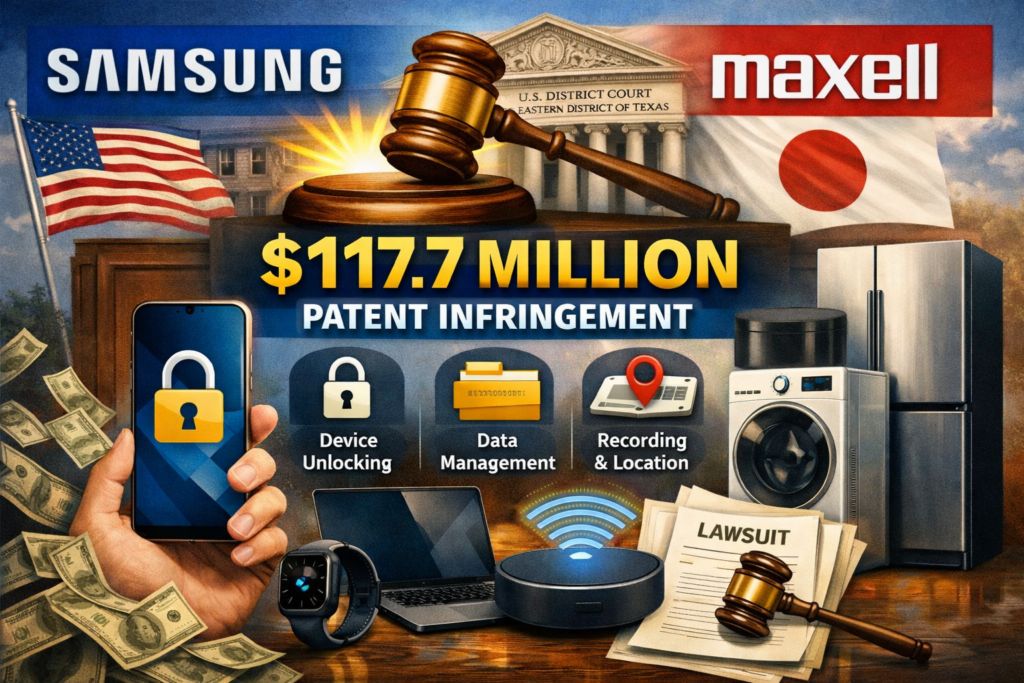
The present suit was initiated in September 2023 , here Maxell alleged Samsung for violating its rights of seven patents by selling a variety of products, including the SmartThings station alongside smartphones, laptops and home appliances all using Maxell’s patented tech.
Issue of Licensing :
Maxell’s patents are licensed by the Samsung for the duration of ten years since 2011. Despite of expiry of the term in 2021 with out renegotiation , Samsung continued using the patented tech without renegotiating its license with Maxell. The Japanese company then filed legal complaints across several district courts across the U.S, Germany and Japan.
Samsung has option to file appeal against the current district court decision in higher court, and is expected to do so, which means this legal battle is far from over.
Roots of Dispute are found in Licensing Agreement :
The roots of dispute derives from licensing agreement which has established between Samsung and Hitachi Consumer Electronics in 2011, which expired in 2021.
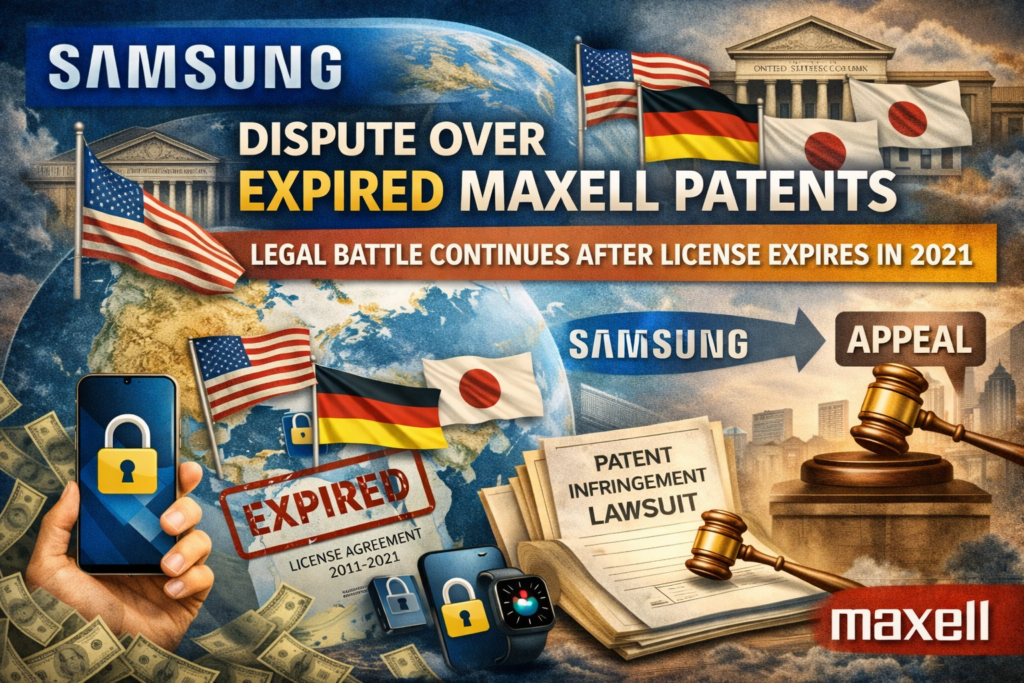
In 2013 Maxell, having acquired Hitachi Consumer Electronics and, attempted to renew the licensing agreement post-expiration. However, Samsung continued to utilize the patented technologies without a new agreement, leading Maxell to initiate legal action in multiple jurisdictions, including the United States, Germany, and Japan.
This case is part of a broader pattern of patent infringement lawsuits against Samsung. In April 2025, a separate jury in Texas ordered Samsung to pay $278.7 million to Headwater Research LLC for infringing on wireless communication patents.
While the $117.7 million judgment represents a fraction of Samsung’s annual revenue, it underscores the importance of adhering to intellectual property laws and the potential financial and reputational risks of infringement.
What it means for Samsung as defendant in terms of risks and responses
a) financial impact & damages
- The judgment is a material hit, though for a giant like Samsung it is not catastrophic. But if the infringement is judged to be willful, the court could treble the damages under U.S. patent law. In many such cases, plaintiffs seek “enhanced damages” for willful infringement.
- Samsung may also face ongoing royalty obligations, or be compelled to license the technology under negotiated terms going forward.
- Samsung is likely to appeal, which can delay enforcement, but uncertainty during the appellate process can affect investor confidence, partner negotiations, and product planning.
b) Operational & strategic risks
- Design-around pressure: Samsung may need to rework certain hardware/firmware/software modules to avoid further infringement, which can raise costs or delay product launches.
- Licensing burden: If multiple patent holders assert claims, Samsung might face a “royalty stacking” problem — many overlapping IPR claims each demanding fees.
- Precedent and leverage: Patent owners may see this as evidence that large incumbents can be beaten. It might embolden more lawsuits from non-practicing entities (NPEs) or firms holding “sleeping patents.”
- Reputational and contractual risk: Suppliers, OEM partners, or component vendors might demand indemnities or clarity on Samsung’s patent exposure in future collaborations.
c) Legal manoeuvres Samsung is likely to employ
- Appeal / motions for new trial / reduction of award: Samsung can attack the jury verdict, challenge claim construction, argue for patent invalidation (e.g., under 35 U.S.C. § 101, § 102/103) or non-infringement.
- Post-grant proceedings & reexaminations: Samsung might ask the U.S. Patent and Trademark Office (USPTO) to reexamine or invalidate the asserted patents (Inter Partes Review, Post Grant Review) to undercut enforceability.
- Settlement / licensing negotiations: If risk of continued exposure is high, Samsung may prefer to settle or negotiate cross-licenses to pull the uncertainty off the table.
- Injunction defense / stay requests: Samsung might resist injunctions or ask a court to stay enforcement pending appeal or reexamination.
Broader implications in the IPR and tech ecosystem
- Software / hardware patent overlap: Many “smart device” patents lie in the confluence of software, firmware, and hardware. Courts are still navigating the fine lines of patentable subject matter especially in the U.S.
- Patent assertion strategies: This case continues a trend where firms with relatively small product businesses (or NPEs) assert valuable, foundational patents against giants.
- Territorial ripple effects: Even though this is a U.S. judgment, Samsung’s global operations may trigger parallel suits in jurisdictions like Korea, Europe, China, or India. Courts may look at the U.S. ruling as persuasive or influential.
- Stricter validity standards: With growing scrutiny on abstract patents, obviousness, prior art, or eligibility, courts and patent offices are becoming more aggressive in invalidating weak or overly broad patents.
- Technology stacking: As devices integrate more delegated functionalities (AI, data processing, connectivity), the risk of unwitting infringement increases. Firms must maintain better patent landscaping and freedom-to-operate (FTO) studies.
Comparison to similar recent patent suits faced by Samsung and its outcome :
- In Netlist vs. Samsung, a U.S. federal jury awarded $118 million to Netlist in 2024, over Samsung’s alleged infringement of patents related to memory modules used in high-performance computing.
- In another case, Samsung was ordered to pay over $192 million for infringing wireless charging patents held by Mojo Mobility.
- The accumulation of multiple large judgments suggests Samsung’s exposure in the U.S. patent arena is gradually deepening and may force shift in its IP strategy.
Way forward for Amicable Solution between both parties
a. Appeals and injunctions — whether Samsung succeeds in reducing or overturning the judgment, or delays consequences via appellate courts.
b. Licensing or settlement deals — Samsung can renegotiate with new licenses with Maxell or acquires rights rather than fight continuing litigation.
c. Parallel or follow-on suits — whether other entities assert patents against Samsung-informed by this success.
d. Invalidation from Patent office whether the asserted patents get invalidated or narrowed through USPTO proceedings or judicial opinions.
e. Global enforcement — will Maxell (or similar patent plaintiffs) attempt to enforce in other jurisdictions against Samsung’s global product sales.
How IIPTA uses this case to train career aspirants of IP ?
From the above case it has been understood its not just the market or consumer landscape more than that an FTO landscape interms of IPR language which emphasizes the
Rights of Patentee which is Section 48 and under Indian Patent Act.
Not only renewal of Patent but also renewal of licensing agreements which secures as well as widens the FTO landscape.