Introduction: Why USPTO Modernization Demands Serious Attention
The modernization initiatives undertaken by the United States Patent and Trademark Office (USPTO) represent far more than administrative or technological upgrades. They reflect a fundamental recalibration of how patent rights are examined, granted, and sustained. For intellectual property professionals, technology-driven enterprises, investors, and aspiring patent practitioners, these changes redefine both opportunity and risk.
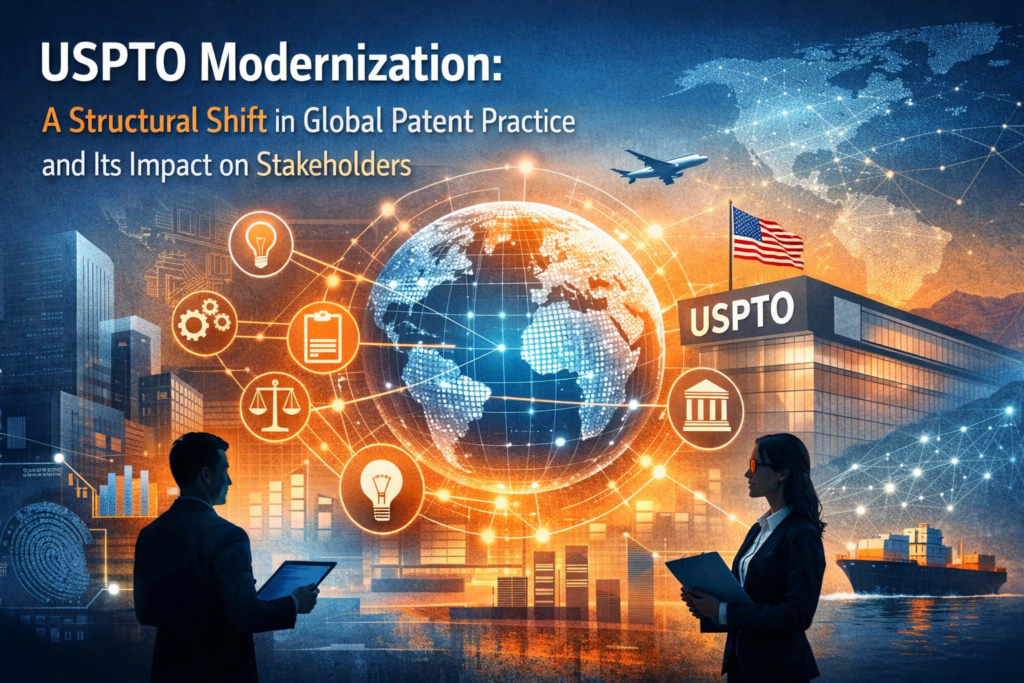
This article critically examines the USPTO’s modernization programme, identifying its deeper implications for stakeholders across the patent ecosystem.
Why Modernization Became Inevitable
The USPTO has experienced sustained pressure due to increased filing volumes, greater technological complexity, and heightened scrutiny of patent quality. Emerging domains such as artificial intelligence, biotechnology, and semiconductor technologies have challenged traditional examination frameworks.
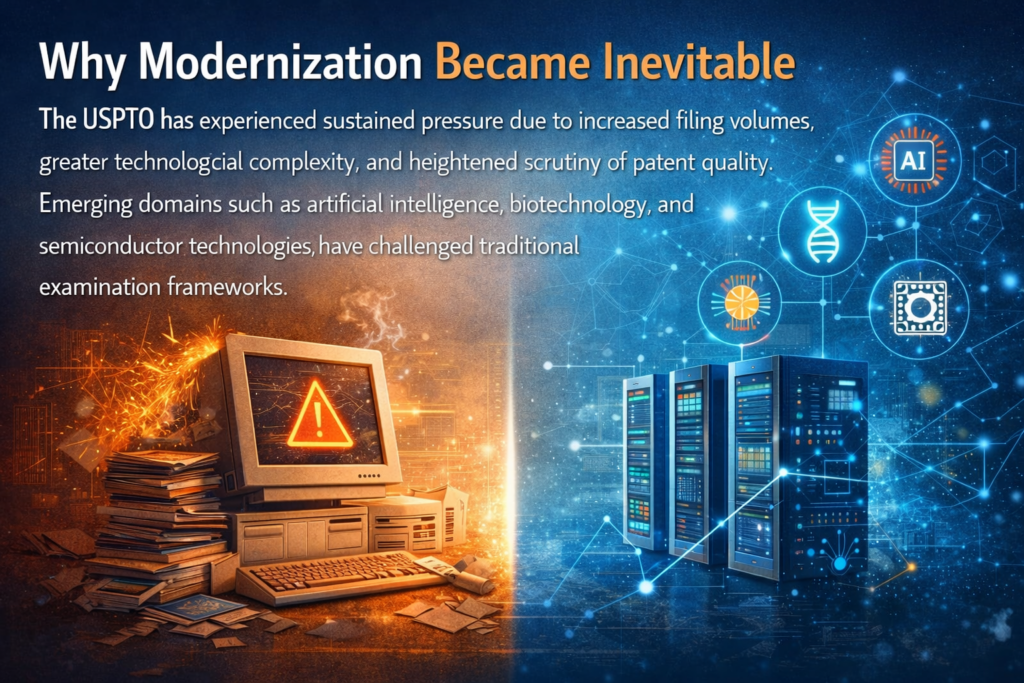
Legacy systems were no longer capable of supporting timely, high-quality examination. Modernization became essential to maintain the USPTO’s credibility as a leading global patent office.
Patent Centre: Transparency as a Strategic Shift
The USPTO’s complete migration to Patent Centre has consolidated filing, prosecution, and monitoring into a unified digital environment. While this transition improves operational efficiency, its greater impact lies in enhanced transparency.
Every prosecution action is now more visible, traceable, and auditable. For applicants and practitioners, this reduces procedural ambiguity and limits strategic delay.
Faster Patent Issuance and Its Consequences
By reducing the time between issue notification and patent grant, the USPTO has accelerated the lifecycle of patent rights. This change benefits innovators seeking faster market certainty but leaves less room for post-allowance corrections.
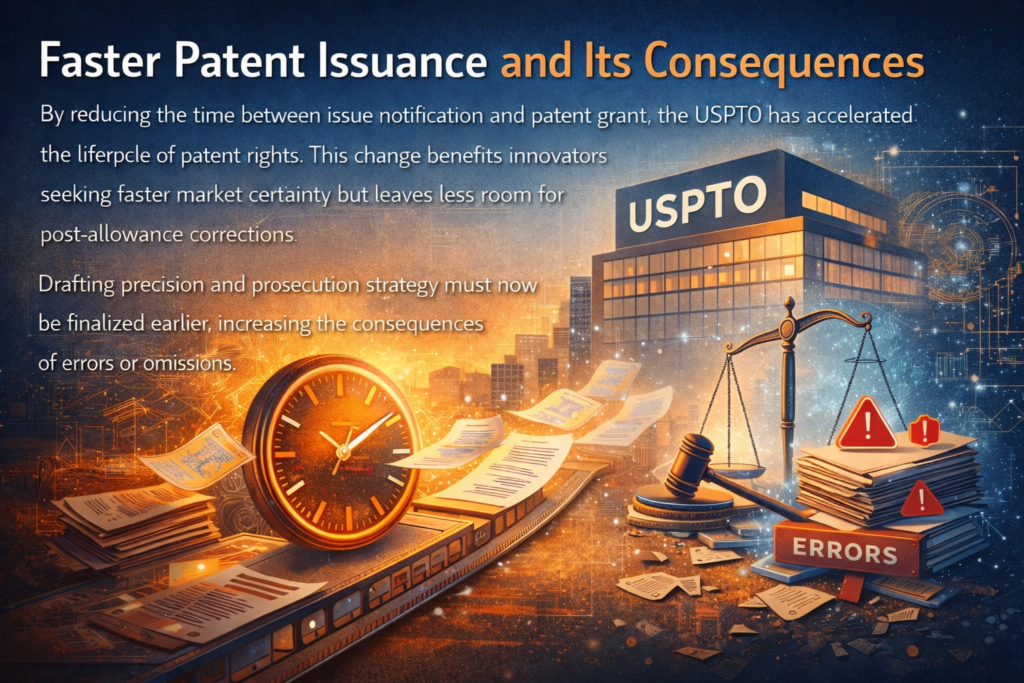
Drafting precision and prosecution strategy must now be finalized earlier, increasing the consequences of errors or omissions.
Security Reforms and Accountability
The introduction of robust identity verification mechanisms signals increased concern regarding filing integrity and data protection. These measures require organisations to implement stronger internal governance and clearly defined responsibility for patent filings.
Open Data and Market Transparency
The USPTO’s Open Data Portal centralizes access to patent data, empowering investors, competitors, and researchers. This transparency strengthens due diligence but also exposes weak or inconsistently prosecuted patents.
Strategic Implications for Stakeholders
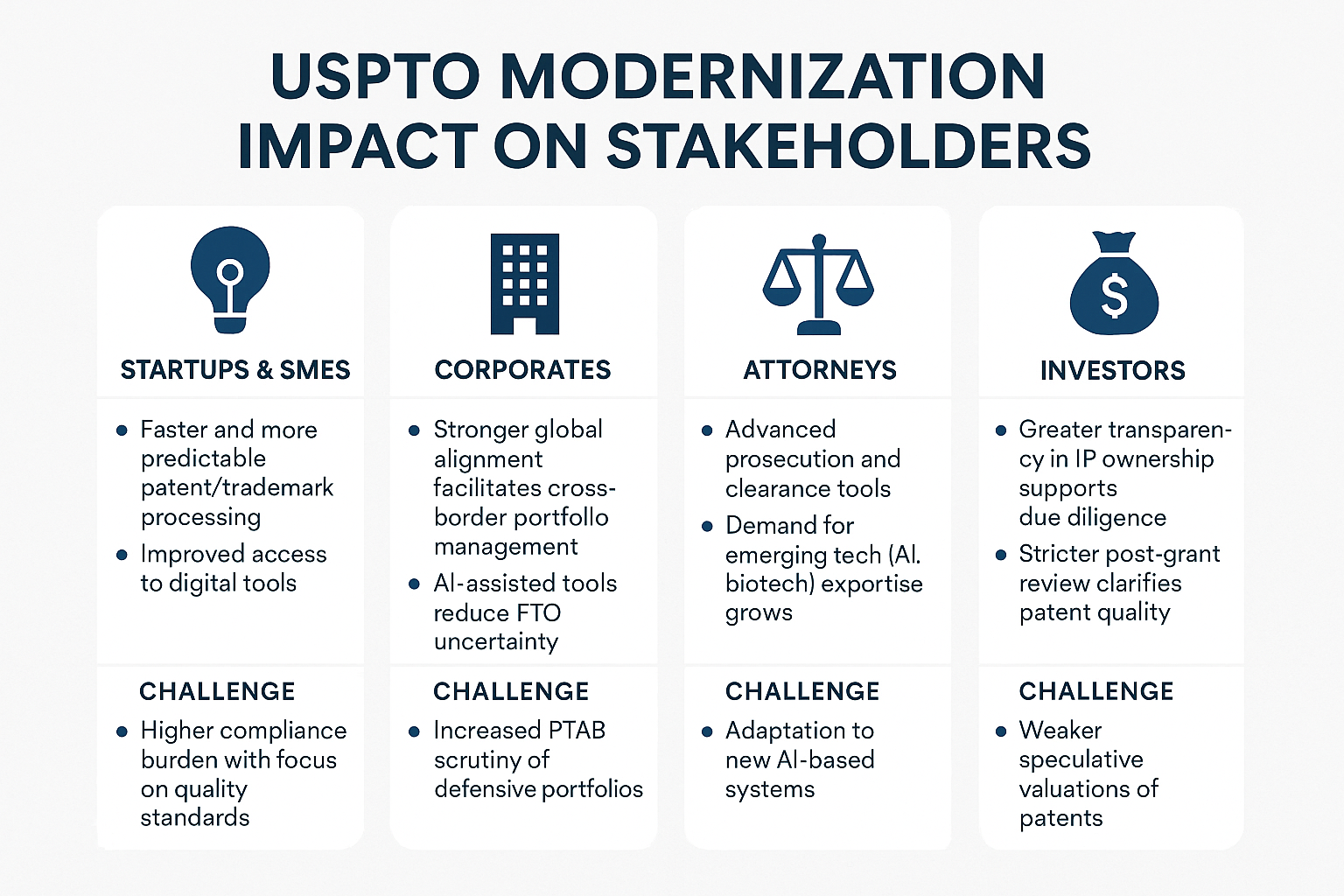
Startups must balance speed with quality. Corporations must reassess portfolio strength. Practitioners must shift from procedural competence to substantive excellence. Investors gain clearer valuation signals.
Implications for Indian Applicants
Indian innovators filing in the United States must adapt to heightened scrutiny and global best practices. Informal drafting approaches are increasingly untenable.
Role of IIPTA in Preparing Professionals
The Indian Institute of Patent and Trademark (IIPTA) aligns its training with evolving global patent office standards, emphasizing practical drafting, prosecution strategy, and case-based learning.
Conclusion
USPTO modernization signals a decisive shift toward quality-driven patent systems. Stakeholders who adapt their strategies accordingly will benefit from stronger, more reliable patent rights.