Lessons from Thomson Reuters v. Ross Intelligence
The use of plaintiffs headnotes which includes editorial summaries of legal opinions to train its AI-driven legal research tool case by defendant became the central theme of the case Thomson Reuters v. Ross Intelligence has emerged as a landmark decision in terms intersection of artificial intelligence (AI) and copyright law. Here the owner of Westlaw, alleged that this constituted direct copyright infringement.
Court’s Ruling on Copyright Infringement which opened the nuances in the said issue
The ruling which favored the plaintiff, where in February 2025, the U.S. District Court for the District of Delaware granted partial summary judgment on direct copyright infringement. The court held that defendant had copied and substantially appropriated 2,243 Westlaw headnotes to train its AI model.
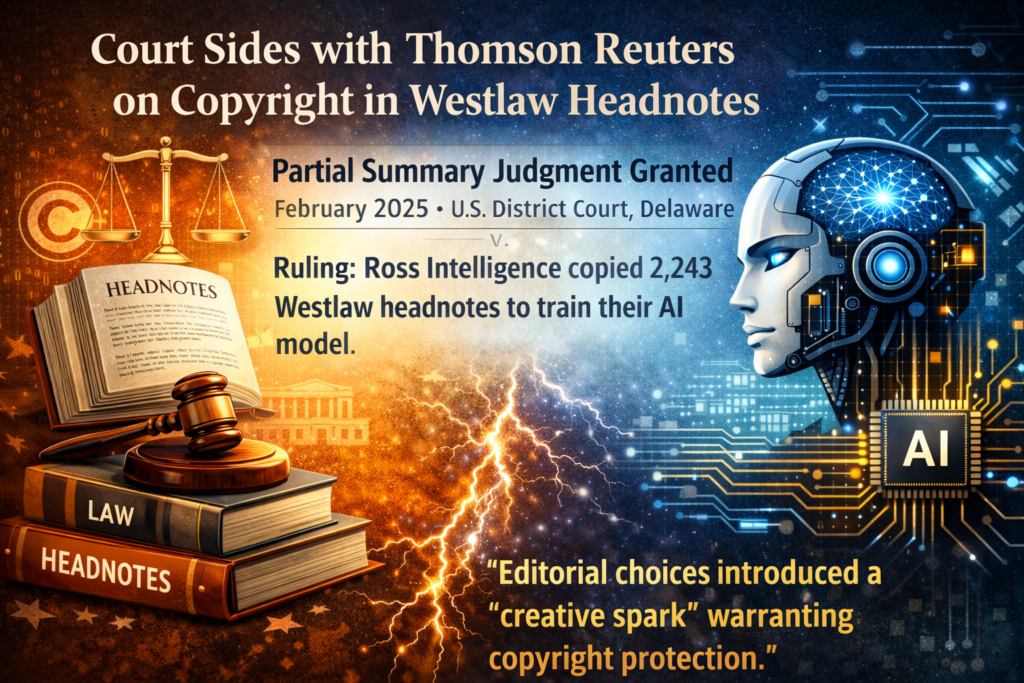
Here the efforts were made in terms of argument that the headnotes were factual and lacking in sufficient originality, in this regard the court held that the headnotes met the low threshold for originality required for copyright protection.
The court emphasized that the editorial choices involved in distilling judicial opinions into headnotes introduced a “creative spark” warranting copyright protection.
Critical Analysis of the Court’s Ruling in Indian stakeholders context :
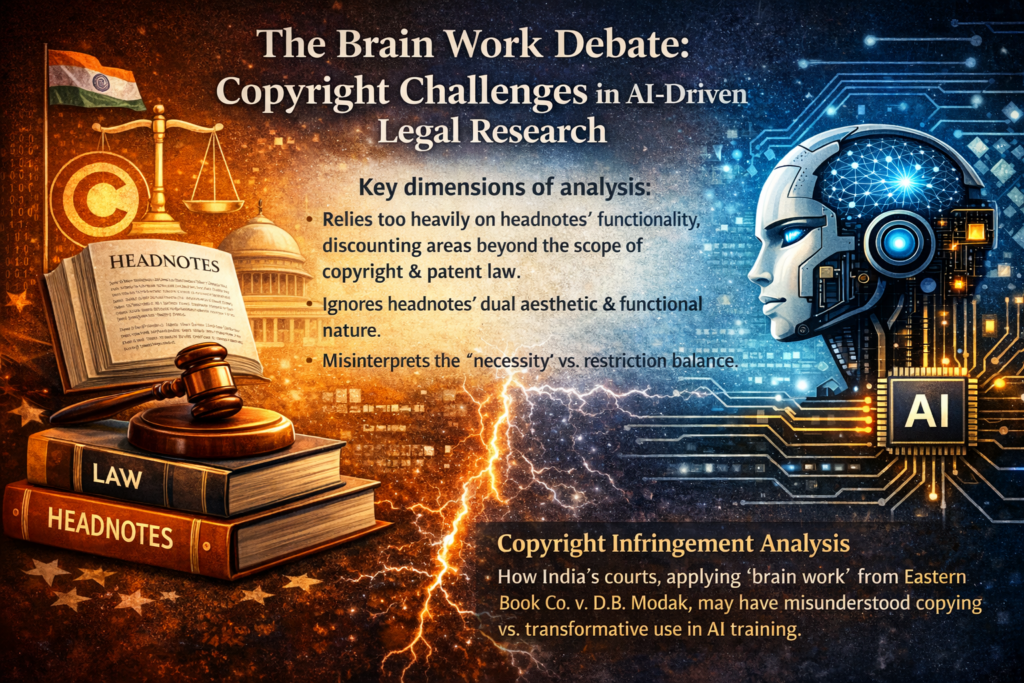
In India’s context the doctrine of originality refers to “brain work” in such context from the case Eastern Book Company v. D.B. Modak However, the key dimension of “brain work” lies in displaying the headnotes potentially incorporating quotes or paraphrases in verbatim alongside the judgment for navigation, not in the headnotes or their use in fact.
While granting copyright to headnotes, it seems that the Court has overlooked the key aspect of “brain work”, was not relevant in the headnotes’ expression itself rather in their creative display along with judicial opinions for easier navigation. The headnote’s essence ‘expressive’ lies in its nature of summary, which enables the users to grasp the crux of judgment crux rather than digging deeper to entire text, combined with the minimal creativity in sequential display its opinion for easier navigation.
The dimensions of analysis:
a. Relies too heavily on similar functionality of headnotes to improve search tools, discounting functional aspects which is outside the scope of copyright as well as patent law’s domain;
b. Ignoring its own recognition that headnotes, like computer software, served both aesthetic and functional purposes;
c. Interprets the ‘necessity’ requirement to apply restriction.
The Copyright Infringement Analysis
In holding summary judgment for infringement, the Court fundamentally discounted the action of plaintiff where headnotes were copied, mere copying would factually amounts to infringement if not used for any ‘expressive’ objective/intent or to portray aesthetic and creative expression. The Court underscored this principle when considering the “amount and substantiality” fair use factor, stating “What matters is not the amount and substantiality of the portion used in making a copy, but rather the amount and substantiality of what is thereby made accessible to a public for which it may serve as a competing substitute.” However, this point was not considered when evaluating prima facie infringement.
The Court’s analysis reveals a misunderstanding of how technological innovation intersects with copyright law. Undisputedly, the Westlaw headnotes were transformed into a numerical, machine-readable format to enable Ross Intelligence’s AI software to learn linguistic syntax and patterns. The fundamental purpose was to create an effective search functionality—a process that necessarily requires extracting key linguistic patterns from judicial opinions.
Analysis of Fair Use Defense
Ross Intelligence invoked the fair use doctrine, asserting that its use of the headnotes was transformative and served a different purpose. However, the court rejected this defense, analysing the four statutory fair use factors:
a. Purpose and Character of the Use: The court found Ross’s use to be commercial and non-transformative, as it aimed to develop a competing legal research tool without adding new expression or meaning.
b. Nature of the Copyrighted Work: While acknowledging that the headnotes were not highly creative, the court noted that they possessed sufficient originality to merit protection.
c. Amount and Substantiality: The court observed that Ross had copied a substantial number of headnotes, which weighed against a finding of fair use.
d. Effect on the Market: The court concluded that Ross’s use could harm the market for Westlaw’s services by creating a direct competitor, thereby negatively impacting Thomson Reuters’s market share.
Based on this analysis, the court determined that Ross’s use did not qualify as fair use under U.S. copyright law.
Implications for AI and Legal Research
This ruling has significant implications for the use of copyrighted materials in training AI models:
- AI Training Data: The decision underscores that using copyrighted content, such as editorial summaries or proprietary databases, to train AI systems without authorization can constitute infringement.
- Fair Use Limitations: The case illustrates the limitations of the fair use defense, particularly when the use is commercial and does not add transformative value.
- Market Impact Considerations: Courts may give considerable weight to the potential market impact of the unauthorized use of copyrighted materials in AI applications.
As AI continues to evolve and integrate into various sectors, this case serves as a cautionary tale for developers to carefully consider the legal ramifications of their training data sources.
The Indian Law Perspective
The Indian legal framework offers a particularly sophisticated approach to understanding copyright in technological contexts. The Supreme Court’s landmark judgment in R.G. Anand v. Deluxe Films provides critical guidance on what constitutes an infringing copy. The Court recognized that infringement is not merely about copying ideas or embedded information, but about adopting the manner, arrangement, and specific expressive elements with minimal alterations in a subsequent expressive work.
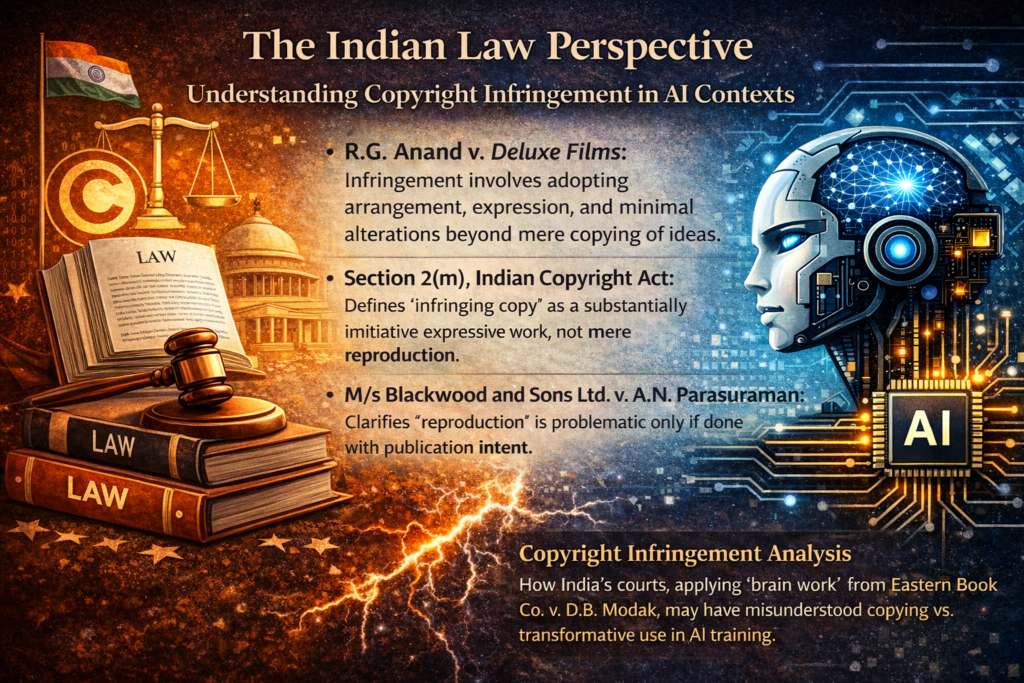
Section 2(m) of the Indian Copyright Act presents a nuanced definition of an ‘infringing copy’ that fundamentally differentiates between reproduction and mere copying. This distinction is crucial in technological contexts like AI training. The law suggests that reproduction becomes problematic only when it involves creating/or intending to create an expressive work that substantially imitates the original’s form of expression.
The Madras High Court’s judgment in M/s Blackwood and Sons Ltd. v. A.N. Parasuraman further refined this understanding. The Madras High Court interpreted infringing reproduction as reproduction that amounts to publication, as opposed to reproduction for private use or without publication intent. Section 3 of the Act defines publication as “making a work available to the public by issue of copies or by communicating the work to the public.”
Transformative Use Under Indian Law
While transformative use is not explicitly part of Section 52 defences in Indian copyright law, courts have increasingly used the concept to restrict the scope of copyright protection itself. The Calcutta High Court’s approach in Barbara Taylor Bradford v. Sahara Media Entertainment significantly limited reproduction and adaptation rights for transformed purposes.
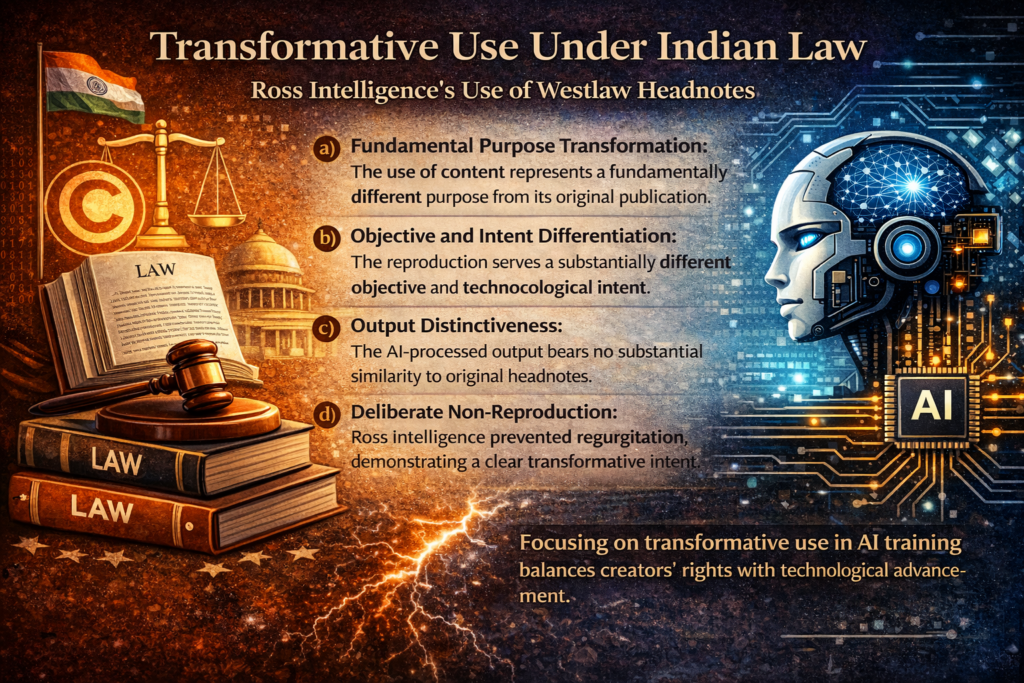
In the context of AI training, Ross Intelligence’s use of Westlaw Headnotes presents a compelling case for transformative use:
a) Fundamental Purpose Transformation: The use of copyright-protected content for AI training represents a fundamentally different purpose from the original publication. The objective is to train an artificial intelligence tool without exposing the expressive form to human readers—a stark departure from the original communicative intent.
b) Objective and Intent Differentiation: The reproduction serves a substantially different objective. While the functional purpose might overlap, the intent is distinctly technological—to enable machine learning and pattern recognition rather than human comprehension.
c) Output Distinctiveness: The subsequent output—judicial opinions extracted through AI processing—bears no substantial similarity to the original headnotes’ expressive form.
d) Deliberate Non-Reproduction: Ross Intelligence’s careful effort to prevent headnote regurgitation demonstrates a clear intent to transform, rather than merely copy, the original content.
This approach aligns with the fundamental principle that copyright protection should not impede technological innovation and extended to functional uses of creative expression. By focusing on the transformative nature of AI training, the law can balance the interests of content creators with the imperative of technological advancement.
FINAL IP PERSPECTIVE
While the Court carefully caveated that the judgment does not specifically address Generative AI, the implications are profound and potentially far-reaching. The findings about potential AI training markets and intermediate copying could create significant impediments to technological innovation.
Intellectual property law does not suppress creativity. It ensures that creativity is respected, controlled, and lawfully shared. For creators and institutions alike, understanding this balance is no longer optional.
CALL TO ACTION – IIPTA
At the Indian Institute of Patent and Trademark (IIPTA), we train students and professionals to understand intellectual property as it functions in real disputes, not just in statutes.
If you want to master copyright, trademark law, and licensing strategy with practical insight, IIPTA is where theory meets application.
Leave a Reply