A Shocking Turn in Indian Patent Law by the Madras High Court
Any invention either it is a product or process to become eligible to get patent must satisfy the following dimensions according to Indian Patent Law 1970 as follows, novelty or new invention, Inventive step and industrial application.
In a recent judgment by the Madras High Court in the case of Navya Network Inc. v. The Controller of Patents & Designs. In this case, the court upheld the rejection of a patent application based solely on the lack of an inventive step under Section 2(1) (ja) of the Patents Act, 1970, without addressing other objections raised, such as exclusion under Section 3(k) and lack of clarity under Section 10(5).
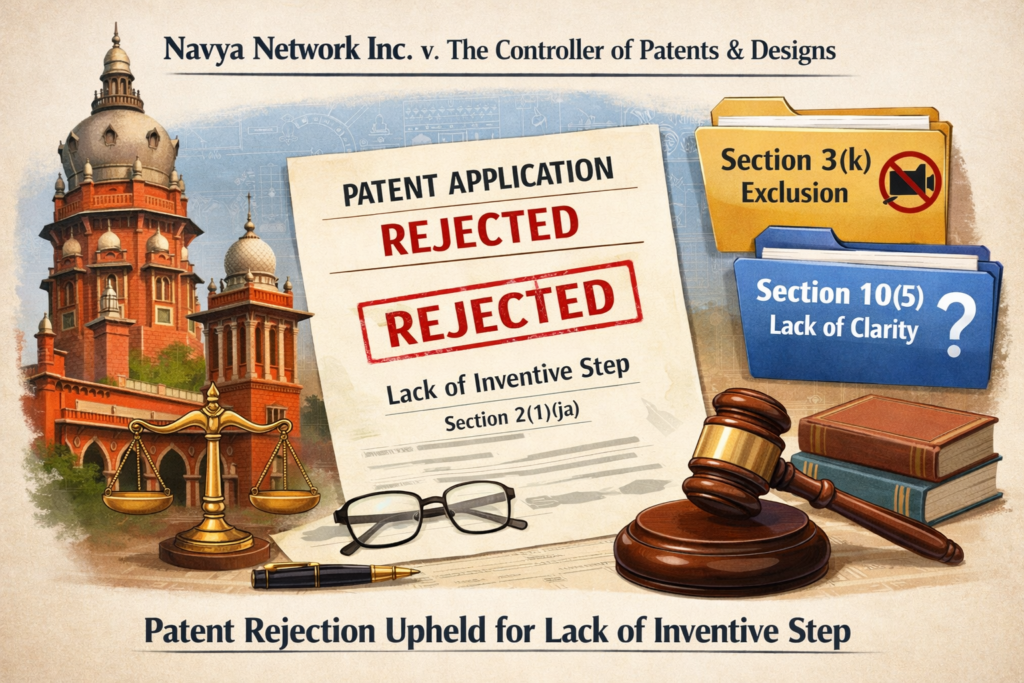
The ruling highlights need of comprehensive approach in in judicial proceedings, especially in specialized areas like patent law.
The court’s decision to address only one ground of rejection, while ignoring others, raises concerns about the thoroughness of judicial review. This approach may lead to uncertainties for applicants, who remain uninformed about the court’s stance on other critical objections.
As per the Indian Patent Act, 1970
Section 2 (1) (ja) “inventive step” means a feature of an invention that involves technical advance as compared to the existing knowledge or having economic significance or both and that makes the invention not obvious to a person skilled in the art;
Section 3(k) under chapter II of the act describes “a mathematical or business method or a computer programme per se or algorithms;” is non- patentable invention
Section 10 (5) The claim or claims of a complete specification shall relate to a single invention, or to a group of inventions linked so as to form a single inventive concept, shall be clear and succinct and shall be fairly based on the matter disclosed in the specification.
As we all aware that claims are not just features of the invention, claims are legal boundaries. It is necessary for an applicant to mention the particular features as claim to get the legal protection.
Concerns raised from ruling:
Some of the critics are arguing through the stance that the ruling has discounted other core aspects which has been explicitly defined in the law. Here it has also been citing the judgement of Delhi High court stance in Best Agrolife v. Deputy Controller of Patents, where the failure to address all objections in a pre-grant opposition was deemed a violation of natural justice. Which underscores the expectation for comprehensive judicial reasoning.
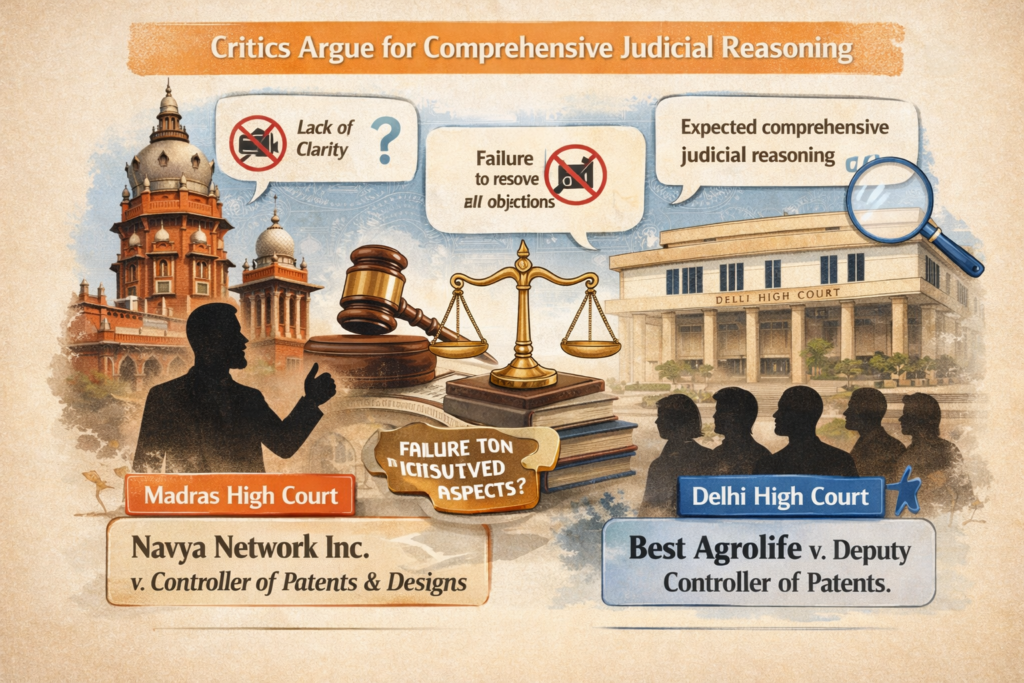
Efficient Justice Delivery is not only confined to Speedy disposal more than that comprehensive approach
While the intent of ruling might be to expedite proceedings, such selective analysis could result in increased litigation. If applicants choose to refile or appeal based on unaddressed objections, it could burden the judicial system further, counteracting the goal of efficiency.Which gives space or may be termed as ray of hope to further appeal in terms of reconsidering the decision or appeal to supreme court which are once again pile up of cases.
Challenges on Judiciary:
In 2021, the abolition of Intellectual Property Appellate Board (IPAB) and transferring the powers to High Court Jurisdiction is one- or other-way transferring burden to judiciary. Where IPAB as separate body with timely reforms could work efficiently, with expertise involvement with the consideration of all dimensions of the expertise IPR in general and Patents in particular.
Implications on stakeholders:
Patents act as both reward as well as protection for an inventor, judicial delay, non-comprehensive rulings are defeating the purpose of Innovation. The needful intervention of governance is through set of expertise body which addresses the scientific landscape according to the dynamics.
This decision also has significant implications for startups and research teams. In a field where innovation moves quickly, patent protection plays a crucial role in attracting investment, commercializing technology, and protecting competitive advantages. However, drafting a successful patent application requires collaboration between researchers who understand the invention and patent professionals who understand the law. This partnership acts as precaution to avoid unwanted judicial litigation in course of patent filing procedure.
What Innovators & R&D Teams Should Learn from This Case
There is certain thing which should be taken as precautionary aspects before filing the patent application to carry out the process smoothly. The aspects which need support from the attorney are as follows
Disclose the invention clearly and Completely: Since the India
Patent law demands high scientific detail, not summaries and description.
So, any patent application MUST include the dimensions and aspects:
- Methodology
- Lab protocols
- Experimental results
- Industrial application (in case of computer programme and algorithm)
- Disclose the features completely
. Draft Claims Smartly (avoid boarder claims):
Claims provide actual protection for the invention and claims are considered as legal boundaries of an invention. So, it is necessary to draft claims in a smarter way as;
Smart claims:
- Match the description
- Are precise
- Highlight inventive steps
A well-drafted claim directly proportional to Higher chance of grant.
Understand India’s Section 3 Restrictions
3(k) a mathematical or business method or a computer programme per se or algorithms;
3(l) a literary, dramatic, musical or artistic work or any other aesthetic creation whatsoever including cinematographic works and television productions;
3(m) a mere scheme or rule or method of performing mental act or method of playing game;
3(n) a presentation of information; (o) topography of integrated circuits;
Which needs expert guidance to overcome the chances grounds for rejection.
Impact on Startups & Researchers:
- BUT only when applications are drafted with precision and scientific depth
For startups, researchers, and companies, the key considerations are as follows:
- Needful preparation of detailed, high-quality patent specifications.
- Need to work with experts who understand both science as well as patent law.
- Need to avoid broad, vague, or incomplete disclosures.
To understand patent drafting, Section 3 and section 10 compliance in accordance to section 2 (1) (j) (a), and global patent trends.
How IIPTA Uses Such Cases in Training
At IIPTA (Indian Institute of Patent & Trademark), uses case laws like Navya Network Inc. v. The Controller of Patents & Designs to make innovators to be aware and bridge this gap to overcome objections in general and the provisions of
Section 2(1) (ja)
Section 3(k) and
Section 10(5) in particular,
and how to draft claims that are both enforceable and compliant with Indian law. Our programs are designed to give applicants the clarity, confidence and legal strategy needed to protect their inventions successfully.
Conclusion : Drafting smarter claims in more important than broader claims
This case not only shows judicial burden but also responsibility of patent practitioner to draft the application in such a way it not only ensures the grant but also a defense in regarding the issues of opposition in future course of patent prosecution during the life of patents.