What India’s Patenting Trends Reveal in 2025
India recently achieved a milestone of fourth largest economy in the world and third in Asia. The innovation landscape of India is expanding and innovators from budding level to entrepreneur, and from grass root level to metropolitan residents. This aspect is reflected through the number of patent filings.
In recent years generally in the decade of early 2020s the filing patents to protect the intellect in terms of scientific invention has amplified, which can be analyzed through shedding light on exponential trend in first half of the decade from 2020 to 2025 in general.
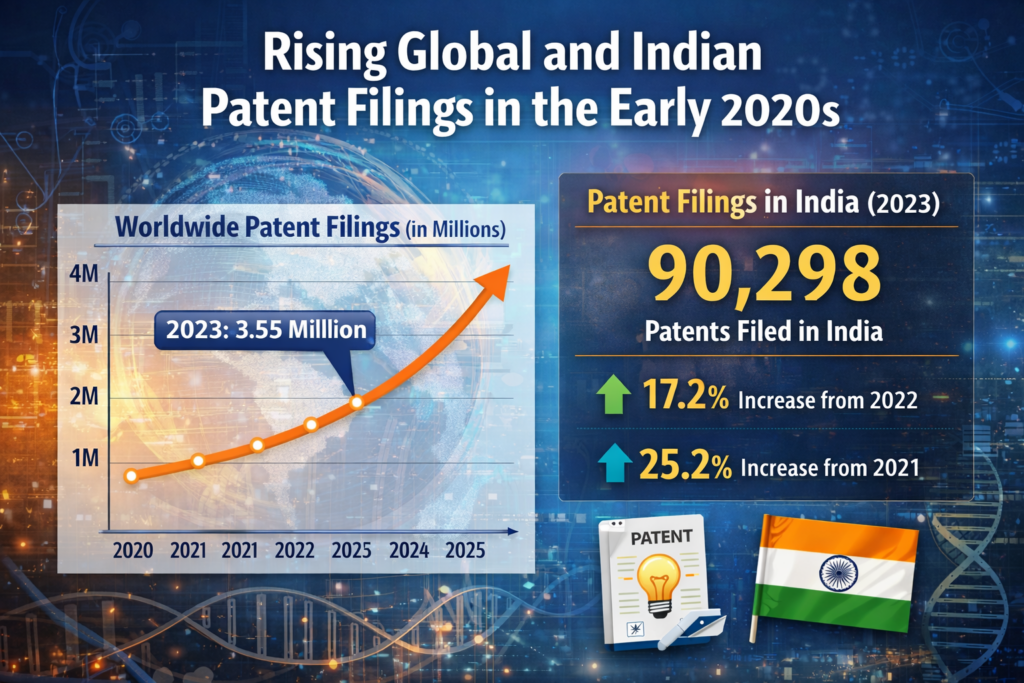
The year 2023 has witnessed filing of 3.55 million across the global landscape. In Indian context the concerned office registered 90298 which is more than 17.2 percentage from 2022 and more than 25.2 percentage from the year 2021.
One significant to take note of is 50 percent application among them are filed from the Indian residents which is the reflection widening domestic landscape innovation as well as invention.
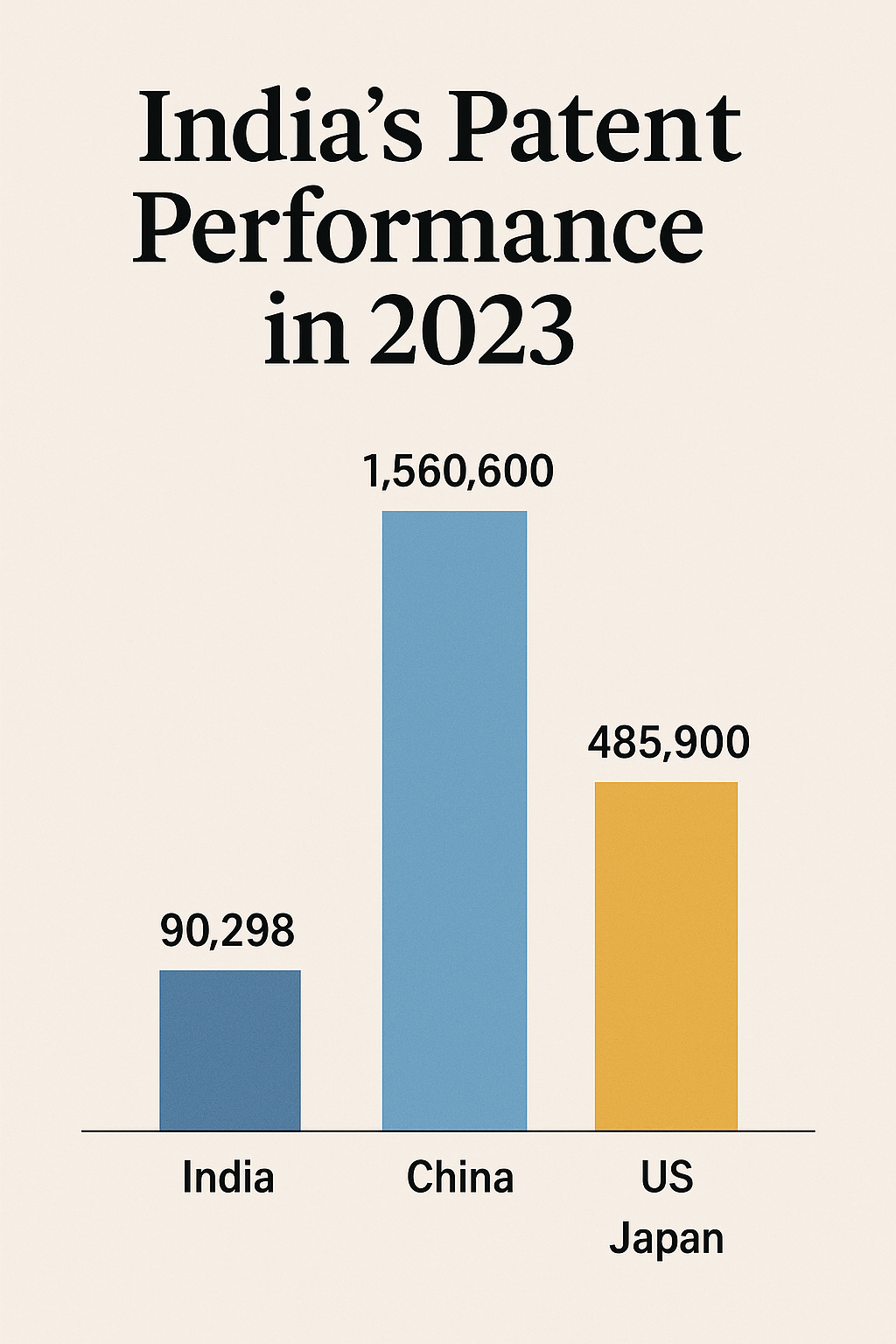
Despite these progress, India continues to lag behind those countries like China, the US, and Japan both in terms of absolute numbers, and applications filed and granted that are domestic in origin, which sheds light on the challenges in terms of, administrative inefficiencies, weaknesses in the domestic innovation ecosystem, the current status of patent filing in the country, capacities in patent boosting and performance, and inconsistencies across state-level patent incentives. A need of the hour for targeted reforms.
An overview of the current trends in India’s patenting landscape (as of 2024–25):
A. Rising Patent Filings
- Steady growth: India has witnessed more than 90,000 patent filings annually (2022–23), compared to nearly 45,000 a decade ago.
- Domestic vs. Foreign: Historically foreign applicants especially from US, Japan, China dominated filings, but domestic filings now account for more than 50% a major policy milestone.
- Key drivers: Startups, academia–industry collaborations, and incentives under Atmanirbhar Bharat and the National IPR Policy (2016)
B . Contribution from sectoral Trends
Applications are filed from diversified landscape of industries :
- Pharmaceuticals and Biotechnology showcasing as the strongest sector, with growth in biologics, biosimilars, and CRISPR-based applications.
- ICT and Electronics: Surge in AI, IoT, semiconductor, and telecom-related patents, partly due to India’s semiconductor mission and 5G/6G R&D.
- Green Technologies: Increase in filings for renewable energy, EV batteries, hydrogen, and waste-to-energy processes helped by “green patent” fast-tracking.
- Agriculture and Food Technology : Amplified filings in biopesticides, climate-resilient crops, biofertilizers, and Agri-biotech innovations.
C. Policy Push and Institutional Support :
As we aware of the reality that innovation blossoms when the environment is free and fertile, in terms of policy
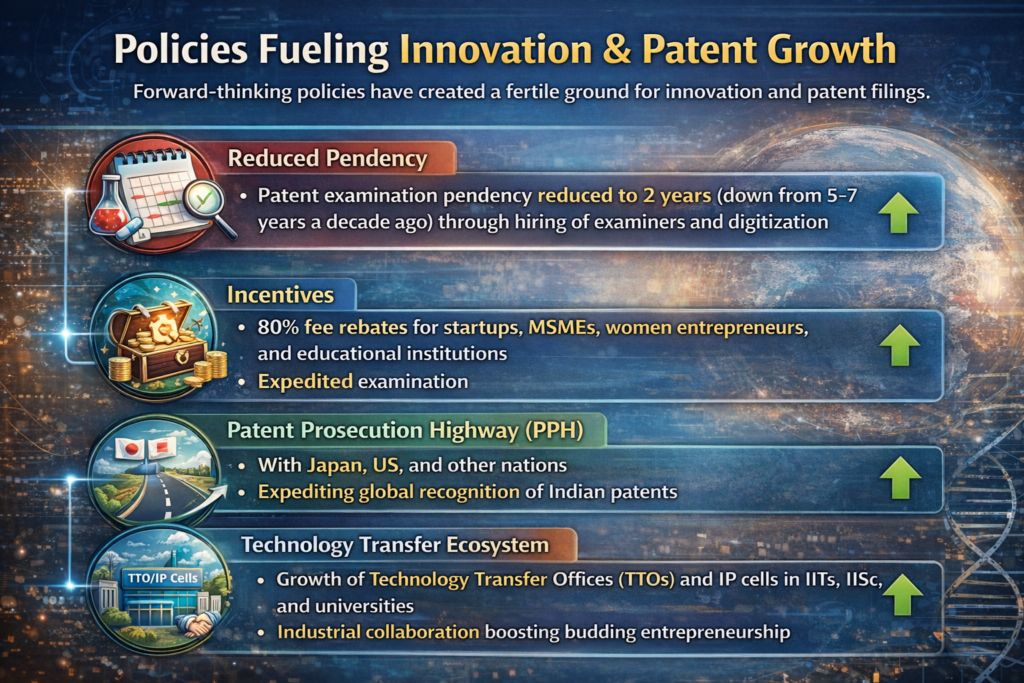
- Reduced Pendency: Patent examination pendency reduced to 2 years (down from 5–7 years a decade ago) through hiring of examiners and digitization
- Incentives: 80% fee rebates for startups, MSMEs, women entrepreneurs, and educational institutions along with expedited examination.
- Patent Prosecution Highway (PPH): With Japan, US, and other nations, expediting global recognition of Indian patents.
- Technology Transfer Ecosystem: Growth of Technology Transfer Offices (TTOs) and IP cells in IITs, IISc, and universities as well as industrial collaboration as boost to budding entrepreneurship.
D. Qualitative Shifts
- From Filing to Commercialization: More focus on patent valuation, licensing, and monetization, not just on numbers but patented inventions serving the need of the society.
- IP as Collateral: Banks and Venture Capitals beginning to recognize patents as intangible assets for financing.
- Startup-Centric IP Culture: Startups are filing patents early to secure funding, often in areas like AI-driven platforms, medtech, and climate tech.
- Digital Tools: AI-based prior art searches, e-filing, and automated examination workflows adopted by IPO (Indian Patent Office).
E. Global Integration
- India in WIPO Rankings: India entered the top 40 of the Global Innovation Index (GII 2023), driven by patent activity.
- PCT (Patent Cooperation Treaty): Indian entities are filing more international patents, but still lag behind China, US, Korea.
- Cross-Border Licensing: Pharma and IT sectors increasingly use patents for global licensing and collaborations.
F. Challenges
- Awareness Gaps: Many MSMEs and universities underutilize IP protections.
- Patent Quality vs. Quantity: Concerns remain that filings are increasing, but enforceable, globally competitive patents are fewer.
- Litigation & Enforcement: Patent litigation remains slow and costly, deterring smaller players.
- CRI (Computer-Related Inventions): Ambiguity around software patents continues despite evolving jurisprudence.
G. Future Outlook
- AI & Data-Driven Patents: Surge expected in AI, machine learning, quantum computing, and blockchain-based filings.
- Sustainability Focus: Policy push for green tech patents in EVs, solar, hydrogen, and bio-based plastics.
- Regional Innovation Hubs: Growth beyond metros (Ahmedabad, Hyderabad, Pune, Coimbatore, and Bhubaneswar emerging as IP-active clusters).
- IP–Startup Nexus: Patents will increasingly serve as fundraising and valuation tools for Indian startups seeking global expansion.
Conclusion :
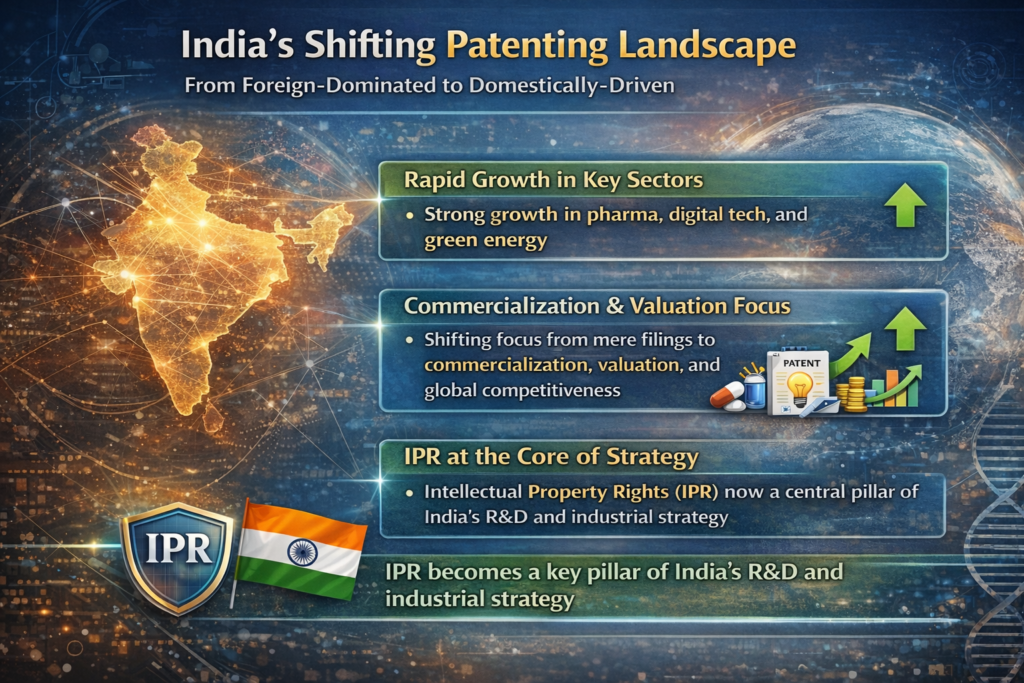
India’s patenting landscape is transitioning from being foreign-dominated to domestically driven, with strong growth in pharma, digital tech, and green energy. The focus is shifting from mere filings to commercialization, valuation, and global competitiveness, making IPR a central pillar of India’s R&D and industrial strategy.
Role of IIPTA in guiding the stake holders to reap the benefits of current trends in terms of career :
As we understood from the news the landscape of innovation is widening which demands the expertise, the demand of the need of the hour is addressed by training aspirants
Through Technical skills in terms
Prior Art Analysis
Patentability analysis
Drafting Skills
Updating of law in terms of amendments.