When academic copyright collides with the public’s right to know
Introduction: When Two Powerful Laws Collide
Indian intellectual property law does not operate in isolation. It frequently intersects with constitutional values, transparency obligations, and public interest considerations.
One such intersection came before the Delhi High Court, where the Court was asked to resolve a deceptively simple but legally complex question:
Can a PhD scholar prevent public access to a thesis submitted to a public university by invoking copyright and future commercial interests?
The answer has significant implications for:
- Researchers
- Universities
- IP professionals
- RTI practitioners
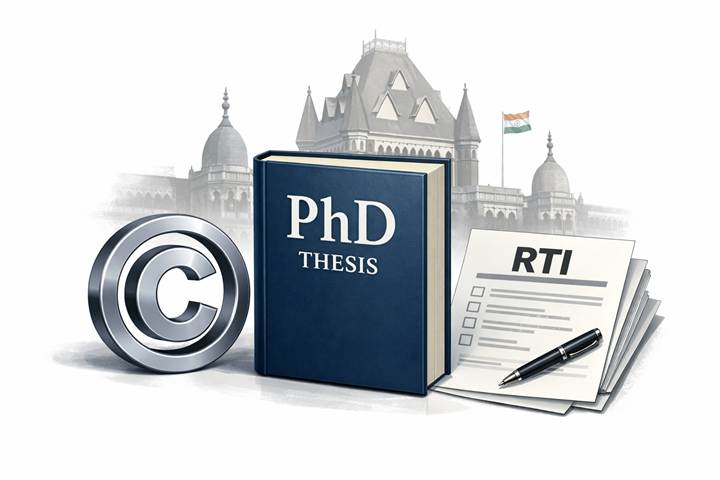
Background of the Case: Thesis, RTI and Refusal
An RTI application was filed seeking access to a PhD thesis submitted to Jamia Millia Islamia University, a public authority under the RTI Act, 2005.
The request was denied at multiple levels on the ground that:
- The thesis was kept in “absolute safe custody”
- Disclosure could harm the commercial interests of the scholar
- The scholar had already obtained a US patent and intended to seek an Indian patent
The Central Information Commission (CIC) upheld the denial under Section 8(1)(d) of the RTI Act.
The Core Legal Conflict Explained Simply
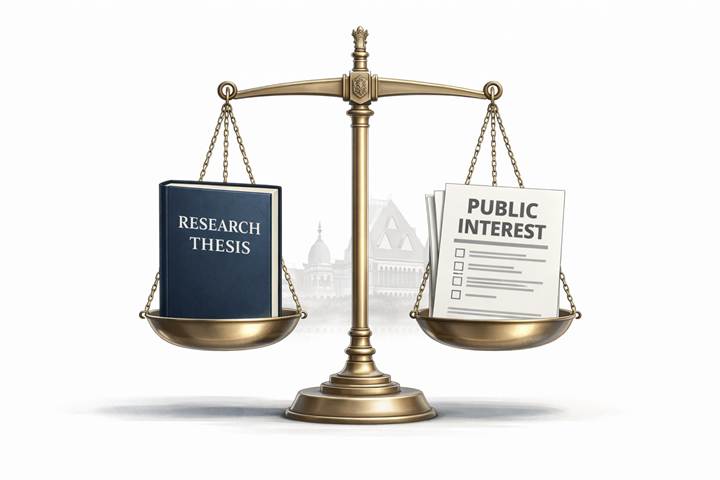
At the heart of the dispute was a clash between two rights:
Right to Access Information (RTI Act)
vs
Right to Communicate the Work (Copyright Act)
The legal issue was not whether copyright subsists in a thesis.
The real issue was:
Does copyright give an author the power to block access to a public record?
Delhi High Court’s Findings: Law Beyond Labels
Justice Sanjeev Narula overturned the CIC’s order and clarified several critical principles.
1. A PhD Thesis Is “Information” Under RTI
A thesis maintained by a public university clearly falls within the definition of “information” under Section 2(f) of the RTI Act.
Calling it “academic” or “copyrighted” does not remove it from RTI scrutiny.
2. Section 8(1)(d) Is a Conditional Exemption
For this exemption to apply:
- The information must be of commercial confidence / IP
- Disclosure must harm competitive position
The Court held:
- Speculative future commercial exploitation is not enough
- No concrete evidence of harm was shown
Copyright Law: Is the Right Absolute?
The scholar’s argument implicitly relied on Section 14(a)(iii) of the Copyright Act — the exclusive right to communicate the work to the public.
However, the Court’s reasoning makes three things clear:
Academic Submission Creates an Implied Licence
University regulations and UGC guidelines require:
- Submission
- Archiving
- Digital availability (INFLIBNET)
This establishes a non-exclusive licence in favour of the university.
Copyright Is Not an Absolute Monopoly
Section 14 is subject to:
- Section 52 (fair dealing)
- Compulsory licensing provisions
Importantly:
- Section 52 permits use for private study and research
- RTI provides the access mechanism for such use

Public Interest: The Deciding Factor
Even where an exemption arguably applies, Section 8(2) of the RTI Act mandates disclosure if public interest outweighs private interest.
The Court noted:
- The thesis was meant for public dissemination
- It had been previously accessible
- Denial of access was therefore arbitrary
The judgment reinforces a fundamental principle:
Copyright protects economic exploitation — not secrecy.
What This Judgment Teaches IP Professionals
Key Learnings
- Copyright cannot be used to suppress public records
- RTI and IP law must be read harmoniously
- Academic IP carries higher transparency obligations
- Public interest remains the ultimate balancing test
Why This Case Matters Beyond One Thesis
This ruling raises larger questions:
- Should academic work be treated like commercial IP?
- How far does the right to research extend in India?
- Can universities continue vague IP policies?
For IP practitioners, this case is a reminder that IP strategy without public law awareness is incomplete.
About IIPTA
At the Indian Institute of Patent and Trademark (IIPTA), we train professionals to understand intellectual property not just as statutes, but as living rights that interact with public policy, transparency, and innovation.
Want to build real IP expertise?
- Learn copyright with practical interpretation
- Understand IP–RTI intersections
- Train under practitioners, not note-makers
Explore IIPTA’s IP training programs and expert-led courses