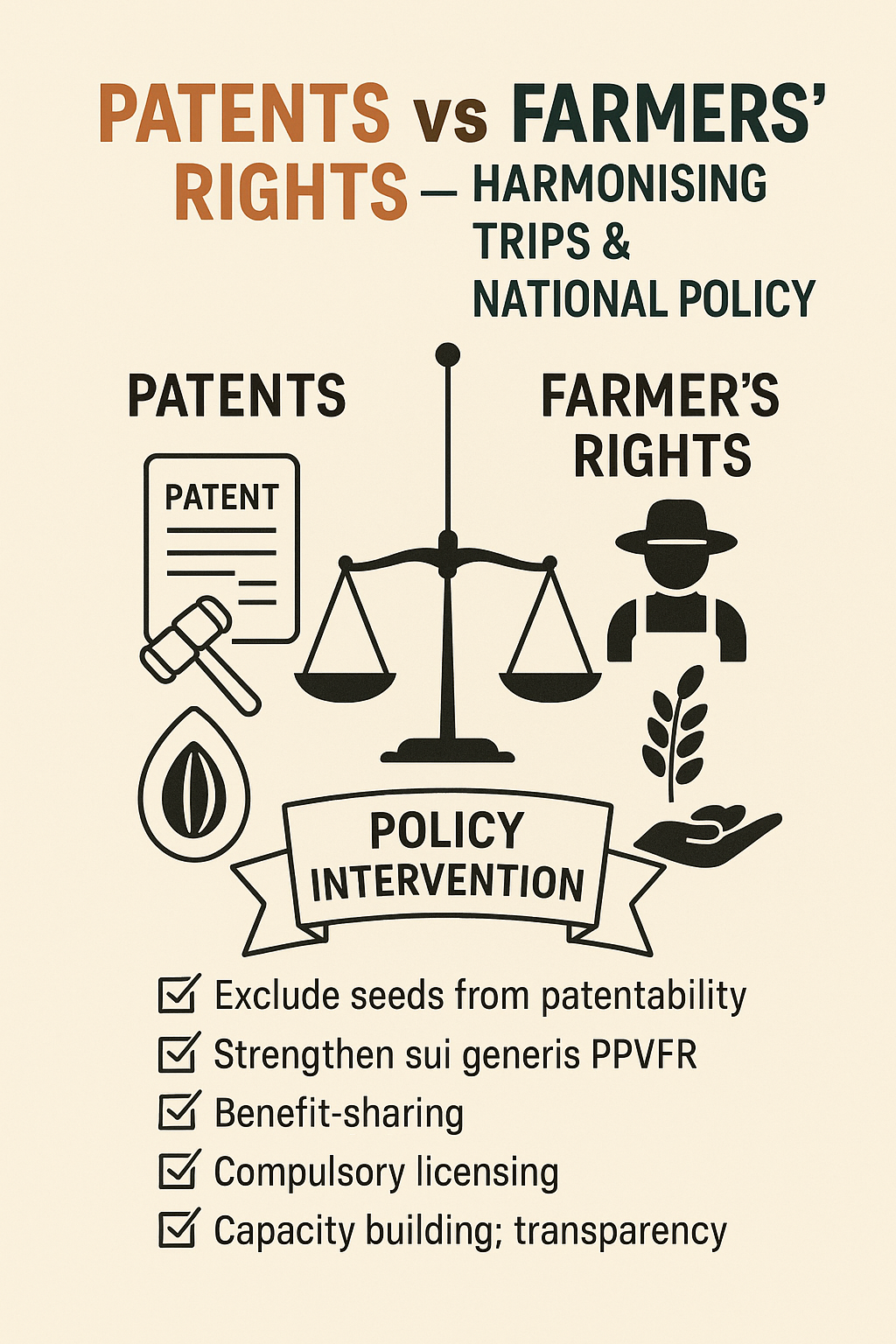
How India Walks a Legal and Policy Tightrope
Patents vs Farmers’ Rights under TRIPS: How India Walks a Legal and Policy Tightrope
Introduction: Why This Debate Still Shapes India’s IP Policy
The intersection of intellectual property rights and agriculture is one of the most complex — and politically sensitive — areas of global IP governance. Unlike patents in pharmaceuticals or technology, agricultural intellectual property directly impacts food security, rural livelihoods, biodiversity, and national sovereignty.
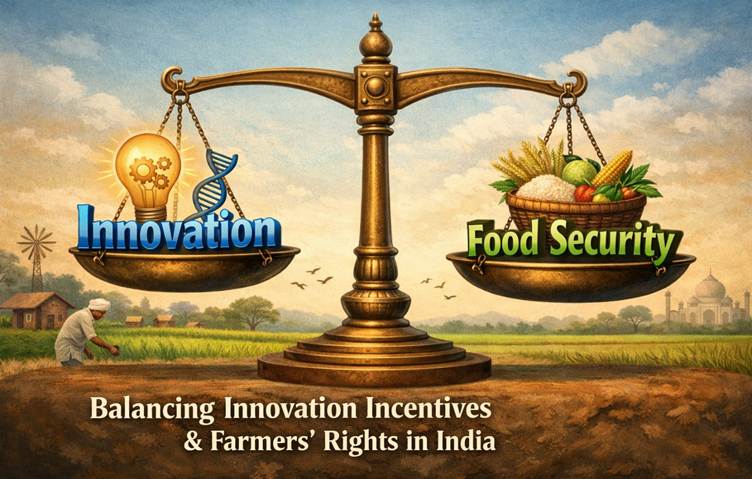
For India, this debate carries added weight. With a large agrarian population and a long tradition of seed saving and exchange, any IP framework governing agriculture must balance innovation incentives with social realities. This balance is tested most visibly at the intersection of TRIPS obligations and farmers’ rights.
India’s legal response is neither accidental nor defensive. It is deliberate, strategic, and deeply rooted in public interest.
Understanding TRIPS: What Does International Law Actually Require?
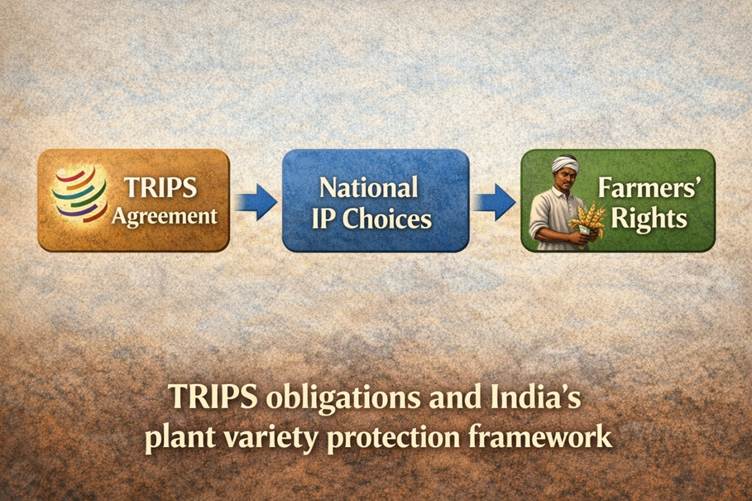
Under Article 27.3(b) of the TRIPS Agreement, WTO member states are required to provide protection for plant varieties. However, TRIPS does not mandate a single model.
Member states may choose to protect plant varieties through:
- patents, or
- an effective sui generis system, or
- a combination of both
This flexibility was intentionally built into TRIPS to accommodate countries with diverse agricultural systems, economic priorities, and food security concerns. Importantly, TRIPS do not compel countries to patent plants, seeds, or animals.
India used this flexibility fully and lawfully.
India’s Sui Generis Choice: The PPVFR Act, 2001
Rather than adopting a patent-heavy or breeder-centric model, India enacted the Protection of Plant Varieties and Farmers’ Rights Act, 2001 (PPVFR Act).
This legislation is globally distinctive because it recognises that innovation in agriculture is not confined to laboratories or corporations. Farmers themselves are breeders, conservers, and innovators.
The PPVFR Act seeks to:
- encourage formal plant breeding,
- protect farmers’ traditional practices,
- ensure benefit-sharing,
- promote sustainable agricultural development.
Unlike international regimes that prioritise commercial breeders, India’s approach embeds social equity directly into its IP framework.
Farmers’ Rights under Indian Law: Not an Exception, but a principle
A defining feature of the PPVFR Act is its explicit statutory recognition of farmers’ rights.
Farmers are legally entitled to:
- save, use, sow, and re-sow farm-saved seeds,
- exchange and share seeds,
- sell unbranded farm produce,
- claim benefit-sharing for conserved genetic material,
- protection against innocent infringement.
These rights are not concessions. They are legal acknowledgements of the historical role farmers have played in conserving and developing plant genetic resources.
Where the Conflict Begins: Patents, Biotechnology, and Control over Seeds
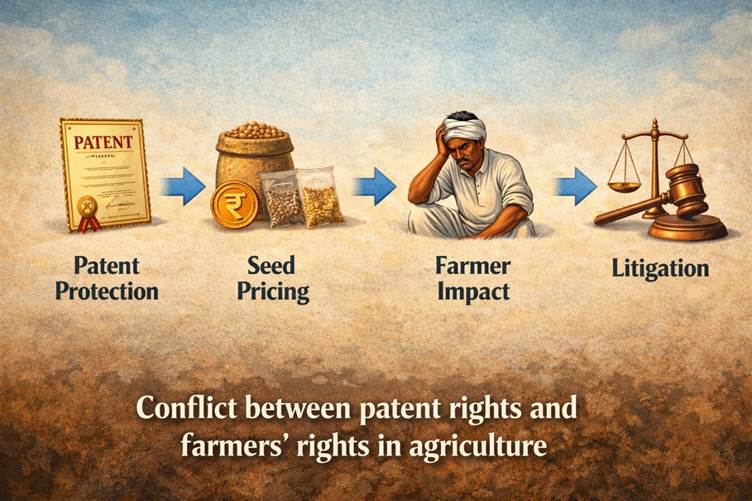
Although plants and seeds are excluded from patentability under the Indian Patents Act, conflict has arisen in the context of biotechnological inventions.
Genetic traits, recombinant technologies, and hybrid seed technologies have tested the boundaries between:
- patent law, and
- plant variety protection law.
The Monsanto v. Nuziveedu litigation exposed these tensions clearly, raising questions about:
- indirect control over seeds through patent claims,
- seed pricing and affordability,
- overlap between patent monopolies and farmers’ freedoms.
Indian courts have shown caution in extending patent protection in ways that could undermine farmers’ rights or distort agricultural markets.
TRIPS vs Farmers’ Rights: A False Legal Dichotomy
It is often suggested that farmers’ rights conflict with TRIPS obligations. This is a misleading narrative.
TRIPS itself do not prohibit farmers’ rights. The tension arises when TRIPS-plus standards often introduced through bilateral trade agreements or external pressure seek to narrow domestic policy space.
India’s framework demonstrates that:
- innovation incentives and farmers’ rights can coexist,
- compliance with international law does not require surrendering food security concerns.
Global Pressure and India’s Policy Position
Developed economies frequently advocate for:
- patent-based plant protection,
- UPOV-style regimes,
- stronger enforcement mechanisms favouring breeders.
India has consistently defended its sui generis model as:
- fully TRIPS-compliant,
- socially necessary,
- economically justified.
India has also supported international discussions on:
- disclosure of origin,
- protection of traditional knowledge,
- benefit-sharing mechanisms.
This reflects a broader view of IP — one that connects innovation with equity and sustainability.
Implementation Challenges on the Ground
Despite a robust legal framework, challenges remain:
- limited awareness among farmers about statutory rights,
- underutilisation of benefit-sharing mechanisms,
- procedural complexity in registration,
- institutional capacity constraints.
Without effective implementation, even well-designed laws risk becoming symbolic rather than transformative.
Policy Roadmap: Strengthening the Balance
A sustainable agricultural IP regime requires:
- clearer statutory demarcation between patents and plant varieties,
- carefully designed compulsory licensing mechanisms,
- stronger enforcement of benefit-sharing provisions,
- integration of IP law with biodiversity regulation,
- capacity-building for farmers and stakeholders.
These measures can reduce uncertainty while preserving both innovation incentives and public interest.
Conclusion: Beyond Compliance, Toward Conscious Policy
Patents and farmers’ rights need not exist in opposition. TRIPS provides the flexibility; national policy provides the conscience.
India’s PPVFR Act illustrates how intellectual property law can support innovation without sacrificing equity, food security, or farmer livelihoods. For IP professionals, policymakers, and students, understanding this balance is essential not just legally, but ethically.
For structured learning on agricultural IP, patent analysis, and TRIPS compliance, explore specialized programs at the Indian Institute of Patent and Trademark (IIPTA).