What Repeated Amendments Reveal About Patent Strategy in High-Stakes Biotech Innovations
Introduction
The early years of the 2020s will be remembered as a defining phase for global public health systems. The COVID‑19 pandemic disrupted economies, strained healthcare infrastructure, and compelled governments and scientific institutions to act at unprecedented speed. For India, this period marked the development of Covaxin—its first indigenously developed COVID‑19 vaccine. While Covaxin emerged as a scientific and strategic success, its journey through the patent system has been complex and instructive.
This article examines the Covaxin patent saga not from a political or emotional standpoint, but through a strict intellectual property lens. The repeated amendments to the patent application filed by Bharat Biotech International Limited (BBIL) raise important questions on inventorship, ownership, prosecution strategy, and transparency—issues that are critically relevant for innovators, biotech startups, R&D teams, and patent professionals.
Scientific and Technical Background of Covaxin
Covax in was developed by Bharat Biotech International Limited in collaboration with the Indian Council of Medical Research (ICMR) and the National Institute of Virology (NIV). The vaccine uses a traditional inactivated whole‑virion platform, a well‑established technology known for safety and stability.
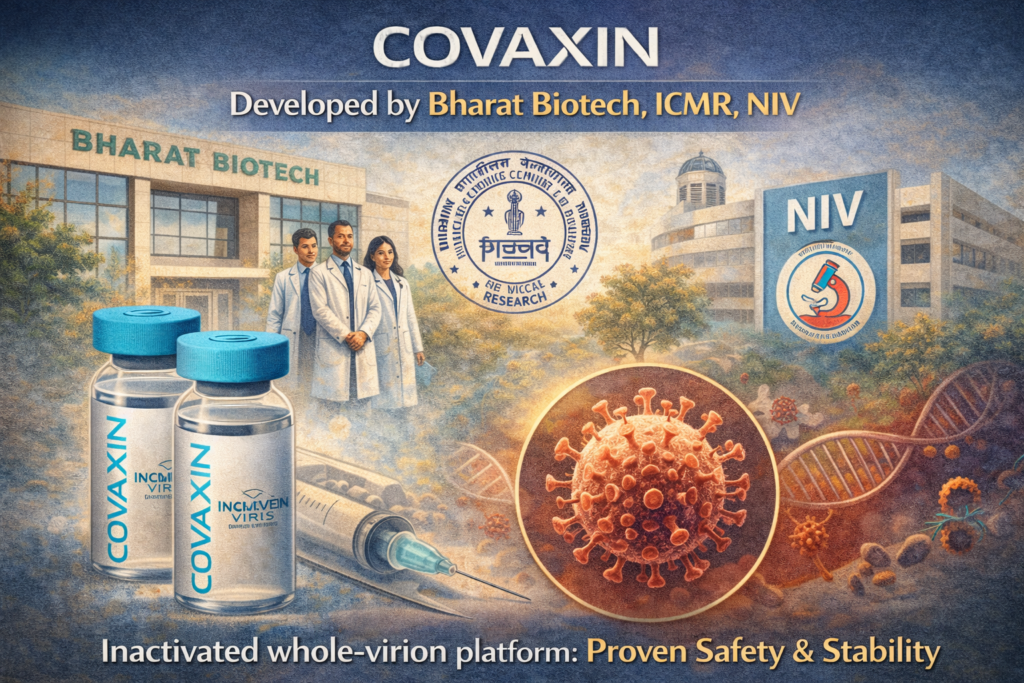
Key features include
• Inactivated whole‑virion SARS‑CoV‑2 vaccine
• Use of Algel‑IMDG adjuvant to enhance immune response
• Intramuscular administration
• Phase‑3 efficacy of approximately 77.8%
• Demonstrated protection against severe disease and multiple variants
• Approval for emergency use in India and WHO Emergency Use Listing
From a public‑health perspective, Covaxin represented self‑reliance and scientific capability. However, innovation success does not automatically translate into sound intellectual property execution.
The Patent Filing Controversy
The original patent application for Covaxin was filed on 21 August 2020 by BBIL. At this stage, the application listed only BBIL scientists as inventors. This decision became controversial because the vaccine was developed under a public‑private collaboration involving ICMR and NIV, with documented scientific contributions and public funding.
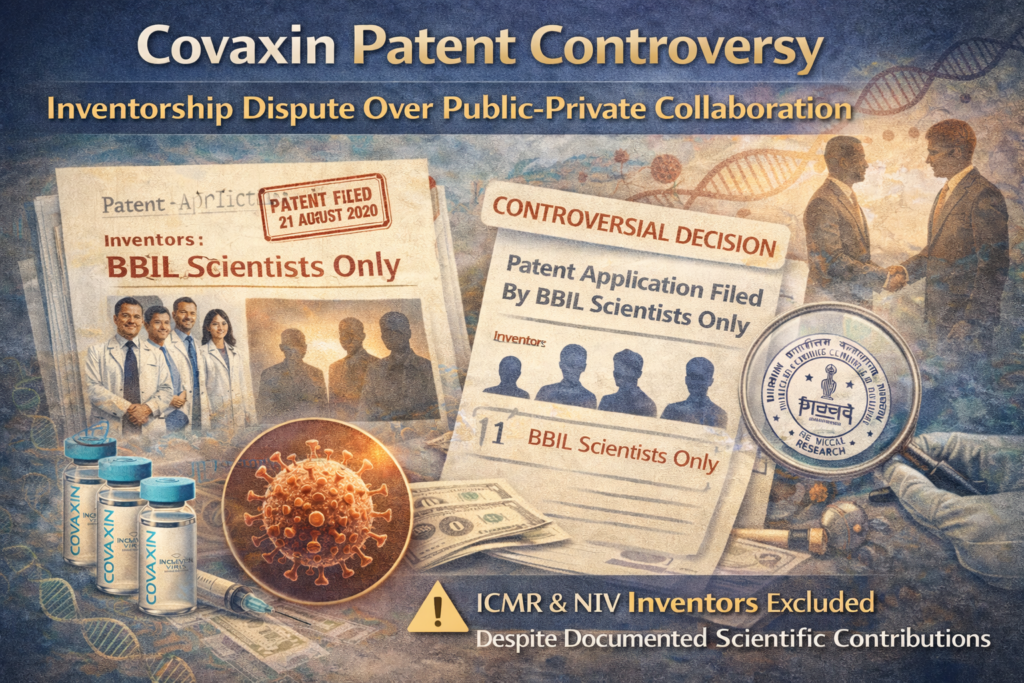
Inventorship under patent law is not a matter of convenience or corporate preference. It is a legal determination based on actual contribution to the inventive concept. Any omission—intentional or otherwise—creates vulnerability in prosecution, enforcement, and licensing.
Timeline of Amendments
First Amendment – July 11, 2024:
Following media scrutiny and objections raised by government authorities, BBIL revised the patent application to include the National Institute of Virology as a co‑applicant and co‑owner. This amendment acknowledged collaborative ownership of the invention.
Second Amendment – August 1–2, 2024:
In a further corrective step, the application was amended again to explicitly include specific NIV scientists as co‑inventors. These changes were reflected through revised statutory filings.
Repeated amendments of this nature are uncommon in high‑value pharmaceutical patents and naturally invite closer legal and commercial scrutiny.
Legal and Financial Dimensions
The Memorandum of Understanding between BBIL and ICMR reportedly provided for joint ownership of intellectual property, while revenue‑sharing arrangements were governed separately. Financial disclosures indicate that ICMR invested approximately ₹35 crore in the development of Covaxin, including around ₹20 crore for Phase‑3 clinical trials. In return, it reportedly received royalty payments of about ₹172 crore.
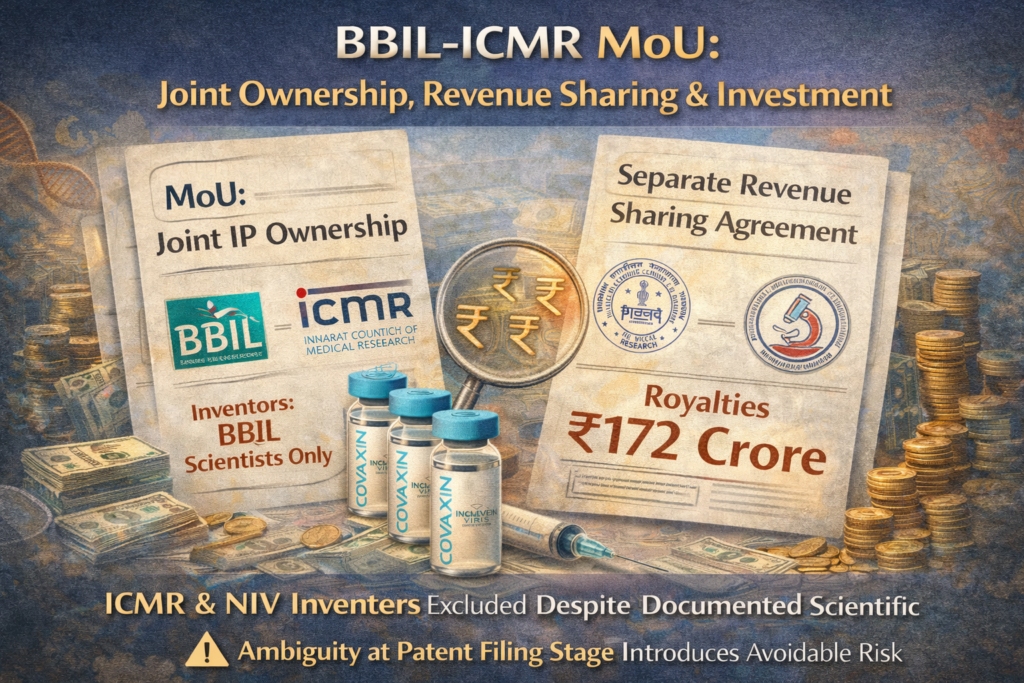
While ownership rights and pecuniary interests can be legally separated, ambiguity at the patent filing stage introduces avoidable risk.
Why Repeated Amendments Matter
From an IP strategy perspective, repeated amendments:
• Raise concerns during investor due diligence
• Attract scrutiny under Section 59 of the Patents Act
• Complicate enforcement and licensing negotiations
• Weaken bargaining positions during technology transfer
In modern biotech, patents are evaluated not only for novelty and inventiveness, but also for transparency, prosecution history, and public accountability.
Lessons for Innovators and R&D Teams
The Covaxin case highlights several critical lessons:
1. Inventorship must be identified correctly at the earliest stage.
2. Public funding demands higher standards of disclosure and transparency.
3. High‑quality drafting at the provisional and complete specification stage reduces long‑term risk.
4. Investors increasingly demand clarity on ownership, amendments, and freedom‑to‑operate.
Impact on India’s Biotech Ecosystem
For startups, academic researchers, and publicly funded innovators, the Covaxin patent saga functions as a cautionary benchmark. It demonstrates how patent strategy, funding structure, legal compliance, and public perception intersect in high‑impact technologies.
How IIPTA Supports Innovators and Patent Aspirants
At the Indian Institute of Patent & Trademark (IIPTA), we focus on bridging the gap between theory and practice. Our training emphasizes:
• Patent drafting aligned with Section 10
• Ownership and inventorship compliance under Sections 20 and 28
• Real‑world prosecution strategy
• Case‑based learning from live biotech disputes
• Patent Agent Examination preparation
• One‑to‑one expert mentoring
The Covaxin patent saga is not merely a controversy, it is a powerful learning tool. It underscores that in high‑stakes innovation, intellectual property strategy must be as robust as the science itself. For innovators and aspiring patent professionals, this case reinforces the importance of accuracy, transparency, and foresight in patent filing and prosecution.