Author: karthik

  • Art Meets Law

    Art Meets Law

    Exploring Intellectual Property at the Intersection of Creativity and Regulation

    In modern era Intellectual Property is one such aspect which is expanding its landscape in wider arena, which is not scientific inventions, trade and services but also in art which is commonly known as creativity, the legal frame work available to protect and promote creativity is through copy right which is equivalent to other aspects of Innovation which are protected as Intellectual Property Rights.
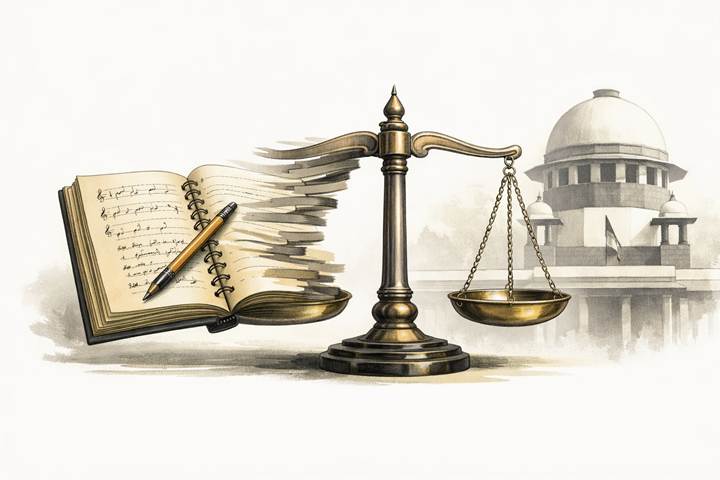
    With an objective to address intersection of art and law is of growing significance in contemporary India. The Centre for Art and Law Initiatives (CALI) hosted a conference “Art Meets Law”in collaboration with RFKN Legal and the German Institute for Art and Law (IFKUR)

    The inaugural Conference, by the , took place on January 31, 2025, at the India International Centre in New Delhi. This event is made landmark by bringing together legal experts, policymakers, and art professionals to explore the intersection of art and law, focusing on themes such as cultural heritage protection, art crime, restitution, and the commercialization of art.

    The main highlights of conference are :

    • Keynote Address: The topic of “Repatriation and Restitution in India” by the Attorney General for India,
    • Distinguished Lectures:
      • “Judicial Insight on Cases Concerning Art Works” by one of the Retd. Justice , Senior Advocate and Former Judge, Patna High Court.
      • “Criminal Aspects of International Art” by , Secretary of Public Prosecutions, Office of the Director of Public Prosecutions (ODPP), Kenya.
      • “Fakes, Forgeries and Art Works” by , Senior Advocate.
      • “Commercial Aspects of Art and Law” by , Director, Institute for Art and Law (IFKUR, Germany).
    • Special Guest Address: “Legal Efforts for the Repatriation of Stolen Art” by Director and Head of Public Prosecution, Kenya.
    • Panel Discussion: “Challenges of Repatriation and Restitution of Art Works”,

    The conference also marked the official launch of CALI, established in 2024 as a hub for dialogue and knowledge exchange on art law in India, aiming to connect artists, legal experts, and policymakers.

    Who were the participants ?

    The event was open to all legal, academic, art, and policy enthusiasts and professionals, with no registration fee.

    Organizer of the Event

    • Centre for Art and Law Initiatives (CALI): Established in 2024, CALI serves as a platform for interdisciplinary engagement on art law in India.
    • RFKN Legal: A global network of lawyers and consultants with expertise in cross-border legal solutions spanning India, Germany, and Kenya.
    • German Institute for Art and Law (IFKUR): Founded in 2006, IFKUR focuses on legal issues in art, cultural property, and related fields, and is renowned for its annual Heidelberg Art Law Days.

    This conference represented a significant step in fostering international collaboration and dialogue on the legal dimensions of art and cultural heritage.

    Relevance of Conference in shedding light on Indian Law which protects Creativity :

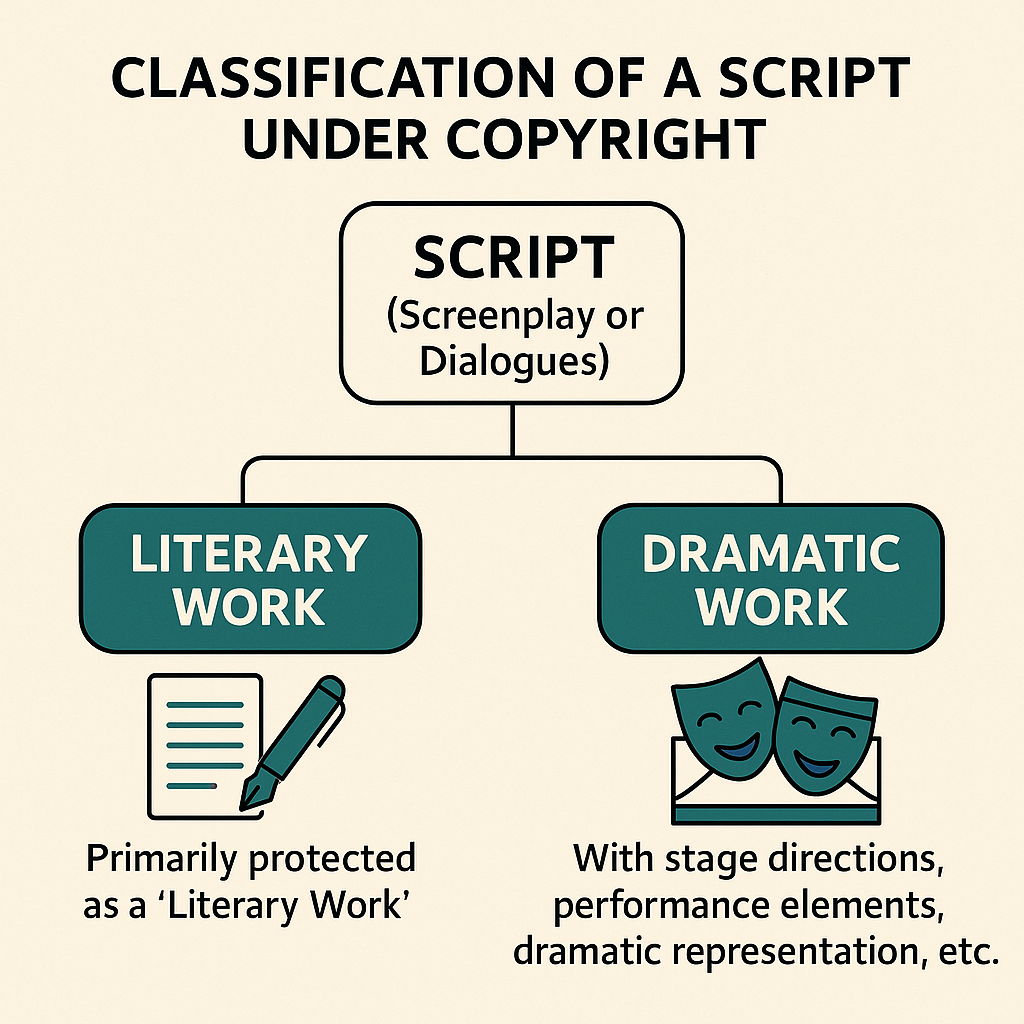
    Artistic works in India are protected through Indian copyright law, as script which includes screenplay and/or dialogues is primarily protected as a “Literary Work”.
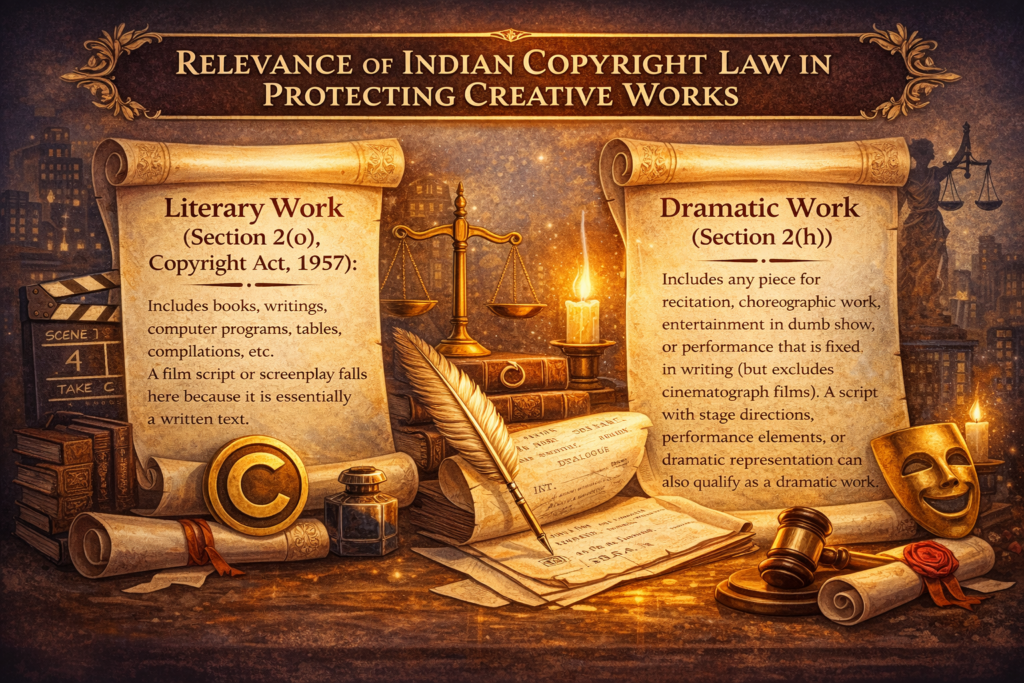
    The provisions are as follows :

    • Literary Work (Section 2(o), Copyright Act, 1957): Includes books, writings, computer programs, tables, compilations, etc. A film script or screenplay falls here because it is essentially a written text.
    • Dramatic Work (Section 2(h)): Includes any piece for recitation, choreographic work, entertainment in dumb show, or performance that is fixed in writing (but excludes cinematograph films). A script with stage directions, performance elements, or dramatic representation can also qualify as a dramatic work.

    ROLE OF IIPTA

    At the Indian Institute of Patent and Trademark (IIPTA), we train students and professionals to understand intellectual property law as it is applied in real-world practice, not as abstract theory. Our programs bridge the gap between creativity and compliance.

    Conclusion :

    In practice, most screenplays and dialogues are registered as literary works, but if the script is meant for performance (like a stage play), it can also be categorized as a dramatic work.

  • Can AI Really Be Regulated by Contracts?

    Can AI Really Be Regulated by Contracts?

    Lessons from The Mirage of AI Terms of Use”

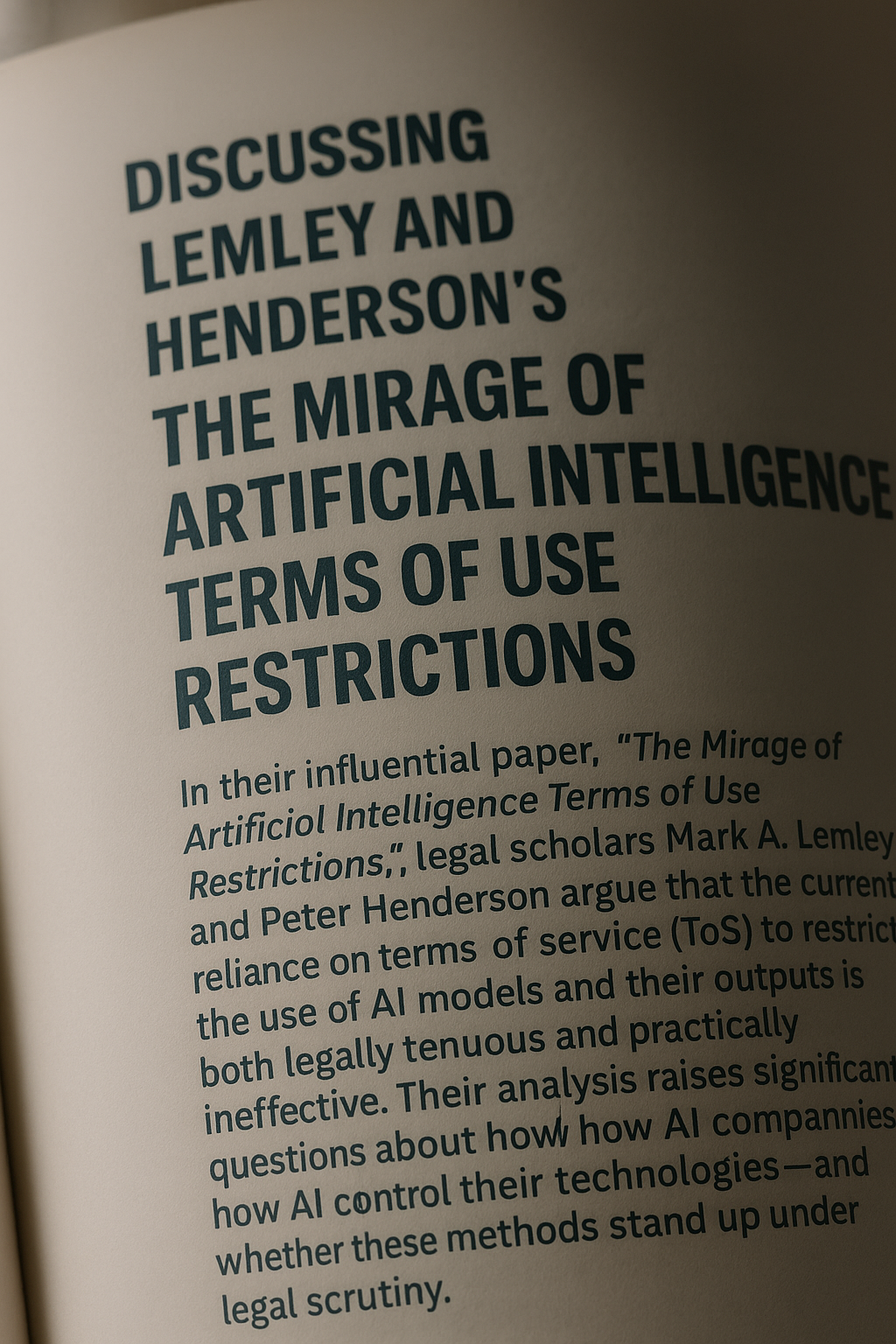
    With an aim to analyze the trends of generative AI, the legal scholars, Mark A. Lemley and Peter Henderson in their influential paper, “The Mirage of Artificial Intelligence Terms of Use Restrictions,” argue that the current reliance on terms of service (ToS) to restrict the use of AI models and their outputs is both legally tenuous and practically ineffective. Where they not only shed light on the present case laws but also forecasted the possible future lawsuits and the lawsuits which are already in process are dealing with violation of copyrights.

    The analysis raises significant questions about how Generative AI firms seek to control their technologies—and whether these methods stand up under legal scrutiny. The paper underscore the terms of use of various models and inquires, which are in the context of the US legal landscape, whether the output-based restrictions contained in the terms of use are whether subject to enforcement. 

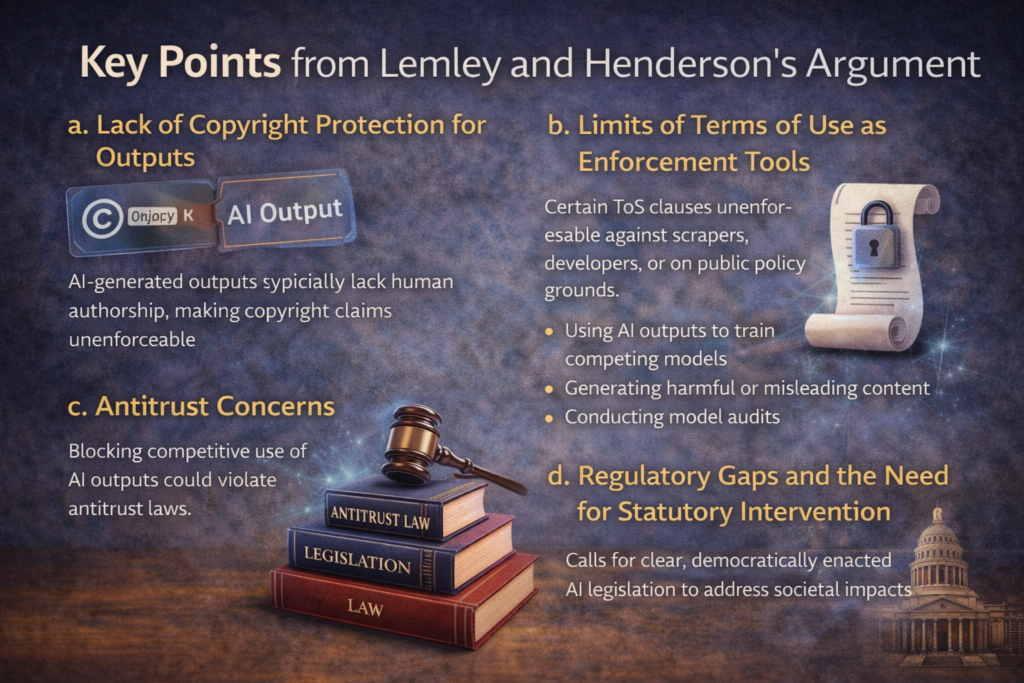
    Key Points from Lemley and Henderson’s Argument

    a. Lack of Copyright Protection for Outputs
    The authors contend that AI-generated outputs are typically not subject to copyright protection under existing U.S. law, as they lack human authorship. As a result, any attempt by AI providers to license these outputs or impose use restrictions through intellectual property claims may lack legal standing.

    b. Limits of Terms of Use as Enforcement Tools
    Lemley and Henderson criticize the reliance on ToS to govern AI usage, especially clauses that prohibit certain activities like:

    • Using AI outputs to train competing models.
    • Generating harmful or misleading content.
    • Conducting model audits or research.

    They pointed that these terms, while binding on users who click “accept,” are unenforceable against those who never agreed to them (such as scrapers or downstream developers). Moreover, many ToS provisions may be overbroad or going against public policy, raising enforceability challenges and issues in court.

    c. Antitrust Concerns

    Restricting users from creating competitive models using publicly available AI outputs may constitute anti-competitive behavior. This could invite scrutiny under U.S. antitrust laws, particularly if dominant AI providers use these terms to block open-source or independent development.

    d. Regulatory Gaps and the Need for Statutory Intervention
    The authors who conclude that private contracts (like ToS) are an insufficient tool for regulating the societal impact of AI. The emphasis for clear, democratically enacted legislation that defines acceptable utilization of AI and enforces transparency, rather than relying on opaque and untested private agreements.

    However, the terms of use for Generative AI companies make for an interesting read.

    The terms of use clarify the ownership of the output generated and how such output whether or not be used.

    For anyone following the barrage of lawsuits filed against these companies, the prominent affirmative defense raised against the allegation of ‘direct copyright infringement’ has been no prize for guessing the obvious – “Fair Use.”

    For instance, in Concord Music Group v. Anthropic, Anthropic, creator of Claude has argued that using copyrighted song lyrics to train an AI model is ‘transformative’ use since the lyrics are not being used for the same end for which they were created. Rather, it is being used to break the lyrics into small tokens to derive statistical weightage.

    Fair use, as a defense, is also being argued in 

    Richard Kadrey v. Meta

    Mike Huckabee v. Bloomberg

    Thomas Reuters v. ROSS Intelligence,

    Paul Lehrman v. LOVO and 

    New York Times Company v. Microsoft Corporation

    So, GenAI companies argue that they can use copyrighted work, without permission, to train their AI model because it is covered by fair use.

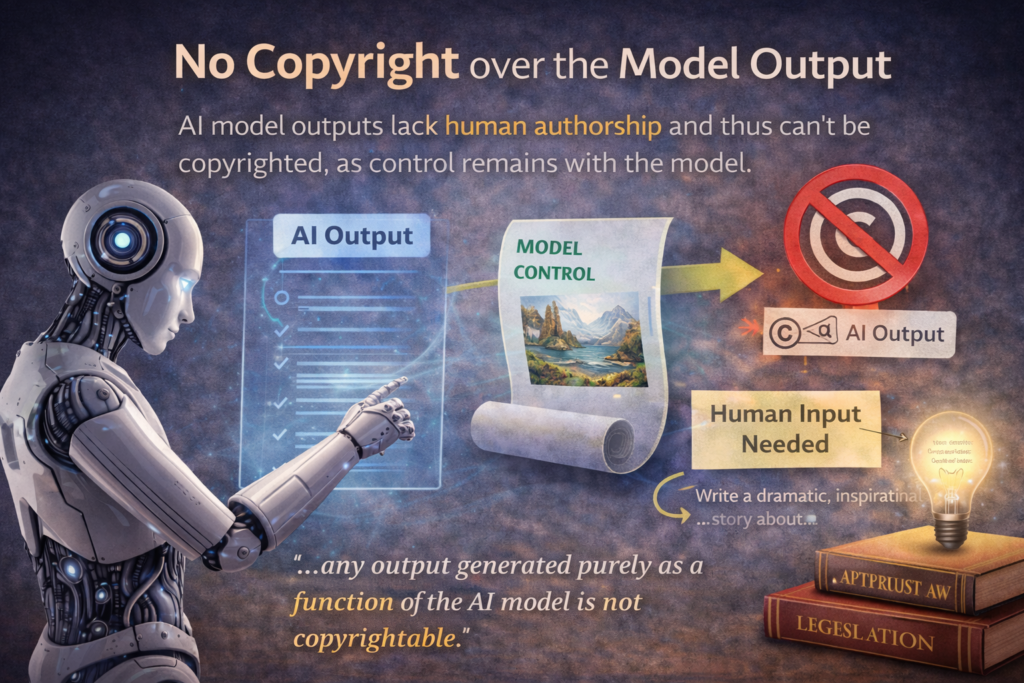
    No copyright over the Model Output

    The authors, main, focus is on the question of the copyrightability of the output generated by an AI model. Relying on US Copyright Office guidelines, the authors argue that model output is not copyrightable since it lacks sufficient human authorship or creative input. The ultimate creative control remains with the model.

    In one of his papers, Lemley, argues that model output could be copyrighted if the user engages in prompt engineering, demonstrating the creative intervention of a human author. Even then, the model creator does not get copyright over the output. Therefore, at the conclusion it has been stated “any output generated purely as a function of the AI model is not copyrightable.”

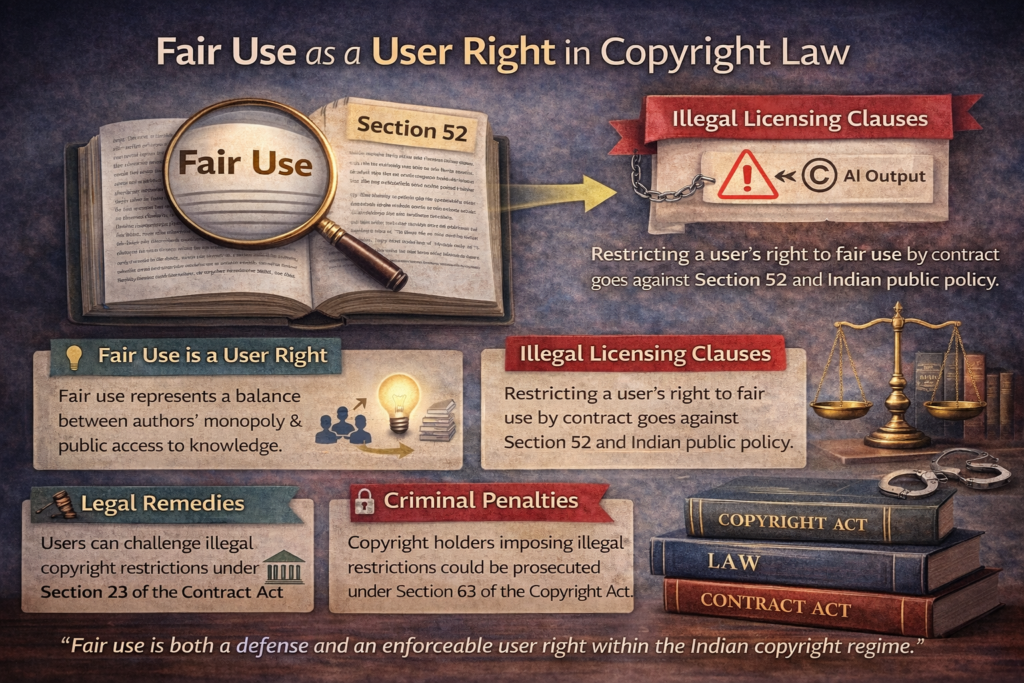
    Extending Monopoly under Copyright Law

    The DHC had said that if a copyright holder imposes restrictive conditions which prohibits someone from doing what is permitted under section 52 (fair use), the same would be illegal and not enforceable. Further, if such illegal conditions are being imposed, a person could pursue independent legal action against the copyright owner to prevent such misuse of copyright. Th fair use of provision, rather than just being a defense to infringement, is also a user right under copyright act. They argue that there is a utilitarian rationale underlying the copyright regime. As a result, the right of fair dealing represents the careful balance between ensuring author’s monopoly as well as dissemination of information and public access to knowledge. Thus, they argue, any contractual or licensing covenant which restrict a user’s right of fair use will likely be held to be void under Section 23 under the Indian Contract Act for being contrary to public policy. Further, such owners imposing these illegal covenants could also be prosecuted under section 63 of the Copyright Act. 

    Broader Implications

    • For AI developers: The paper underscores the importance of crafting more legally sound and ethically robust governance mechanisms.
    • For lawmakers: It calls for public regulation that balances innovation with accountability.
    • For users and researchers: It affirms the legal ambiguity of many current restrictions and highlights the importance of challenging overreach in private licensing.

    Conclusion : The issue of AI governance away from private control toward public law, challenging assumptions about licensing, enforcement, and platform power. For students and practitioners, it underscores a critical lesson Contracts may shape platforms—but they cannot replace law.

  • When Films Borrow Real Identities:

    When Films Borrow Real Identities:

    MSF vs Dharma Productions and the Limits of Artistic Freedom


    INTRODUCTION

    In December 2024, Médecins Sans Frontières (Doctors Without Borders), one of the world’s most respected humanitarian organizations, initiated legal proceedings against Dharma Productions regarding a scene in the film Jigra. The dispute does not revolve around box office performance or cinematic critique, but around a far more sensitive issue: the unauthorized and allegedly misleading use of a real-world humanitarian identity in a fictional narrative.

    This case has attracted attention not merely because it involves a major film production house, but because it raises fundamental questions about trademark law, reputation, artistic freedom, and the legal responsibilities of content creators. For intellectual property professionals, students, and creators, this dispute serves as a contemporary illustration of how IP law quietly but firmly regulates storytelling.

    FACTUAL BACKGROUND OF THE DISPUTE

    According to pleadings placed before the Delhi High Court, a scene in Jigra depicts characters impersonating personnel associated with “Doctors Without Borders / Medics Without Frontiers” to facilitate illegal border crossings. MSF contends that this portrayal creates a false association between the organization and unlawful activities.

    MSF asserts that the use of its name, even without its logo, is sufficient to mislead viewers and damage the organization’s goodwill. Given MSF’s humanitarian role and global reputation for neutrality, even fictional misrepresentation can undermine public trust.

    The Delhi High Court, after hearing preliminary submissions, referred the matter to mediation, signalling judicial preference for amicable resolution while keeping all legal issues open.

    WHY NGOs OCCUPY A SPECIAL POSITION IN TRADEMARK LAW

    Unlike conventional commercial trademarks, humanitarian and non-profit organizations rely almost entirely on reputation and trust. Their marks signify neutrality, safety, and ethical conduct. Any dilution or tarnishment of such marks can have consequences far beyond commercial loss.

    Indian trademark jurisprudence recognises that well-known marks and marks associated with public trust deserve enhanced protection. In cases involving NGOs, courts are particularly sensitive to reputational harm and false association.

    TRADEMARK INFRINGEMENT, PASSING OFF, AND TARNISHMENT

    MSF’s claims potentially fall under multiple legal doctrines:

    • Passing off, where misrepresentation leads the public to believe there is an association or endorsement 
    • Trademark dilution, where the distinctiveness of a well-known mark is weakened 
    • Tarnishment, where a mark is linked with illegal or unethical conduct 

    Importantly, Indian courts have held that even non-commercial or narrative use may be actionable if it damages goodwill or causes confusion.

    ARTISTIC FREEDOM AND ITS LEGAL LIMITS

    Indian constitutional jurisprudence protects freedom of expression, including artistic expression. However, such freedom is not absolute. Courts routinely balance creative liberty against competing rights such as reputation, privacy, and intellectual property.

    When a real and identifiable entity is portrayed as engaging in unlawful conduct, the defence of artistic freedom becomes significantly weaker. The law does not prohibit fictional storytelling; it regulates irresponsible representation.

    NOMINATIVE USE: WHY THE DEFENCE MAY FAIL

    A common defence in such disputes is nominative fair use — using a trademark merely to identify the entity. However, nominative use is permissible only when:
    • The reference is necessary 
    • No endorsement is implied 
    • The use is minimal 

    In Jigra, the allegation involves impersonation and narrative reliance on the MSF identity, which goes beyond incidental reference.

    WHY THE COURT CHOSE MEDIATION

    The Delhi High Court’s referral to mediation reflects practical judicial reasoning. Film-related disputes often resolve through:
    • Scene edits 
    • Disclaimers 
    • Muted references 
    • Modified dialogue 

    Such outcomes preserve creative expression while safeguarding reputation, without entering prolonged litigation.

    IMPLICATIONS FOR FILMMAKERS AND CONTENT CREATORS

    This dispute sends a clear message:
    • Real organizations are not free narrative tools 
    • Script clearance is a legal necessity 
    • Disclaimers are not absolute shields 
    • Reputation-based claims are real and enforceable 

    Failure to address these issues at the scripting stage can result in injunctions, edits, and reputational fallout.

    LEARNINGS FOR IP STUDENTS AND PROFESSIONALS

    For students of intellectual property law, this case demonstrates:
    • Practical application of passing off principles 
    • Balance between speech and trademark rights 
    • Protection of non-commercial goodwill 
    • Judicial preference for proportionate remedies 

    This is not theoretical law; it is applied to IP governance.

    CONCLUSION

    The MSF vs Dharma Productions dispute underscores a fundamental principle: creative freedom thrives within legal boundaries. Intellectual property law does not silence storytelling; it ensures accountability.

    As films increasingly draw from real-world institutions, legal diligence becomes as essential as creative vision. For creators and lawyers alike, this case serves as a timely reminder that reputation, once compromised, is difficult to restore.

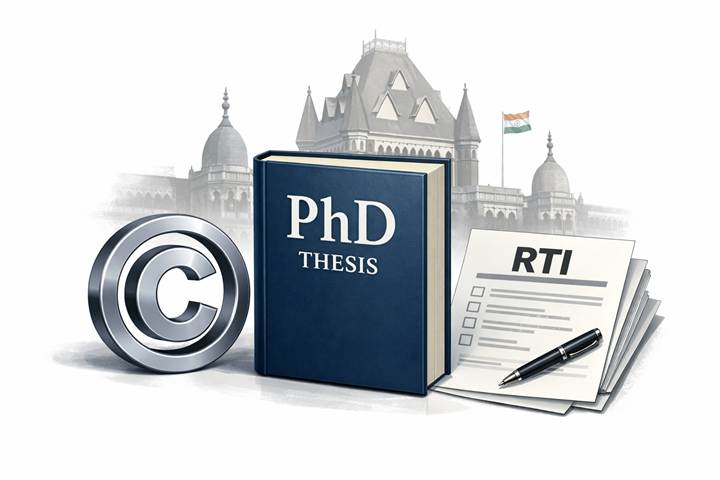
  • Can Copyright Be Used to Block RTI? Delhi High Court Draws the Line on Access to PhD Theses

    Can Copyright Be Used to Block RTI? Delhi High Court Draws the Line on Access to PhD Theses

    When academic copyright collides with the public’s right to know

    Introduction: When Two Powerful Laws Collide

    Indian intellectual property law does not operate in isolation. It frequently intersects with constitutional values, transparency obligations, and public interest considerations.

    One such intersection came before the Delhi High Court, where the Court was asked to resolve a deceptively simple but legally complex question:

    Can a PhD scholar prevent public access to a thesis submitted to a public university by invoking copyright and future commercial interests?

    The answer has significant implications for:

    • Researchers
    • Universities
    • IP professionals
    • RTI practitioners

    Background of the Case: Thesis, RTI and Refusal

    An RTI application was filed seeking access to a PhD thesis submitted to Jamia Millia Islamia University, a public authority under the RTI Act, 2005.

    The request was denied at multiple levels on the ground that:

    • The thesis was kept in “absolute safe custody”
    • Disclosure could harm the commercial interests of the scholar
    • The scholar had already obtained a US patent and intended to seek an Indian patent

    The Central Information Commission (CIC) upheld the denial under Section 8(1)(d) of the RTI Act.

    The Core Legal Conflict Explained Simply

    At the heart of the dispute was a clash between two rights:

     Right to Access Information (RTI Act)

                             vs

    Right to Communicate the Work (Copyright Act)

    The legal issue was not whether copyright subsists in a thesis.

    The real issue was:

    Does copyright give an author the power to block access to a public record?

    Delhi High Court’s Findings: Law Beyond Labels

    Justice Sanjeev Narula overturned the CIC’s order and clarified several critical principles.

    1. A PhD Thesis Is “Information” Under RTI

    A thesis maintained by a public university clearly falls within the definition of “information” under Section 2(f) of the RTI Act.

    Calling it “academic” or “copyrighted” does not remove it from RTI scrutiny.

    2. Section 8(1)(d) Is a Conditional Exemption

    For this exemption to apply:

    • The information must be of commercial confidence / IP
    • Disclosure must harm competitive position

    The Court held:

    • Speculative future commercial exploitation is not enough
    • No concrete evidence of harm was shown

    Copyright Law: Is the Right Absolute?

    The scholar’s argument implicitly relied on Section 14(a)(iii) of the Copyright Act — the exclusive right to communicate the work to the public.

    However, the Court’s reasoning makes three things clear:

    Academic Submission Creates an Implied Licence

    University regulations and UGC guidelines require:

    • Submission
    • Archiving
    • Digital availability (INFLIBNET)

    This establishes a non-exclusive licence in favour of the university.

    Copyright Is Not an Absolute Monopoly

    Section 14 is subject to:

    • Section 52 (fair dealing)
    • Compulsory licensing provisions

    Importantly:

    • Section 52 permits use for private study and research
    • RTI provides the access mechanism for such use

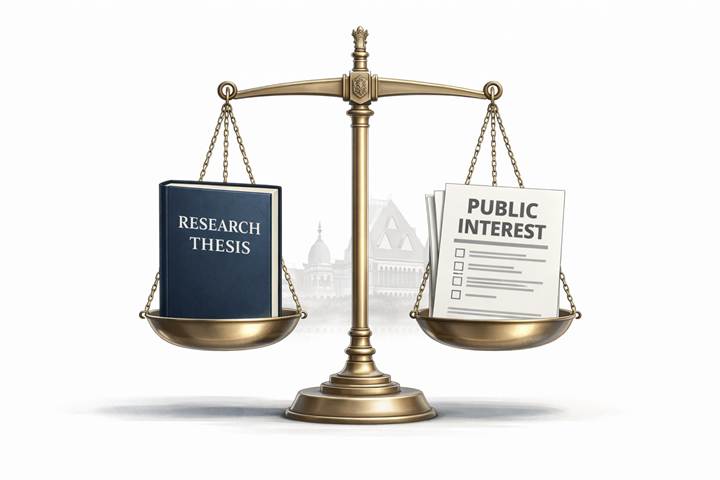
    Public Interest: The Deciding Factor

    Even where an exemption arguably applies, Section 8(2) of the RTI Act mandates disclosure if public interest outweighs private interest.

    The Court noted:

    • The thesis was meant for public dissemination
    • It had been previously accessible
    • Denial of access was therefore arbitrary

    The judgment reinforces a fundamental principle:

    Copyright protects economic exploitation — not secrecy.

    What This Judgment Teaches IP Professionals

    Key Learnings

    • Copyright cannot be used to suppress public records
    • RTI and IP law must be read harmoniously
    • Academic IP carries higher transparency obligations
    • Public interest remains the ultimate balancing test

    Why This Case Matters Beyond One Thesis

    This ruling raises larger questions:

    • Should academic work be treated like commercial IP?
    • How far does the right to research extend in India?
    • Can universities continue vague IP policies?

    For IP practitioners, this case is a reminder that IP strategy without public law awareness is incomplete.

    About IIPTA

    At the Indian Institute of Patent and Trademark (IIPTA), we train professionals to understand intellectual property not just as statutes, but as living rights that interact with public policy, transparency, and innovation.

    Want to build real IP expertise?

    • Learn copyright with practical interpretation
    • Understand IP–RTI intersections
    • Train under practitioners, not note-makers

     Explore IIPTA’s IP training programs and expert-led courses

  • Manoj Muntashir, Copyright Law and the Myth of Originality

    Manoj Muntashir, Copyright Law and the Myth of Originality


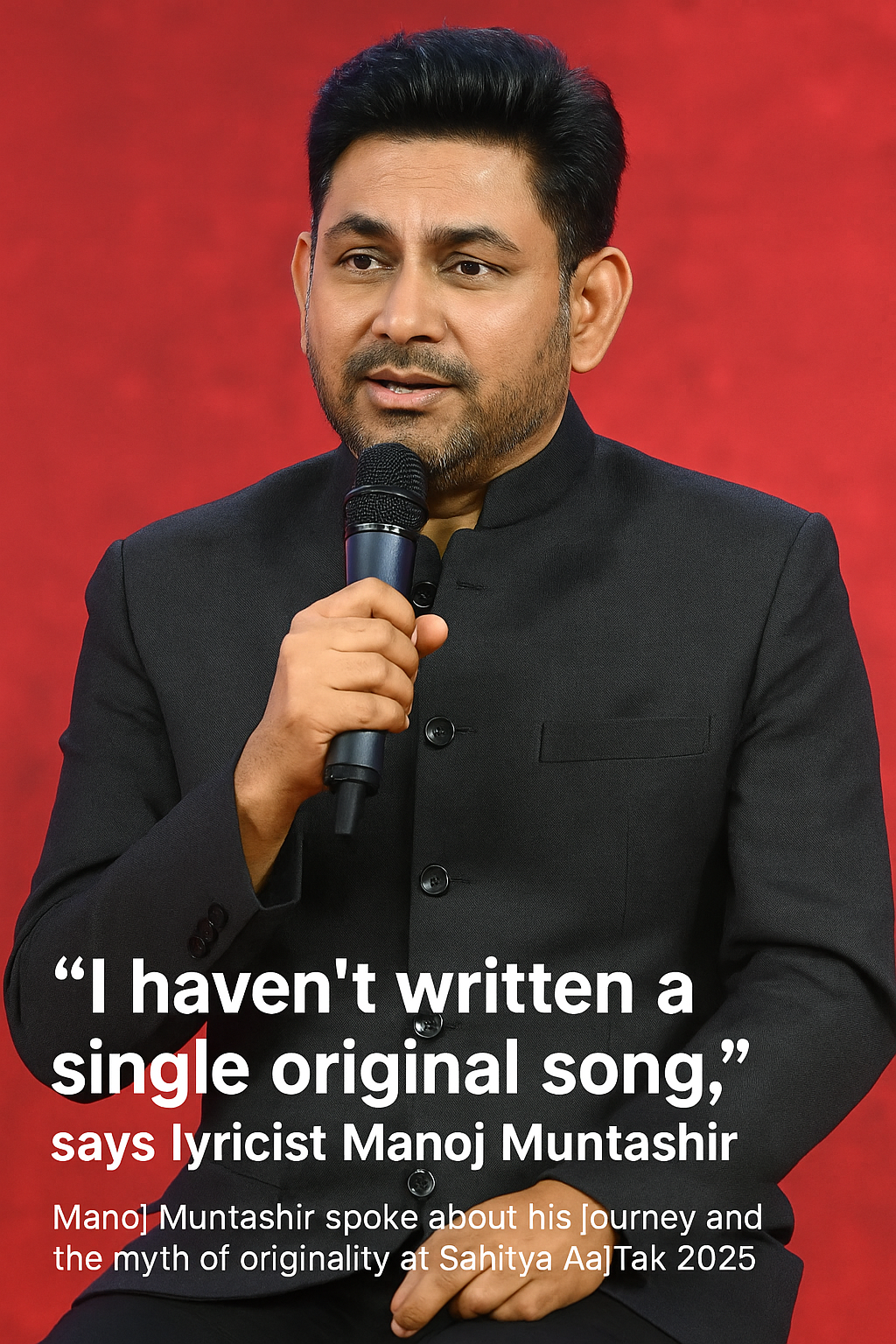
    At Sahitya AajTak 2025, lyricist and screenwriter Manoj Muntashir made a statement that resonated far beyond the literary audience present at the event. When he said, “I haven’t written a single original song,” it was not an act of humility or provocation, but a legally and philosophically accurate reflection of how creativity truly functions.

    This article analyses that statement through the lens of Indian copyright law, creative jurisprudence, and industry practice, offering deeper insights for creators, legal professionals, students, and institutions.

    CREATIVITY AS A CONTINUUM, NOT AN ISOLATED ACT

    Indian copyright law has never demanded novelty in the sense used in patent law. Creativity, in copyright, is cumulative. Authors build upon cultural memory, linguistic traditions, and lived experiences. Courts have consistently recognised that human creativity is evolutionary, not revolutionary.

    Originality under the Copyright Act, 1957 merely requires independent creation with minimal creativity. It does not require that the work be unprecedented.

    A graphic of a light bulb and a shield with music notes

AI-generated content may be incorrect.IDEA–EXPRESSION DICHOTOMY

    One of the most misunderstood principles in copyright law is the idea–expression dichotomy. While ideas are free for all, expressions are protected. Manoj Muntashir’s statement fits squarely within this framework. A lyricist may draw from emotions, folklore, poetry, or even earlier songs, but the final lyrical expression must bear the author’s individual imprint.
    INSPIRATION VS INFRINGEMENT

    Inspiration is lawful when it involves absorption and reinterpretation. Infringement occurs when there is substantial and material copying of protected expression. Indian courts apply the test of substantial similarity, focusing on whether an average listener or reader can recognize copying.

    PLAGIARISM AND COPYRIGHT INFRINGEMENT

    Plagiarism is an ethical concern, while copyright infringement is a legal violation. A work may be criticised as plagiarised even if it does not meet the threshold of infringement. This distinction is crucial for creators operating in the public eye.

    MORAL RIGHTS AND AUTHORSHIP

    Section 57 of the Copyright Act safeguards the moral rights of authors, including the right of attribution and the right to object to distortion. Even when economic rights are assigned, moral rights subsist.

    DIGITAL AGE CHALLENGES

    With streaming platforms, remixes, sampling, and AI-assisted creation, questions of originality and ownership have become more complex. Contracts, registrations, and rights management are now more important than ever.

    LEARNINGS FOR STUDENTS AND PROFESSIONALS

    • Creativity is cumulative
    • Law protects expression, not ideas
    • Attribution remains a legal right
    • Contracts define ownership
    • Registration strengthens enforcement

    ROLE OF IIPTA

    At the Indian Institute of Patent and Trademark (IIPTA), we train students and professionals to understand intellectual property law as it is applied in real-world practice, not as abstract theory. Our programs bridge the gap between creativity and compliance.

    CONCLUSION

    Manoj Mutahir’s statement dismantles the myth of absolute originality. Copyright law does not punish influence; it protects transformation. Understanding this distinction is essential for anyone working in creative or legal industries.

  • WIPO Translate Expands to 18 Languages

    WIPO Translate Expands to 18 Languages

    A Game-Changer for Global Patent Research

    World Intellectual Property Organisation, (WIPO) The World Intellectual Property Organization (WIPO) is the United Nations agency that serves the world’s innovators and creators, ensuring that their ideas travel safely to the market and improve lives everywhere.

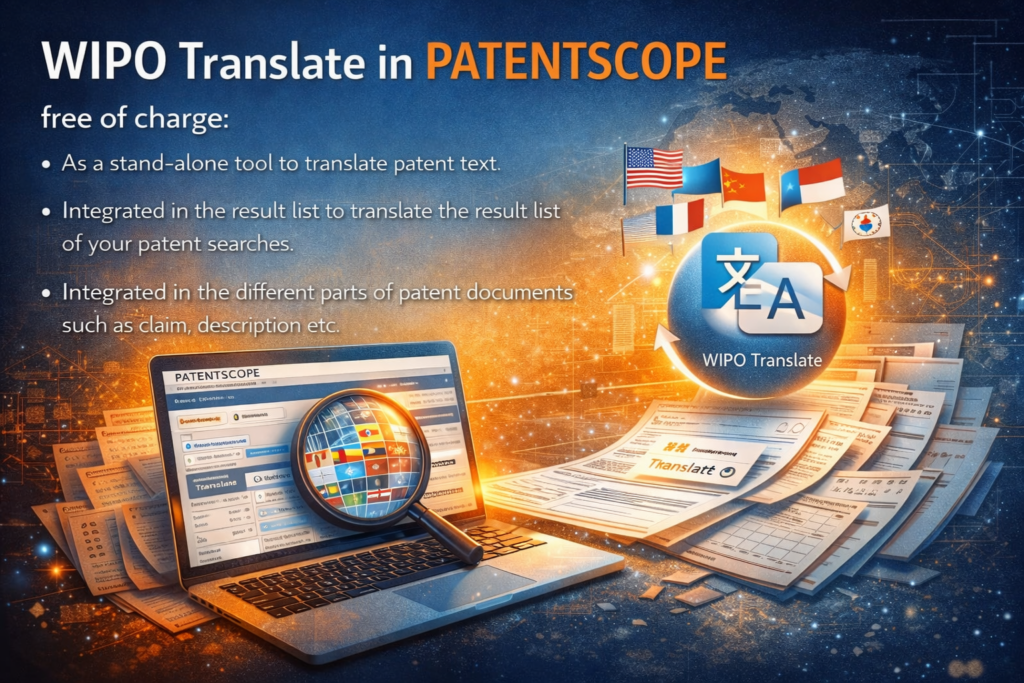
    WIPO Translate is available in WIPO’s global patent database PATENTSCOPE free of charge: As a stand-alone tool to translate patent text. Integrated in the result list to translate the result list of your patent searches. Integrated in the different parts of patent documents such as claim, description etc.

    WIPO Translate is an AI-powered neural machine translation tool developed by the World Intellectual Property Organization (WIPO). It is specifically trained on patent documents to provide accurate translations of technical content. Integrated into PATENTSCOPE, WIPO Translate enables users to translate various parts of patent documents, including:

    • Titles
    • Abstracts
    • Descriptions
    • Claims
    • Full-text content

    This functionality allows users to access and understand patent information across different languages, facilitating global research and innovation.

    Creators and innovators worldwide use IP to translate their ideas into assets. These properties create economic and social benefits that improve the lives of people everywhere.

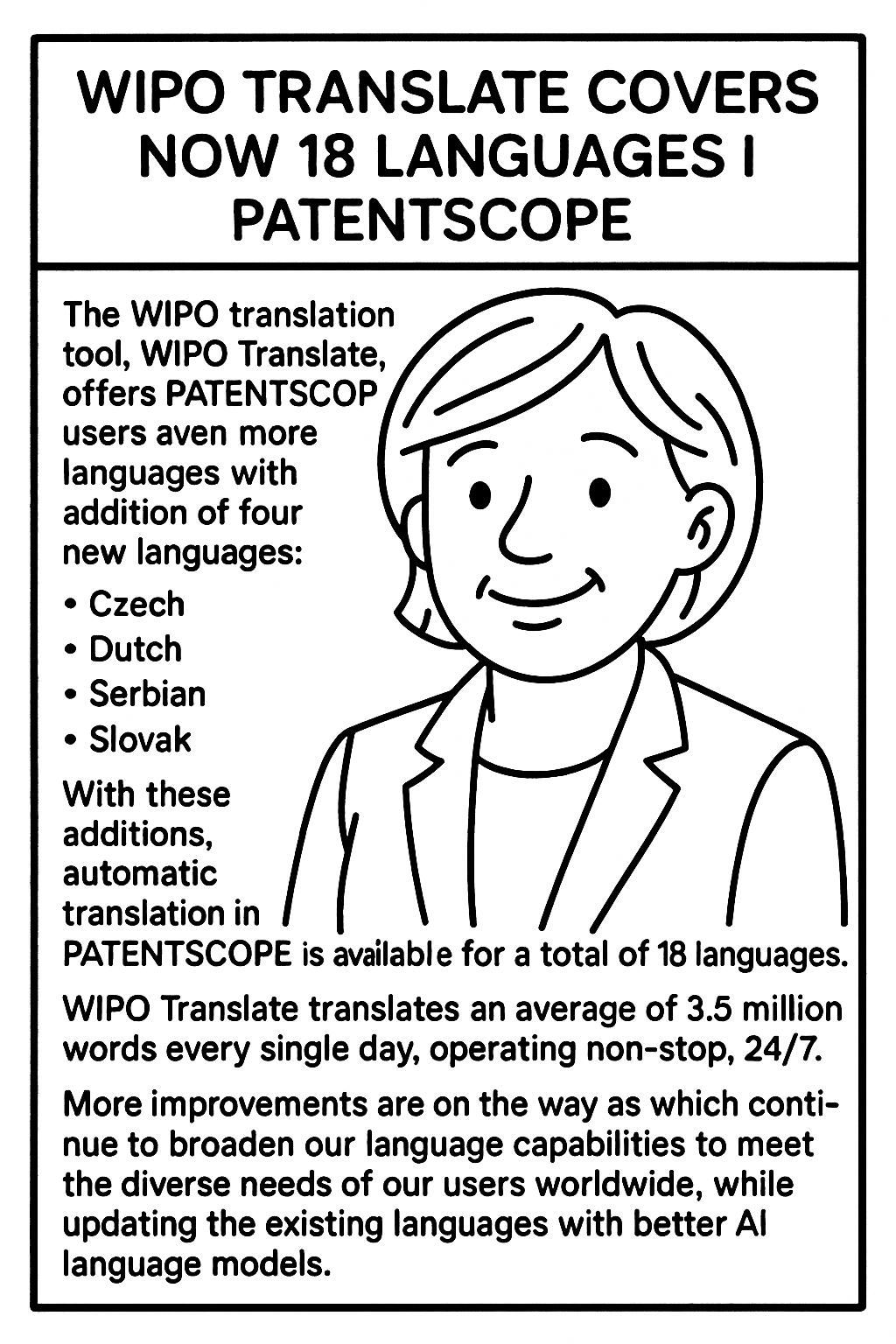
    The WIPO translation tool, WIPO Translate, offers PATENTSCOPE users even more languages with the addition of four new languages:

    • Czech
    • Dutch
    • Serbian 
    • Slovak 

    With these additions, automatic translation in PATENTSCOPE is available for a total of 18 languages.

    WIPO Translate translates an average of 3.5 million words every single day, operating non-stop, 24/7.

    To put this into perspective, that’s equivalent to translating the entire text of about 7,000 standard-length novels daily – assuming an average of 500 words per page and 100 pages per novel. 

    More improvements are on the way as which continue to broaden our language capabilities to meet the diverse needs of our users worldwide, while updating the existing languages with better AI language models

    Highlights

    • Expanded Language Support: With the recent additions, WIPO Translate now covers 18 languages, enhancing accessibility for a broader user base.
    • High Translation Volume: The tool translates an average of 3.5 million words daily, operating continuously to meet user demands.
    • User-Friendly Interface: Translations are seamlessly integrated into the PATENTSCOPE platform, allowing users to view translated content directly within search results and document views.

    How to Use WIPO Translate in PATENTSCOPE

    1. Access PATENTSCOPE: Navigate to PATENTSCOPE
    2. Perform a Search: Use the search functionality to find patent documents of interest.
    3. View Translations: In the search results or within a specific patent document, look for translation options to view content in your preferred language.

    This integration of WIPO Translate into PATENTSCOPE significantly enhances the ability of users worldwide to access and comprehend patent information, promoting greater collaboration and innovation across linguistic boundaries.

    Broader Implications

    1. Geographic inclusion: Addition of Czech, Slovak, Serbian, and Dutch widens access for Central/Eastern Europe and Benelux markets.
    2. AI in IP: WIPO Translate’s reliance on neural machine translation reflects the growing role of AI in legal/technical domains.
    3. Equity in IP: Smaller players and developing economies benefit most, as they gain cheaper access to multilingual patent data.
    4. Quality vs. speed tradeoff: While translations broaden reach, patent litigation or licensing still requires human-verified translations.
    5. Future trajectory: As AI language models improve, the scope may expand to more Asian and African languages, further democratizing global IP access.


    The expansion of WIPO Translate to 18 languages in PATENTSCOPE strengthens transparency, inclusivity, and efficiency in the global patent system. It lowers barriers for SMEs, examiners, and researchers while creating new strategic considerations for large firms and translation professionals.

    More than a technical enhancement—it is a structural shift in how different IP stakeholders’ access, interpret, and leverage global patent information. Its ripple effects are being felt across the entire innovation ecosystem.

    Impact on Innovators & Startups

    Language barriers often restricted prior-art searches to English-centric databases, increasing risks of accidental infringement or weak patents.

    Startups and MSMEs gain competitive parity with large corporations in global patent intelligence.

     Due to:

    •  Easier access to patent literature from China, Japan, Korea, Europe, and emerging economies
    • Improved novelty and inventive-step assessments
    • Reduced dependency on costly professional translations in early-stage R&D

    Impact on Researchers & Academic Institutions

    A Landscape shift, academic research becomes more globally informed, reducing duplication and accelerating innovation.

    For universities and public research institutions:

    • Easier access to global technological trends
    • Better mapping of white spaces and research gaps
    • Stronger technology-transfer and commercialization strategies

    How IIPTA uses such Cases in Training

    At the Indian Institute of Patent and Trademark (IIPTA), update of global like WIPO are used to teach:

    Students to have track on global database with latest or recent updates

    Wider knowledge about stakeholders of global landscape.

    Using the database of WIPO to understand the content in convenient language.

    Conclusion: Updating with current trends is an opportunity opens plethora of opportunity in IPR landscape in terms of reaching underserved potential areas of Research and Development

    Since most part of the world is remaining underserved or unserved in terms converting intellect into asset because of language barrier the move from WIPO is one of the objective where both creators and innovators worldwide use IP to translate their ideas into assets. At large these properties create economic and social benefits that improve the lives of people everywhere.

  • From Faster Wi-Fi to Stronger IP

    From Faster Wi-Fi to Stronger IP

    What Innovators Can Learn from the Samsung Verdict

    In the era of Industrial Revolution 4.0 wi-fi made conduct of business easier and the features of Wi-Fi and the science behind it is as follows,  Wi-Fi (Wireless Fidelity) technology uses radio waves to provide high-speed internet and network connections wirelessly, allowing devices like phones, laptops, and smart TVs to communicate without cables. It works by a router broadcasting signals (using 2.4 GHz, 5 GHz, or 6 GHz bands) that your device picks up, establishes a connection, authenticates, and then receives an IP address to access the internet or other devices. 

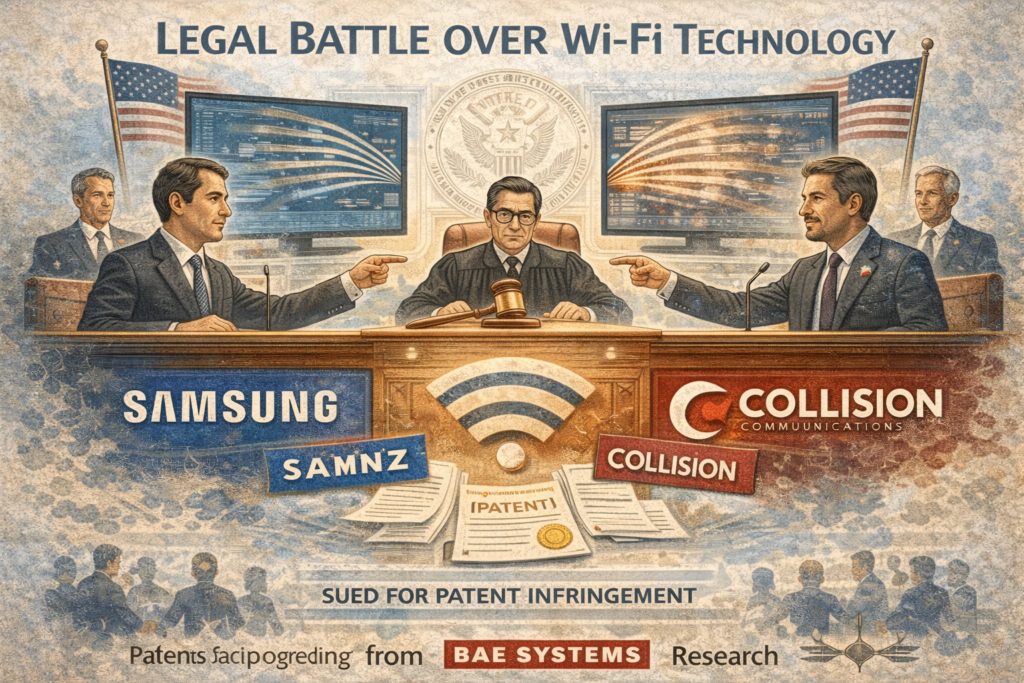
    The Wi-Fi technology has become tug war between tech giants the scenario of the case is Peterborough, New Hampshire-based Collision sued Samsung in 2023 for infringing patents related to improving wireless network efficiency. Collision said in the lawsuit that the patents stemmed from research conducted by defense contractor BAE Systems, which is not involved in the case.

    The jury determined that Samsung’s mobile phones, tablets, and other devices incorporated Headwater’s patented technology without authorization. Samsung has denied the allegations and contested the validity of the patents. The case was heard in the U.S. District Court for the Eastern District of Texas, known for its history of patent litigation.

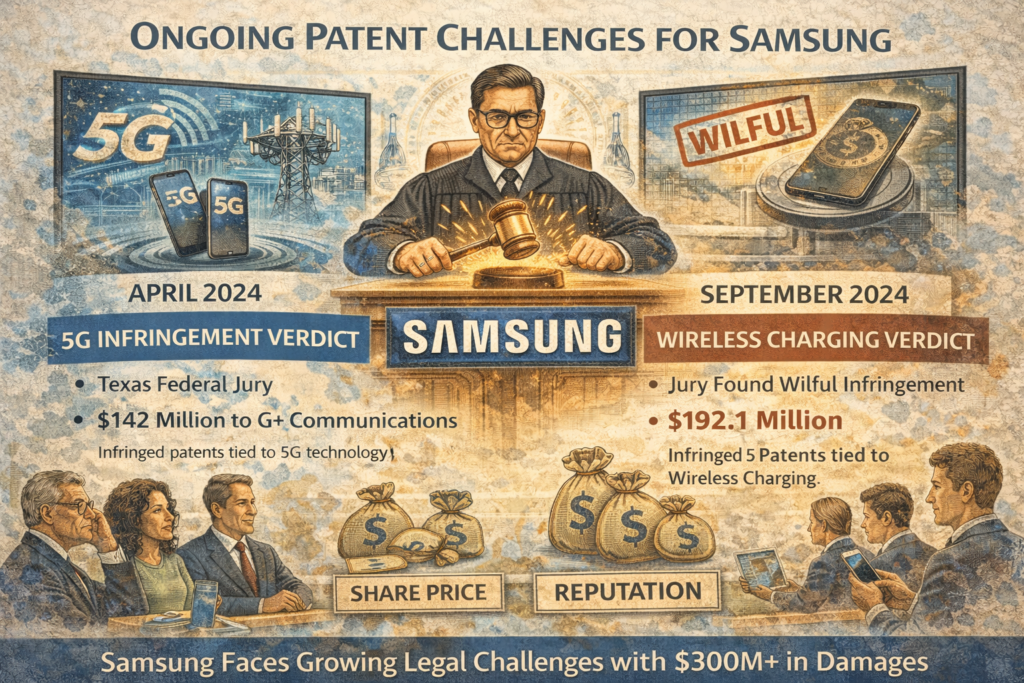
    Samsung Electronics has been ordered to pay $278.7 million in damages after a U.S. federal jury found that the company infringed upon two wireless communication patents held by Headwater Research LLC. These patents pertain to technology that enhances Wi-Fi speed and reliability, reduces data usage, alleviates network congestion, and extends battery life in mobile devices.

    This verdict adds to a series of significant patent-related legal challenges faced by Samsung. In April 2024, a Texas federal jury ruled that Samsung owed $142 million to G+ Communications for infringing upon patents related to 5G wireless technology in its Galaxy smartphones. Additionally, in September 2024, another jury found that Samsung infringed upon five patents related to wireless device charging, resulting in a $192.1 million verdict. In that case, the jury also found the infringement to be wilful, which could lead to the award being tripled.

    Samsung has the right to appeal these decisions. The company has not yet commented on the latest verdict, and the legal proceedings are ongoing.

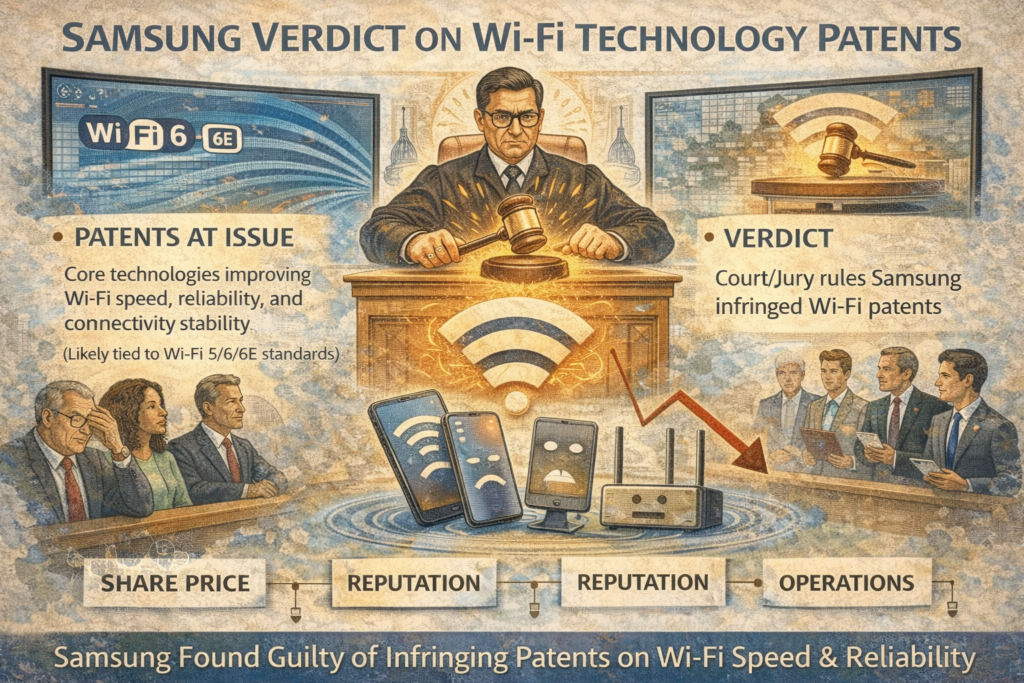
    The Samsung verdict concerning patents related to Wi-Fi speed and reliability and its stakeholder impact:

    • Patents at issue: Concern core technologies improving Wi-Fi performance, specifically speed, reliability, and connectivity stability (likely tied to Wi-Fi 5/6/6E standards).
    • Verdict: A court/jury has ruled on patent infringement claims against Samsung (details vary by jurisdiction, but such cases often involve SEPs or implementation patents within wireless standards).

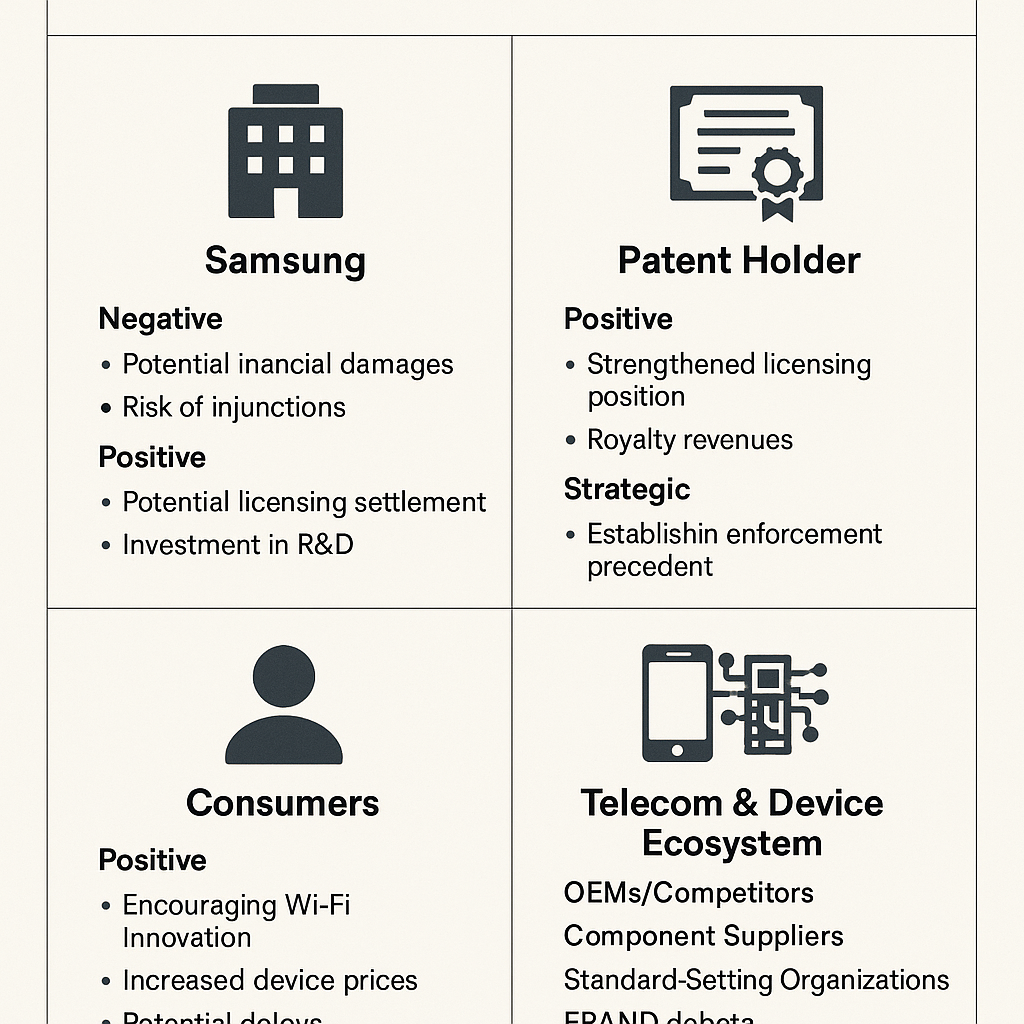
     Implications of the Verdict :

    A. Samsung

    • Negative:
      • Potential financial damages (royalties, settlements, or penalties).
      • Risk of injunctions in certain jurisdictions restricting product sales.
    • Positive (long-term):
      • May negotiate a licensing settlement to ensure freedom to operate (FTO) for its Wi-Fi-enabled devices.
      • Could also push Samsung to invest in homegrown R&D to avoid future dependency on third-party patents.

    B. Patent Holder (Plaintiff)

    • Positive:
      • Strengthens licensing position, validating its R&D investment.
      • Gains royalty revenues and stronger leverage in future licensing negotiations with Samsung and other manufacturers.
    • Strategic:
      • Establishes precedent for enforcing Wi-Fi-related patents in other jurisdictions.

    C. Consumers

    • Positive:
      • Verdict may encourage further innovation in Wi-Fi technologies, leading to better connectivity standards.
    • Negative:
      • Possible increase in device prices if Samsung passes on royalty/licensing costs to consumers.
      • Short-term delays in availability of certain Wi-Fi-enabled Samsung devices if injunctions are imposed.

    D. Telecom & Device Ecosystem

    • OEMs/Competitors: The verdict signals increased enforcement of Wi-Fi-related patents, meaning other companies may also face lawsuits unless they secure licenses.
    • Component Suppliers: May see new compliance requirements, including ensuring modules are licensed for use.
    • Standard-Setting Organizations (SSOs): This could reignite the FRAND (Fair, Reasonable, and Non-Discriminatory) debate if the patents are standard-essential patents (SEPs).

    E. Courts & Regulators

    • Courts: Reinforce the enforceability of Wi-Fi patents, shaping case law in the wireless sector.
    • Regulators: May monitor whether enforcement aligns with FRAND commitments, to prevent anti-competitive practices.

    F. Investors

    • Samsung: Short-term uncertainty due to damages/penalties, but potential for long-term stability once licensing agreements are in place.
    • Patent Holder: Positive impact on valuation, as validated patents increase bargaining power and royalty income streams.

    The Samsung Wi-Fi patent verdict underscores the critical role of wireless SEPs in today’s connected ecosystem.

    • Samsung faces financial/legal pressures but may secure stability through licensing deals.
    • Patent holders gain stronger leverage in Wi-Fi SEP enforcement.
    • Consumers benefit from stronger innovation incentives, but may face higher costs.
    • Ecosystem players must adapt to heightened scrutiny on Wi-Fi SEPs and FRAND obligations.

    What Innovators & R&D Teams Should Learn from This Case

    Disclose Completely

    A tech patent MUST include:

    • Aligning inventions with standards can transform patents into Standard Essential Patents (SEPs)
    • SEPs which create long-term licensing leverage, even beyond product cycles.

    Draft Claims Smartly Not Broadly but with Technical Depth Wins Legal Battles

    Patent drafting is not paperwork—it’s engineering storytelling. Courts reward patents that translate complexity into clarity.
    Smart claims:

    • Match the description
    • Are precise
    • Highlight inventive steps
    • Exclude natural organisms
    • Strong linkage between claims and real-world performance outcomes
    • Robust technical evidence showing how the invention improves Wi-Fi speed or reliability
    • Defensive IP Is as Important as Offensive IP

    Build IP not just to sue, but to survive cross-licensing wars, especially in connectivity, telecom, and electronics.

    Samsung’s portfolio strength helped:

    • Deter counter-claims
    • Strengthen negotiation position
    • Support enforcement without appearing opportunistic
    • Impact on Startups & Researchers

    This judgment signals that:

        For innovators, the message is simple but urgent:

    • Innovate deeply
    • Patent early
    • Draft precisely
    • Think beyond products—think platforms and standards

    For startups, researchers, and companies, Samsung’s portfolio strength helped:

    • Startups working on networking, IoT, smart devices, or edge computing should treat Wi-Fi innovation as strategic IP terrain, not generic plumbing.
    • Synchronize R&D timelines with IP strategy—especially when working on next-gen Wi-Fi (Wi-Fi 6/6E/7).
    • Innovators should monitor standards bodies early and file patents before technical features become mandatory.
    • Think beyond products—think platforms and standards

     How IIPTA Helps Biotech Innovators & Students
    At IIPTA (Indian Institute of Patent & Trademark),use this type of case law to train :

    • Innovators
    • R&D teams
    • Startups
    • Students
    • IT professionals

    To understand 

    Patent drafting, Section 3 and Section 10   compliance, and global patent trends

    The grounds for opposition Section 25

    Precaution regarding infringement according to Section 48,through awareness in dimensions of

    •  Patent drafting training
    •  Patent agent exam preparation
    •  Real case-law analysis
    •  One-to-one expert guidance
    •  Hands-on practice with live biotech cases
    • Prior Art Search
    • Patentability Analysis
    • FTO Analysis
    • Infringement Analysis

    Conclusion : The Samsung Wi-Fi patent verdict is more than a courtroom win—it is a strategic blueprint for technology innovators navigating fast-moving, standards-driven industries like wireless communication in terms of both invention and innovation.

  • Overcoming Obstacles: Securing IPR for Computer-Related Inventions (CRIs) in India

    Overcoming Obstacles: Securing IPR for Computer-Related Inventions (CRIs) in India

    Introduction: Why CRIs Remain the Most Misunderstood Patent Category in India

    Computer-Related Inventions (CRIs) occupy the most contentious space in Indian patent law. Despite technological sophistication and commercial relevance, a significant number of CRI applications fail—not due to lack of innovation, but due to how the invention is positioned before the Indian Patent Office.

    This article examines the real obstacles in securing IPR for CRIs in India and, more importantly, the strategies that consistently work in practice.

    Legal Framework & Patentability Hurdles

    The Statutory Barrier

    Section 3(k) of the Indian Patents Act, 1970 excludes:

    “a mathematical or business method or a computer program per se or algorithms”

    In practice, this provision is often interpreted conservatively, leading to mechanical rejections of software-centric inventions.

    The Real Problem

    The issue is not Section 3(k) itself—but drafting that fails to demonstrate technical contribution.

    What Actually Works

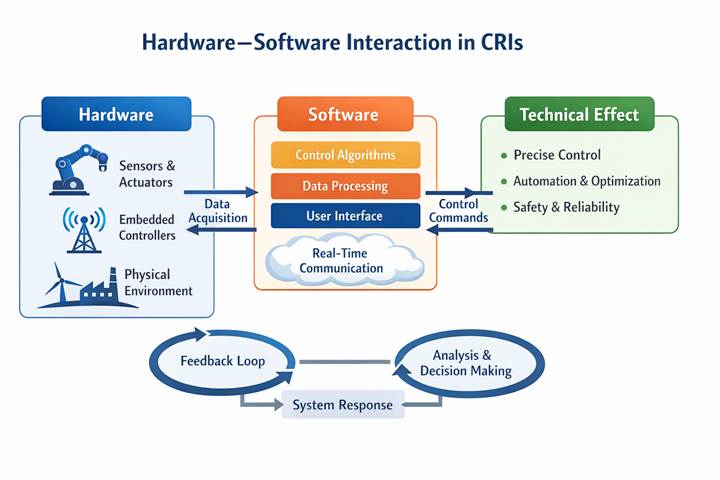
    • Demonstrating technical effect (speed, efficiency, security, resource optimization)
    • Showing hardware integration or industrial application
    • Avoiding claims that isolate software logic

    Examples that have succeeded include:

    • AI-based diagnostic systems
    • IoT-driven control architectures
    • Blockchain-based secure transaction platforms

    Drafting & Specification Strategies That Survive Examination

    One of the most frequent causes of CRI rejection is algorithm-centric claim drafting.

    Drafting Approaches That Work:

    • Use a problem–solution framework
    • Include system and apparatus claims
    • Clearly explain data flow, processing steps, and hardware interaction

    Professional Tip

    Always align the specification with the Guidelines for Examination of CRIs (2017; updated 2023). These guidelines are not optional reading—they are examination reality.

    Examination Delays & Inconsistent Interpretation

    CRI examination often varies significantly between controllers, particularly in domains such as:

    • Artificial Intelligence
    • Machine Learning
    • Blockchain
    • Quantum computing

    Practical Strategies:

    • Proactive participation in hearings
    • Use of technical diagrams
    • Filing pre-hearing submissions to explain technical effect

    Education of the examiner is often part of CRI prosecution.

    Global Alignment and Comparative Filings

    India’s approach to CRIs remains more conservative than jurisdictions such as the USPTO or EPO. However, foreign prosecution can be strategically leveraged.

    Effective Tools:

    • PCT filings
    • Positive International Search Reports (ISRs)
    • Foreign grants submitted under Section 8

    These act as credibility anchors during Indian examination.

    Lack of Clarity in AI, ML & Emerging Technologies

    The absence of specific AI legislation creates uncertainty for patent applicants. In such cases, hybrid IP strategies often offer stronger protection.

    Alternative IP Routes:

    • Copyright: Source code, UI/UX
    • Trade Secrets: Algorithms, models
    • Design Protection: GUIs
    • Trademarks: Platform branding

    Strategic IP planning is critical in fast-moving tech sectors.

    Key Takeaways

    • CRIs are not automatically non-patentable in India
    • Technical effect is the decisive factor
    • Drafting quality determines prosecution outcome
    • Foreign filings strengthen Indian prosecution
    • Combining IP rights offers durable protection

    Conclusion

    Securing IPR for Computer-Related Inventions in India requires more than technical brilliance it demands strategic drafting, informed prosecution, and legal-technical alignment.

    When approached correctly, the Indian patent system does offer meaningful protection for CRIs. The difference lies in understanding how innovation must be translated into patent language.

    At IIPTA, CRIs are taught not as exclusions but as strategic patenting challenges.

  • USPTO Modernization: A Structural Shift in Global Patent Practice and Its Impact on Stakeholders

    USPTO Modernization: A Structural Shift in Global Patent Practice and Its Impact on Stakeholders

    Introduction: Why USPTO Modernization Demands Serious Attention

    The modernization initiatives undertaken by the United States Patent and Trademark Office (USPTO) represent far more than administrative or technological upgrades. They reflect a fundamental recalibration of how patent rights are examined, granted, and sustained. For intellectual property professionals, technology-driven enterprises, investors, and aspiring patent practitioners, these changes redefine both opportunity and risk.
    This article critically examines the USPTO’s modernization programme, identifying its deeper implications for stakeholders across the patent ecosystem.

    Why Modernization Became Inevitable

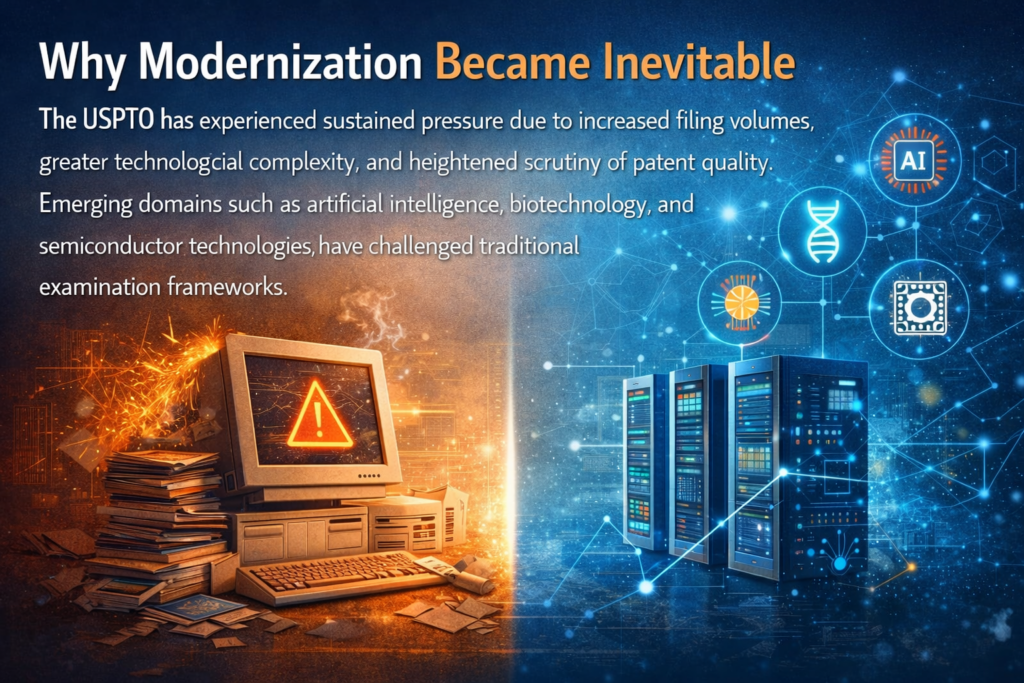
    The USPTO has experienced sustained pressure due to increased filing volumes, greater technological complexity, and heightened scrutiny of patent quality. Emerging domains such as artificial intelligence, biotechnology, and semiconductor technologies have challenged traditional examination frameworks.

    Legacy systems were no longer capable of supporting timely, high-quality examination. Modernization became essential to maintain the USPTO’s credibility as a leading global patent office.

    Patent Centre: Transparency as a Strategic Shift

    The USPTO’s complete migration to Patent Centre has consolidated filing, prosecution, and monitoring into a unified digital environment. While this transition improves operational efficiency, its greater impact lies in enhanced transparency.

    Every prosecution action is now more visible, traceable, and auditable. For applicants and practitioners, this reduces procedural ambiguity and limits strategic delay.

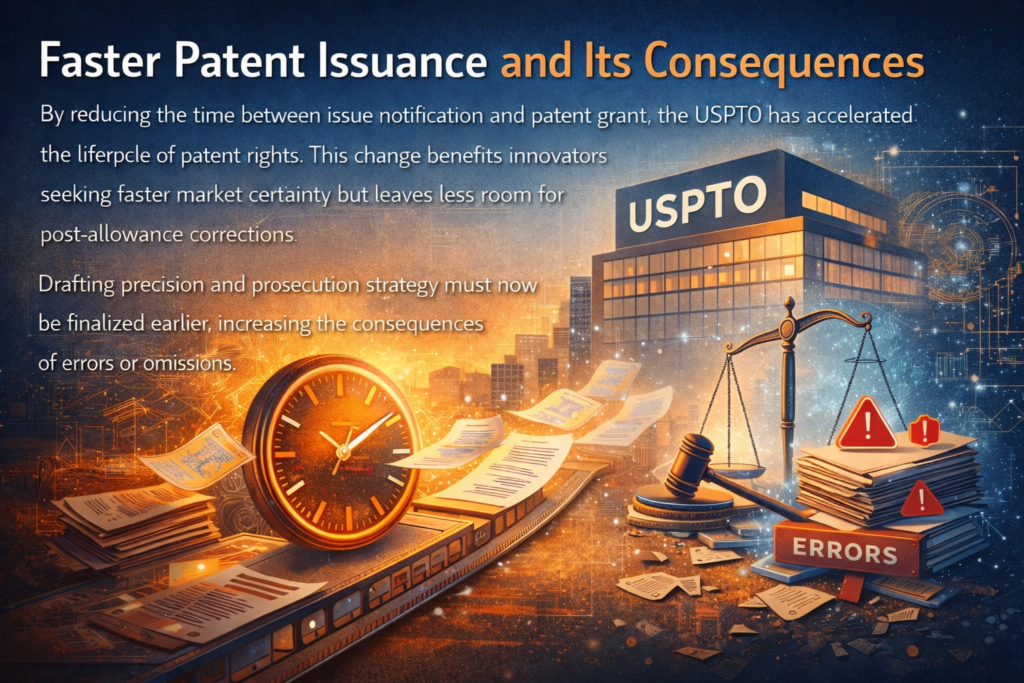
    Faster Patent Issuance and Its Consequences

    By reducing the time between issue notification and patent grant, the USPTO has accelerated the lifecycle of patent rights. This change benefits innovators seeking faster market certainty but leaves less room for post-allowance corrections.

    Drafting precision and prosecution strategy must now be finalized earlier, increasing the consequences of errors or omissions.

    Security Reforms and Accountability

    The introduction of robust identity verification mechanisms signals increased concern regarding filing integrity and data protection. These measures require organisations to implement stronger internal governance and clearly defined responsibility for patent filings.

    Open Data and Market Transparency

    The USPTO’s Open Data Portal centralizes access to patent data, empowering investors, competitors, and researchers. This transparency strengthens due diligence but also exposes weak or inconsistently prosecuted patents.

    Strategic Implications for Stakeholders

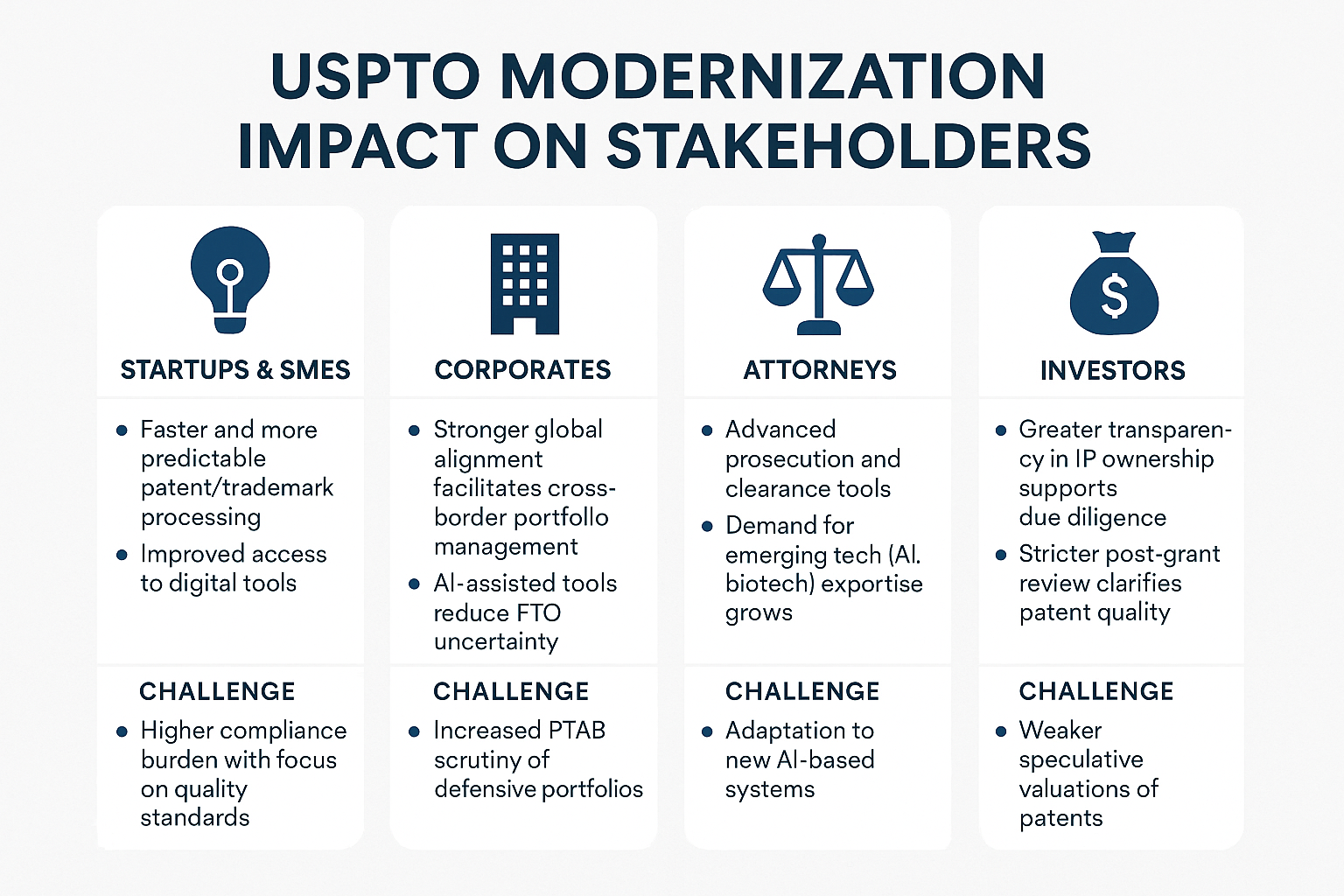
    Startups must balance speed with quality. Corporations must reassess portfolio strength. Practitioners must shift from procedural competence to substantive excellence. Investors gain clearer valuation signals.

    Implications for Indian Applicants

    Indian innovators filing in the United States must adapt to heightened scrutiny and global best practices. Informal drafting approaches are increasingly untenable.

    Role of IIPTA in Preparing Professionals

    The Indian Institute of Patent and Trademark (IIPTA) aligns its training with evolving global patent office standards, emphasizing practical drafting, prosecution strategy, and case-based learning.

    Conclusion

    USPTO modernization signals a decisive shift toward quality-driven patent systems. Stakeholders who adapt their strategies accordingly will benefit from stronger, more reliable patent rights.


  • “The Return of Patent Certainty

    “The Return of Patent Certainty

    Why PERA 2025 Is a Game-Changer for Innovators”

    Intellectual Property Rights, despite of being recognised globally it protects the rights domestically means, if a researcher works energy storage device to store solar energy and applies to patent then he gets the protection in India not in USA unless he applies for the same USPTO. Like other aspects Patents are also governed by the act of law which is enacted by the respective territorial government, The law which has enacted would be amended and modified according to the demand of the situation and time to address the requirements of stakeholders. As we are aware of the fact that Indian Patent Law has amended from time to time where major amendments are like 1999 , 2000 and 2005 and recently Jan Vishwas Act 2023 and Amendment to Rules 2024 which brought considerable flexibilities to ease the filing process and some strict aspects like increasing fees for condonation of delay charging fee for Pre-grant opposition which is a check and balance to take the obstacles created by competitors with malefice intensions.

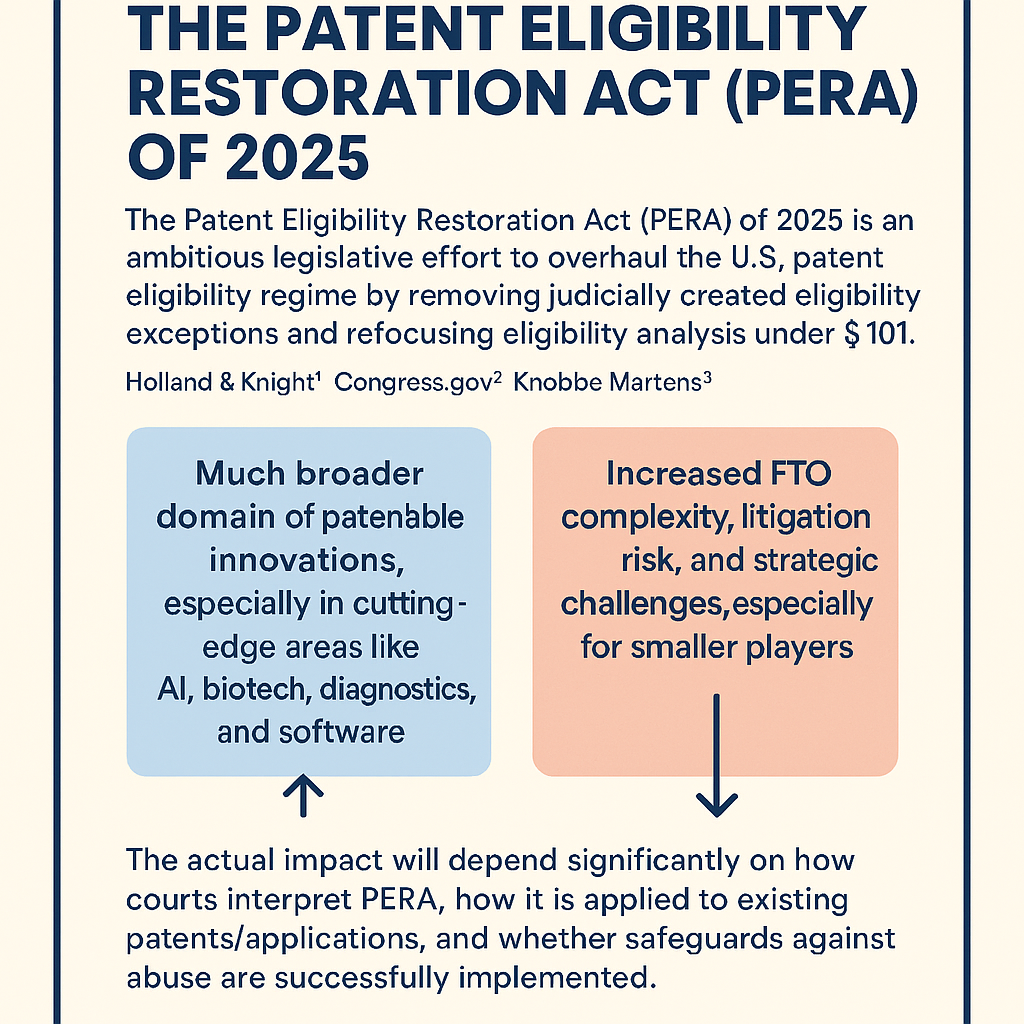
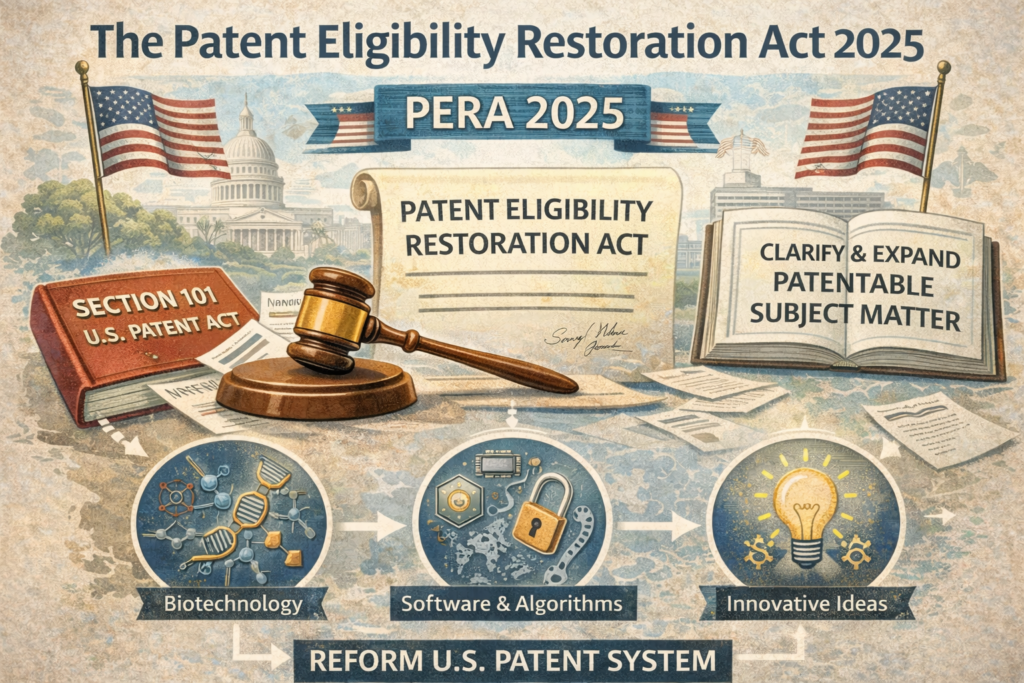
    In the same we are going to analyze one of the Reforms in US, The Patent Eligibility Restoration Act (PERA) 2025. The Patent Eligibility Restoration Act (PERA) of 2025 is a significant legislative proposal aimed at reforming the U.S. patent system by clarifying and expanding the scope of patent-eligible subject matter. PERA seeks to address longstanding ambiguities stemming from judicial interpretations of Section 101 of the U.S. Patent Act.

    Due to a series of judicial decisions beginning in 2012—both from the U.S. Supreme Court and the Court of Appeals for the Federal Circuit—patent eligibility law in the United States has become confused, inconsistent, and unclear. The lack of a clear, consistent, repeatable test for what inventions possess the basic threshold characteristics necessary to obtain a patent there has been well-documented and wide-ranging negative impacts within the innovation and investment communities, which has led to unpredictable business outcomes and a stagnation of innovation in certain high-tech industries.

    Roadmap of PERA 2025:

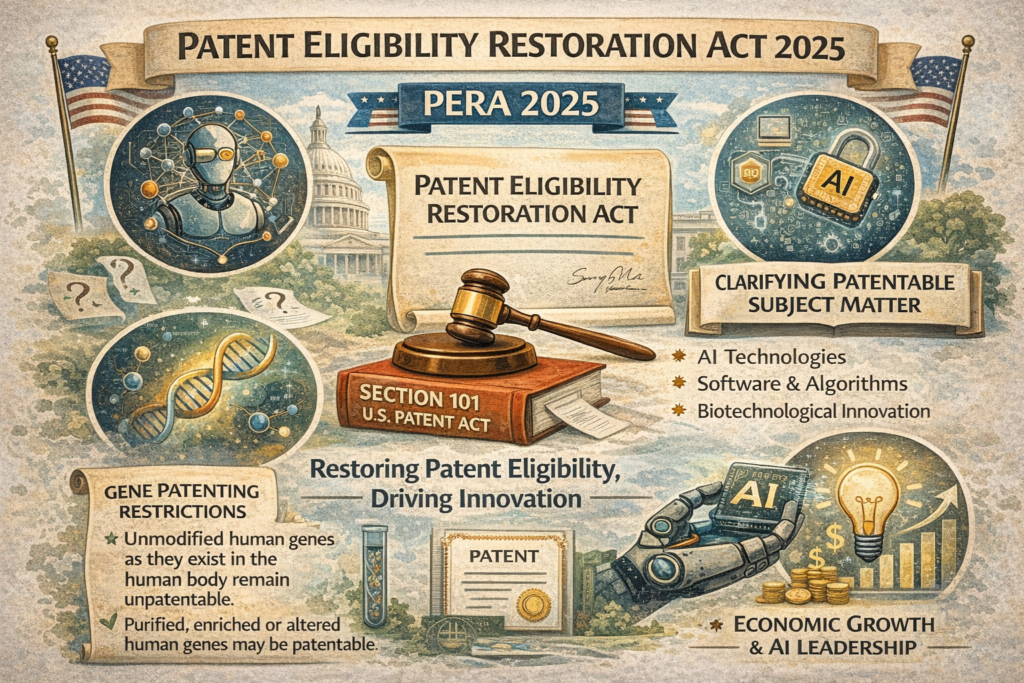
    The Patent Eligibility Restoration Act of 2025 (PERA 2025) is a bipartisan legislative effort in the United States Congress aimed at reforming patent eligibility law under 35 U.S.C. § 101 to restore clarity, predictability, and global competitiveness to the U.S. patent system.

    PERA 2025 would restore patent eligibility to important inventions critical to the growth of the U.S. economy, and critical to delivering on the goal for the United States to dominate AI Landscape. The bill would accomplish the intention and also prevent the patenting of mere ideas, which are already exists in nature, and social and cultural content that virtually everyone agrees is beyond the scope of the patent system.

    PERA 2025 is slightly different than the bill introduced in 2023, at least relating to human genes. PERA 2025 still says that unmodified human genes as they exist in the human body are not patent eligible, but prior versions of the bill said that isolation of genes was considered a modification. PERA 2025, however, leaves out the world “isolated” and says that “a human gene shall not be considered to be unmodified if that human gene is purified, enriched, or otherwise altered by human activity; or otherwise employed in a useful invention or discovery.”

     Why PERA 2025 Matters

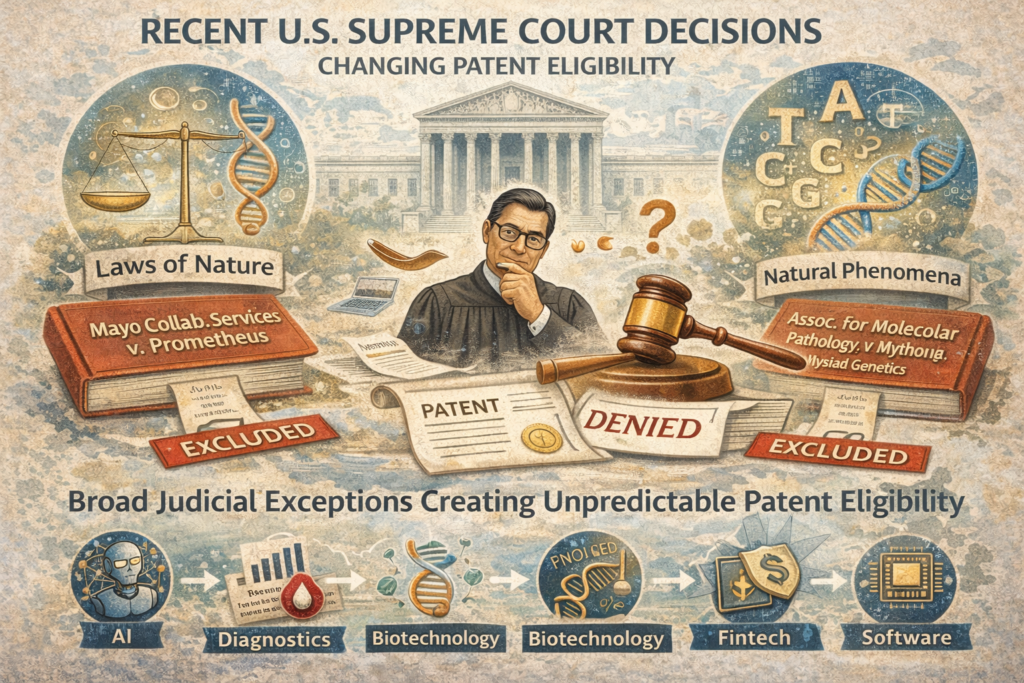
    Over the past decade, several U.S. Supreme Court decisions — most notably Mayo Collaborative Services v. Prometheus, Alice Corp. v. CLS Bank, and Assoc. for Molecular Pathology v. Myriad Genetics — created broad judicial exceptions to patent eligibility for “abstract ideas,” “laws of nature,” and “natural phenomena.” These exceptions have made patent eligibility unpredictable, especially for innovation in AI, diagnostics, biotechnology, fintech, and software.

    Key Dimensions of PERA 2025:

    PERA aims to amend Section 101 of the U.S. Patent Act to provide clearer guidelines on patent eligibility. The bill’s main provisions include:

    • Elimination of Judicial Exceptions: PERA proposes to remove all judicially created exceptions to patent eligibility, such as abstract ideas, laws of nature, and natural phenomena.
    • Defined Ineligible Subject Matter: The bill specifies certain categories that would remain ineligible for patent protection:
      • Mathematical formulas not integrated into a practical application.
      • Mental processes performed solely in the human mind.
      • Unmodified human genes as they exist in the human body.
      • Unmodified natural materials as they exist in nature.
      • Processes that are substantially economic, financial, business, social, cultural, or artistic in nature.
    • Clarification on Machine-Implemented Processes: Processes that cannot be practically performed without the use of a machine (including a computer) or manufacture would be considered patent-eligible.
    • Separation from Other Patent Requirements: PERA emphasizes that patent eligibility should be determined independently of other patentability criteria such as novelty (Section 102), non-obviousness (Section 103), and disclosure requirements (Section 112).

    Support and Opposition

    Supporters of PERA argue that the bill would:

    • Restore clarity and predictability to patent law, encouraging innovation and investment.
    • Align U.S. patent eligibility standards more closely with those of other countries, enhancing global competitiveness.
    • Provide stronger protection for advancements in emerging technologies like artificial intelligence, quantum computing, and personalized medicine.

    Opponents, including some public interest groups and scholars, express concerns that:

    • The elimination of judicial exceptions could lead to the patenting of fundamental scientific principles and natural phenomena, potentially hindering research and access to essential technologies.
    • Allowing patents on unmodified human genes and naturally occurring associations between genes and diseases could increase costs and limit access to genetic testing and diagnostics.

    Legislative Outlook

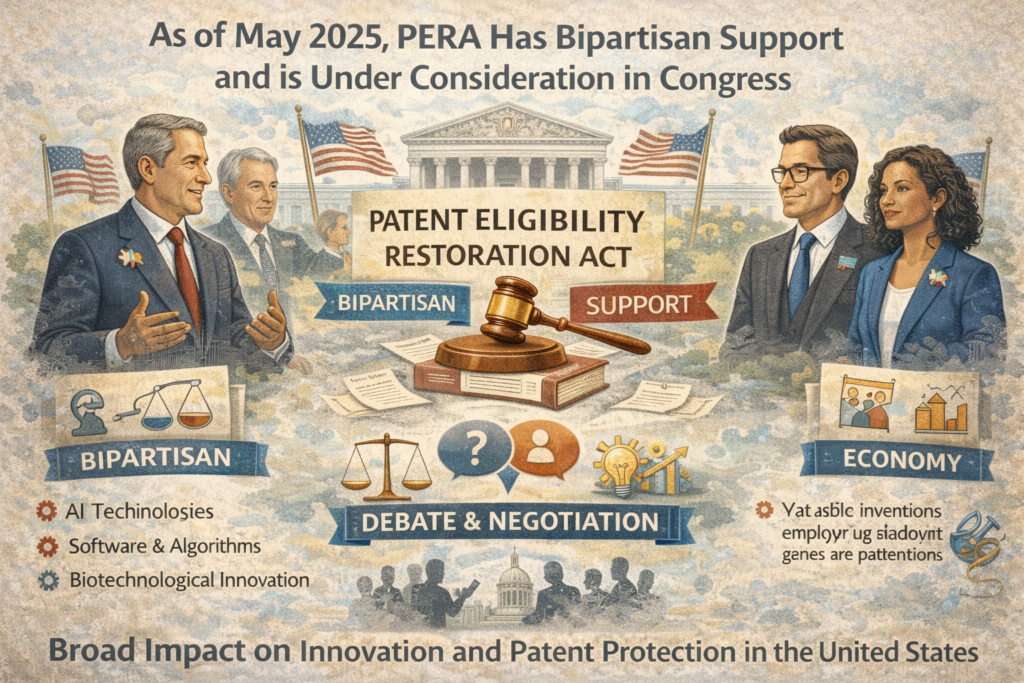
    As of May 2025, PERA has garnered bipartisan support and is under consideration in Congress. While the bill aims to address critical issues in patent law, its passage will depend on ongoing debates and negotiations among lawmakers, stakeholders, and interest groups. The outcome will significantly impact the future landscape of innovation and patent protection in the United States.

    What Innovators & R&D Teams Should Learn from This Case Before filing Conventional Application in general and USPTO filing particularly?

    Basic Dimensions

      Disclose Completely

    Any patent application MUST include:

    • Genetic sequence information
    • Methodology
    • Lab protocols
    • Culture conditions
    • Experimental results
    • Deposit details (if needed)

    Since India and other global stakeholders’ demands high scientific detail, not summaries.

      Draft Claims Smartly not broadly which is an essential aspect across the patent landscape:

    Smart claims are those when they:

    • Match the description
    • Are precise
    • Highlight inventive steps
    • Exclude natural organisms

    A well-drafted claim is proportional to Higher chance of grant.

      Understand the patentability and non-patentability criteria of the designated country.

    In Indian scenario Section 3 restricts

    Common rejection grounds:

    • Section 3(c) – natural organisms
    • Section 3(d) – known variants
    • Section 3(i) – diagnostic & therapeutic methods
    • Section 3(j) – plants, animals, seeds
    • Section 3 (k) – mathematical model and algorithms
    • Section 3 (m)- mental act
    • Section 3 (n) – presentation of information

    If your invention falls here there is a for need expert drafting to overcome objections as well as rejection.

     Impact on Biotech Startups & Researchers

    This amendment signals that:

    • Indian Patent law is in consonance according to international standards and also operating according to the framework of international guideline strategies.
    • BUT only when applications are drafted with precision and scientific depth then only it meets the international standards.

    For startups, researchers, and companies, the key considerations are as follows:

    • Needful preparation of detailed, high-quality patent specifications.
    • Need to work with experts who understand both science as well as patent law.
    •  Need to avoid broad, vague, or incomplete disclosures.

      How IIPTA Helps Biotech Innovators & Students
    At IIPTA (Indian Institute of Patent & Trademark),

    we help:

    • Innovators
    • R&D teams
    • Startups
    • Students
    • Biotech professionals

    In understanding patent drafting, Section 3 compliance, and global patent trends.

    We offer:

    •  Patent drafting training
    •   Patent agent exam preparation
    •   Real case-law analysis
    •   One-to-one expert guidance
    • Hands-on practice with live international cases

    Conclusion : Despite of being domestic rights intellectual property in general and patent in particular are granted according to global standards and it is essential for the IPR professionals to upgrade the execution service to global landscape standards with updating of International dynamics.