Category: Uncategorized

  • From Plagiarism to PMLA

    From Plagiarism to PMLA

    How a Copyright Dispute Pulled the ED into the Enthiran Saga

    The movie Enthiran, which is famously known as Robo world wide which was theatrically released in 2010. In the year 2011 author Aarur Tamilnadan alleged that the film’s storyline was plagiarized from his earlier work Jugiba.
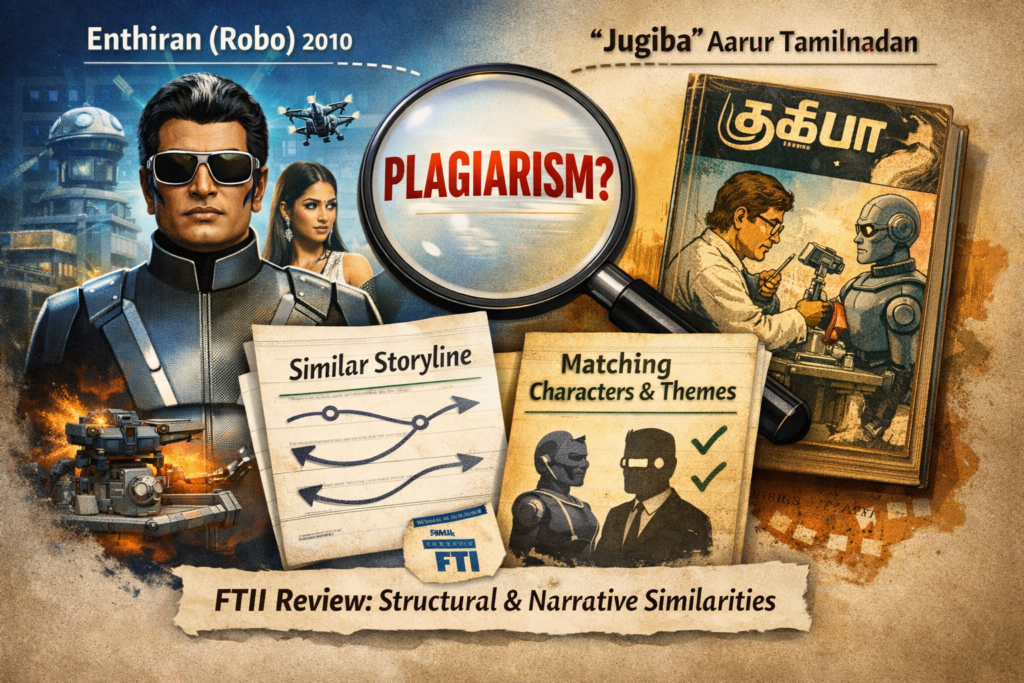
    As the independent review conducted by Film and Television Institute of India (FTII) justified the claims of plagiarism through identification similarities between Enthiran and Jugiba in terms of structural narrative, flow of character and themes.

    Background of the Dispute

    In 2011, Tamilnadan filed a civil suit and a criminal complaint alleging that Enthiran plagiarized his 1996 story Jugiba. He sought damages and claimed that Shankar had committed offenses under Section 63 of the Copyright Act infringement and Section 420 of the Indian Penal Code cheating.
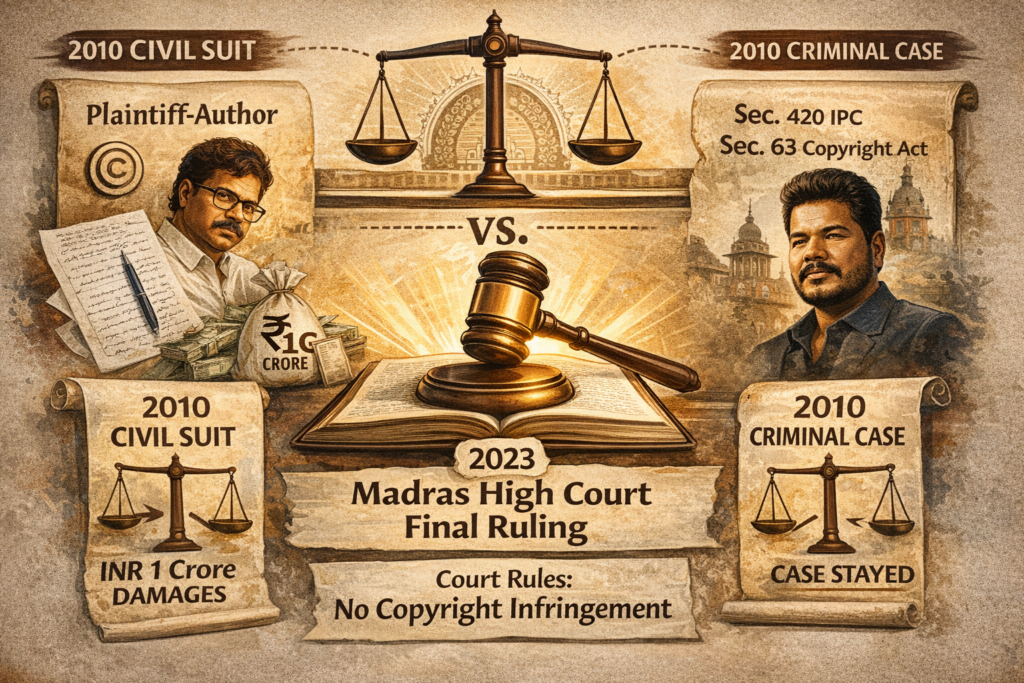
    In the present case both, the civil suit and the criminal case were filed by plaintiff against defendant in 2010. In the civil suit, the writer sought a declaration that he was the first author and owner of the “Enthiran”, a permanent injunction against the director, rendering the accounts of profit made by the film to plaintiff, and also damages worth INR 1 Crore.

    After duration more than 3 years after a decade, the Madras High Court in 2023 decided the civil suit in favor of defendant . The Court observed that the plaintiff failed to prove copyright infringement.

    The court citied well-established principle from the R.G. Anand v. Deluxe Films (1978) was applied to highlight the idea-expression dichotomy and the Court found that while both the works Jugiba and Enthiran involved humanoid robots, their ways of carrying out the story were very different.

    The judgement pointed out the flaws in plaintiff’s submissions as unable to prove literal imitation by providing sufficient evidence, as well as lack of independent witnesses to rely on for his claims. The Court also found that the similarities may be considered generic and even inevitable in a sci-fi narrative of a robot film.

    The criminal case dimension analysis as in 2019, the High Court turned down the criminal charge under Section 420, based on the facts and circumstances of the case do not make an issue for the offence. The Court also sidelined the case against the producer but allowed it to continue vis a vis Sec. 63 against defendant. But in 2023, influenced by the civil suit finding in favor of Defendant, the Madras High Court stayed the proceedings in the criminal case.

    Repercussions of Allowing a crime investigating agency to Investigate Intellectual property like Copyright Cases which is a civil suit:

    A copyright owner could file a civil suit and/or explore remedies under criminal law, according to their circumstances for out-of-court, settlement simpler negotiations, and other strategies as first step. But now, due to the PMLA’s involvement, even if the parties settle, the money laundering investigations will continue.

    However, one argument could be that this may not eventually matter since the money laundering charges are dependent on whether the scheduled offences (i.e. copyright infringement) have been proved or not. 

    Theoretically, PMLA’s involvement even affects existing copyright remedies and makes them redundant.

    As remedies like Mareva injunctions , helps the plaintiff in preventing an infringer from disposing of their assets so that damages can be recovered.

    But with PMLA in effect, these assets can be attached as proceeds of crime under the PMLA and be confiscated by the Government instead. While Section 64 already allowed for the seizure of infringing copies, the PMLA now adds another mechanism that can cause conflict.

    The main issue here is, that the Government’s ability to seize assets may have priority over the plaintiff’s right to recover damages. This situation demands clarity whether the PMLA will be considered to supersede the Copyright Act since it is a more recent enactment, too.

    The application of PMLA to cases like these, where defendants’ assets were being attached without a definitive judicial ruling, creates a chilling effect. Based on allegations alone, creative professionals may be faced with serious repercussions when people weaponize copyright disputes.

    The need for a clearer, more balanced approach to IP disputes in India has never been more highlighted. At this point, the Enthiran case seems to be a reflection of how due process and justice remain shadows in a dystopian criminal system.

    Legal and Ethical Considerations

    The involvement of crime investigative agencies and action has raised concerns about the application of money laundering laws to copyright disputes which is a civil case . The ED’s further move came despite the dismissal of civil suit’ as well as stay on criminal proceedings, leading to concerns about overreach.
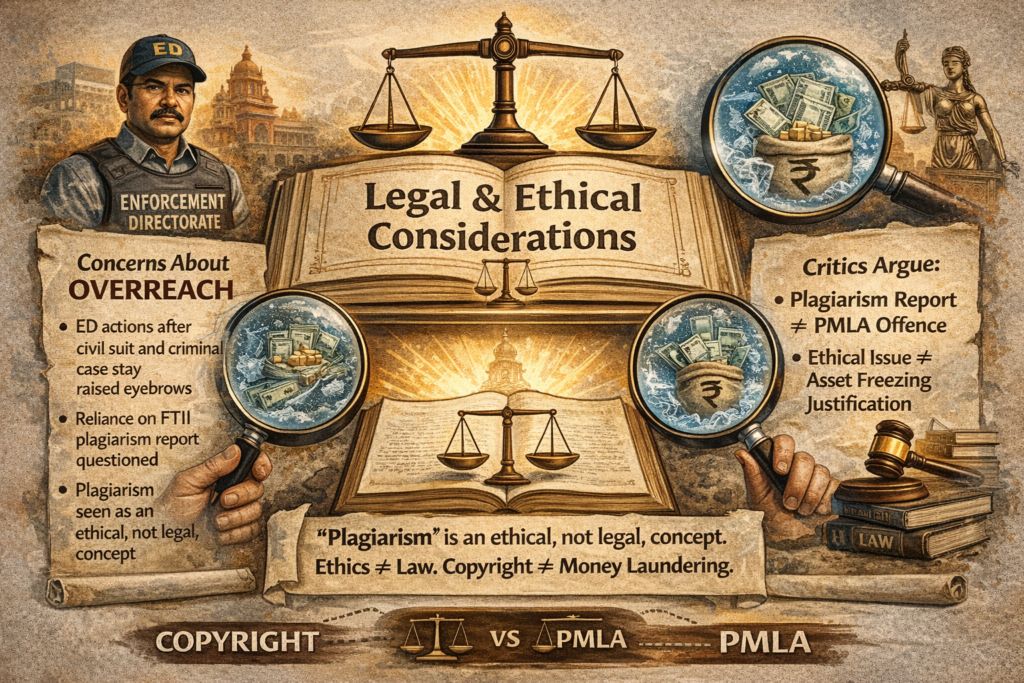
    The stand of critics argument that the agency relying on the FTII report and the use of the term “plagiarism” which is an ethical, not legal, concept which does not justify asset freezing under PMLA provisions.

    Present Scenario :

    On March 11, 2025, the Madras High Court stayed the ED’s provisional attachment of defendant’s assets, demanding the rationale behind the action despite the prior dismissal of the civil suit and the stay on criminal proceedings. The court directed the ED to submit a counter-affidavit, with the hearing scheduled for April 21, 2025.

    Key Learnings :

    The case highlights the danger of blurring civil wrongs with economic crimes.

    Reinforces the importance of keeping PMLA confined to serious financial criminality, not creative disputes.

    Encourages predictable, innovation-friendly IP enforcement.

    Protects India’s film and creative industries from chilling effects.

    Conclusion :

    This case underscores the complexities of application of financial and crime laws to intellectual property disputes and highlights the need for clear legal frameworks to address such intersections.

    CALL TO ACTION – IIPTA
    At the Indian Institute of Patent and Trademark (IIPTA), we train students and professionals to understand intellectual property as it functions in real disputes, not just in statutes.


    If you want to master copyright, trademark law, and licensing strategy with practical insight, IIPTA is where theory meets application

  • ‘Star’ring In Conflict:

    Rogue IPTV Players Meet Star India In IP Battle

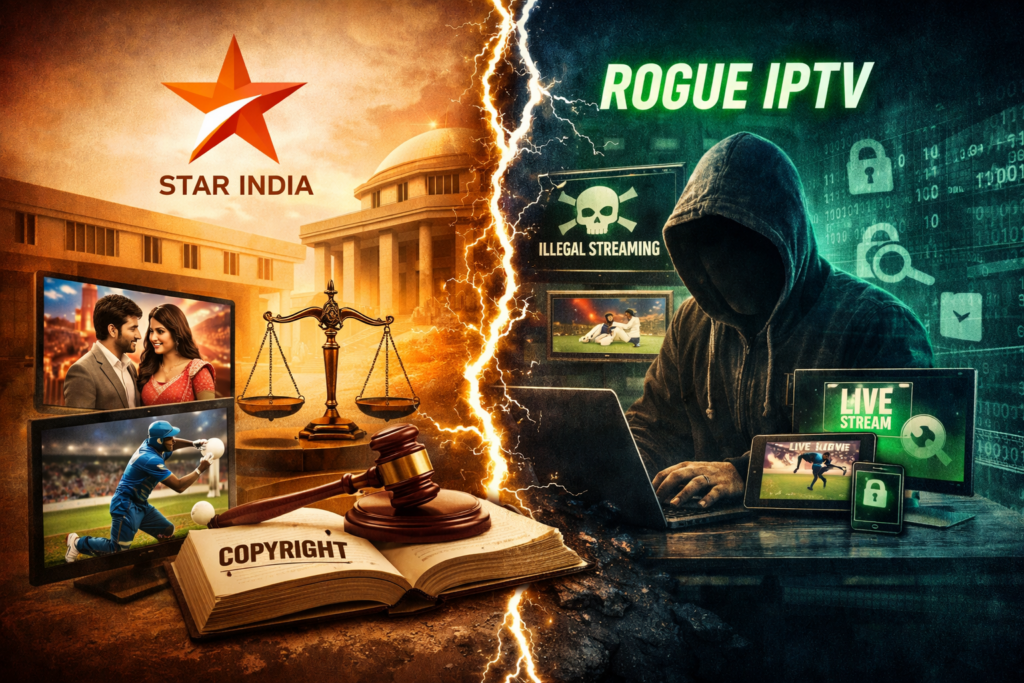
    Star India — one of India’s largest broadcasters with exclusive rights with respect major entertainment slots of soap opera, sitcoms and live sports content including Indian Premier League cricket and other marquee events has taken strong legal action against rogue IPTV players that stream its content without authorization. These services often bypass licensing and distribution rules, offering illegal access to premium live broadcasts through IPTV apps and websites, undermining Star’s IP rights and business model.

    Who are IPTV Players ? Why there are actions with respect to Star channel is amounting to Infringement ?

    IPTV Smarters Pro is a media streaming application that supports smart TVs, Android, iOS, Windows, and other platforms in providing consumers/end-users the ability to stream live TV, entertainment and sports content, etc. Users may download the IPTV Smarters Pro application and register their accounts for availing the service. The application relies on the IPTV technology (Internet Protocol over Television) which provides delivery of audio/visual/graphic/textual data over IP-based networks. Legal IPTV platforms in India include Airtel XstreamJioTV, and Tata Sky Binge.


    Star India alleging streaming apps such as IPTV Smarters Pro  as rouge as the undermining the value of its intellectual property in the original entertainment, sports content, etc. which are broadcasted on its OTT platforms, Disney+ Hotstar and JioCinema. The accessibility is available through iOS and Android devices, and make use of owners works and logo to attract audience. Hence, through their operational frameworks, the platforms complained of were alleged to infringe the copyright, and broadcasting rights held by Star India.

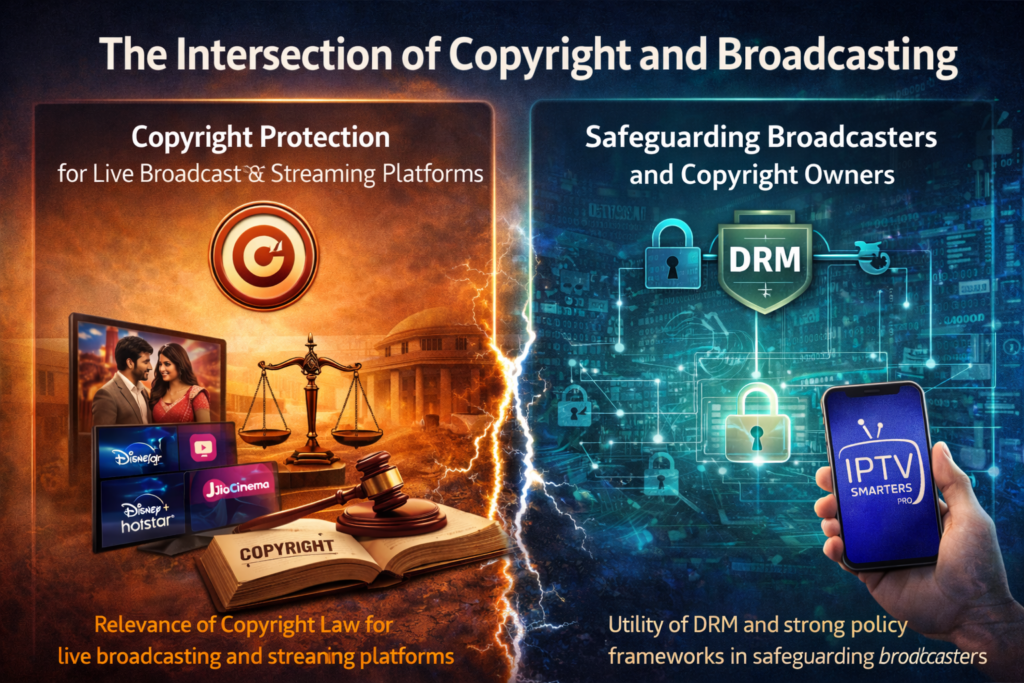
    The intersection of both copy right and broad casting the are analyzed in two dimension relevance of copyright law for live broadcasting and streaming platforms;

    the utility of digital rights management (“DRM”) and strong policy frameworks in safeguarding broadcasters and copyright owners.

    Since the roots of copy right law derives from from the right of reproduction held by broadcasters and copyright owners with respect to their works. 

    Where as DRM refers to strategies and tools employed to safeguard copyrights of any digital content from sharing, selling, and access in illegal way . The restrictions are on the number of copies that can be made by a legitimate user, specification of particular softwares /devices that may be used to access the content, encryption, and others . In this context of IPTV technology, the TRAI issued regulations in 2023 prescribing DRM requirements to safeguard against copyright infringement.

    Case Overview :

    • Plaintiff: Star India Pvt. Ltd.
    • Defendants: IPTV Smarters Pro and multiple “rogue” IPTV websites/apps.
    • Court: Delhi High Court.
    • Core issue: Unauthorized streaming and distribution of Star India’s copyrighted and licensed broadcast content (e.g., live sports).

    Court Action :

    Temporary / Interim Injunction

    In February 2025, the Delhi High Court granted Star India an interim injunction ordering:

    • Blocking access to known rogue IPTV websites and services infringing Star’s rights.
    • Directing intermediaries like ISPs to restrict such access.

    “Superlative” Injunction

    In June 2025, the court went further and granted a superlative injunction — a powerful, real-time enforcement order. This allows:

    • Immediate blocking of newly emerging infringing websites, mobile apps, domains, or mirror versions.
    • Star India to notify authorities directly when new pirate platforms appear, without returning to court each time.
    • ISPs and domain registrars to act swiftly to suspend access.

    This superlative injunction is an evolution of India’s dynamic injunction approach — designed for the fast-moving digital piracy ecosystem where infringing sites symptoms.

    Why This Matters

    For Rights Holders

    This case sets a strong precedent in India for real-time intellectual property protection in the digital age. It shows will of judiciary to adapt traditional IP enforcement tools to counter rapid, online infringement tactics.

    Against Piracy

    By allowing Star to act proactively not just reactively, courts help curb unauthorized streaming that costs broadcasters and rights holders revenue and undermines legitimate content distribution markets.

    Technology and Law

    The case highlights courts stand on IPTV piracy — including web, mobile, and cross-platform distribution — as a serious infringement of exclusive broadcasting rights.

    Traditional injunctions not sufficient due to infringers can immediately launch mirror sites or variants. So ,need for judicial tools upgrade.

    Conclusion

    The Star India vs. Rogue IPTV legal battle underscores a broader trend courts are empowering content owners with stronger, real-time legal remedies to protect their IP in an age where digital platforms and piracy tools booming. The case is a significant development in Indian copyright and broadcasting law, shaping to counter content piracy in upcoming situations.

  • IP Rights vs Rogue Streams: Star India and the Expanding Reach of Digital Injunctions

    IP Rights vs Rogue Streams: Star India and the Expanding Reach of Digital Injunctions

    After ANI, Bollywood Music Labels Face Off with Open AI

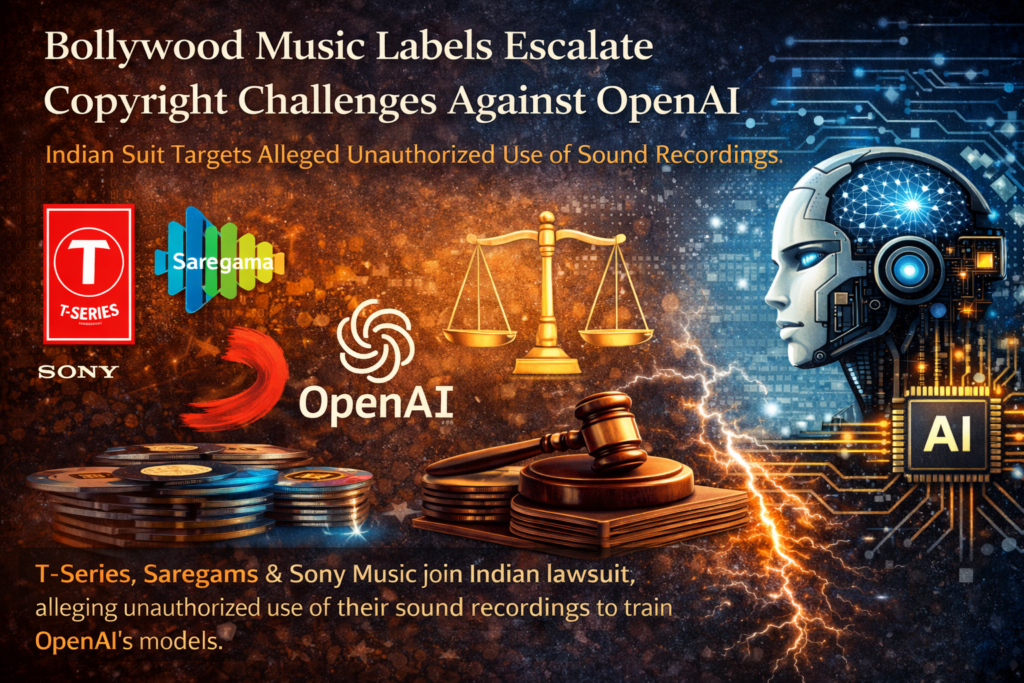
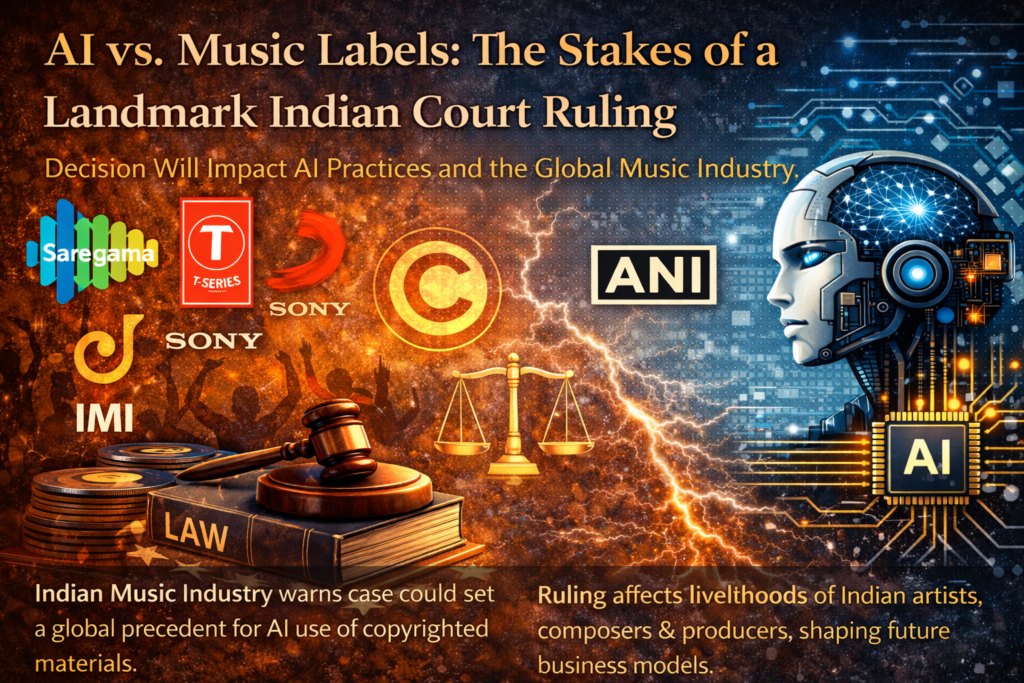
    Open AI which is backed by the tech giant Microsoft and having second largest market in terms of users. legal challenges are mounting globally and in India, its second biggest market by users. In a significant escalation of the ongoing legal challenges faced by OpenAI in India, major Bollywood music labels—including T-Series, Sare Gama, and Sony Music—have sought to join a copyright lawsuit against the AI company.

    Their primary concern revolves around the alleged unauthorized use of their sound recordings to train OpenAI’s AI models, which they argue infringes upon their copyrights.

    Key Issues

    Under Sections 13 and 14 of the Copyright Act, rights for sound recordings, including adaptation, making a copy, and distribution to the public, are provided. This is distinct from the protection/rights associated with written content or images, which come u/s 13(1)(a).

    The arguments of the music labels mainly contend that OpenAI extracts music compositions, sound recordings and lyrics to train their Gen AI models without permission. The argument about composition seems to be unclear .  Regardless, with respect to the other works, the use by Open AI would seem like a direct infringement of the copyright of labels under Section 14. Open AI has defended itself against allegations of copyright infringement by invoking the principle of ‘fair use’ principles in employing publicly available data to build its AI models

    Under Section 52 of the Indian Copyright Act, fair use extends to matters such as research, review or criticism. However, the transformative use defense is not available in the statute, and there exists no judicial precedent regarding AI training under Indian law, making this case all the more important, similar defenses of fair use have not worked for other tech companies like Telegram and seem like a long shot for Open AI.

    Jurisdiction Challenges :

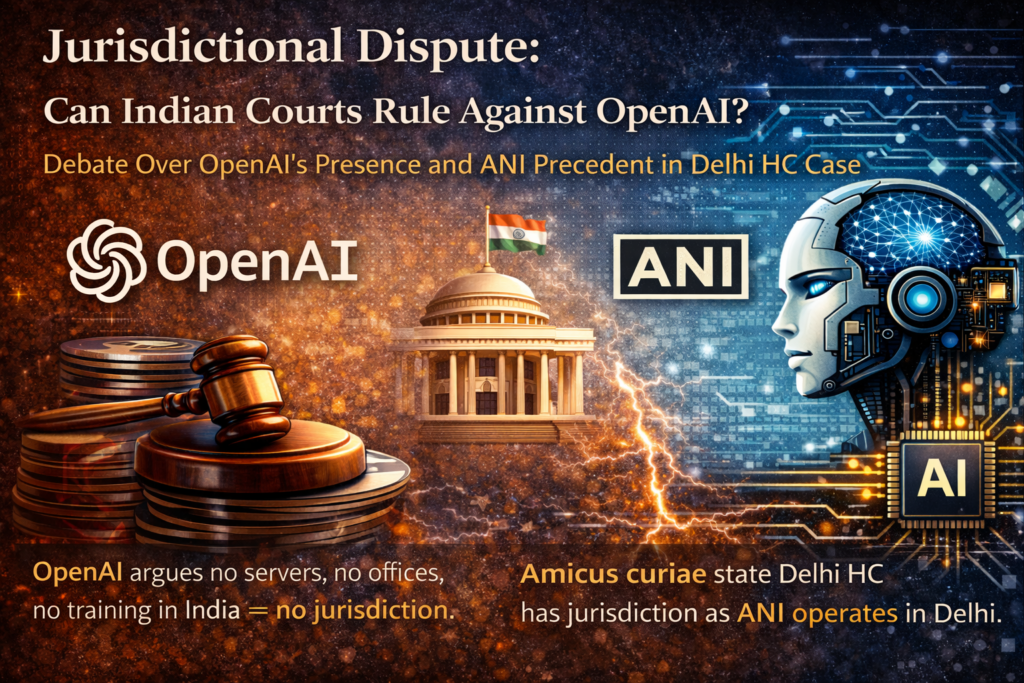
    OpenAI’s contends about  the jurisdiction . It has been argued that lack of the jurisdiction in Indian courts to decide on the case as they have no servers or permanent office in India, and lack of training activities locally.

    In contrast to this  two amicus curiae appointed have stated in their submissions that the Delhi HC does have jurisdiction since ANI operates out of New Delhi. Based on the Court’s final word, this would be an important factor in deciding the trajectory of the case.

    Locus Standi or Right to Sue:

    The case, was filed by news agency ANI in 2024, initially had alleged that OpenAI’s ChatGPT was using their content without authorization to train the AI models. Similarly, the music labels want to join the bandwagon. Previously, even the Federation of Indian Publishers and the Digital News Publishers Association (DNPA) had sought to intervene and be made parties to the suit.

    The scope of the suit could be broadened to include these issues. However, it remains to be seen what the court will decide since this may require them to frame additional issues for adjudication as has already said that affected parties must file individual suits as the current suit by ANI cannot continue expanding.

    Broader Implications on Industry:

    The ruling of this case not only decide on the future of AI companies and the data they can use for training but also the business models of the music labels and, arguably more importantly, the livelihoods of artists, composers and producers of India. The IMI even claimed that this may affect the global industry, too, acting as a dangerous precedent for the acceptance of AI systems being trained on copyrighted materials.

    Response from Policy Makers :

    In response to the mounting legal challenges involving AI and copyright, the Indian government has established a panel to review its copyright laws. This panel aims to examine how current laws apply to AI-generated content and to propose recommendations addressing the legal and policy implications of AI in copyright.

    Global Context

    This legal battle in India reflects a broader global trend where content creators are challenging AI companies over the use of copyrighted material.

    Similar lawsuits have been filed in the U.S. and Europe, indicating a growing concern over how AI models are trained using existing creative works without proper authorization or compensation.

    IMPLICATIONS FOR FILMMAKERS AND CONTENT CREATORS

    This dispute sends a clear message:
    • Real organizations are not free narrative tools 
    • Script clearance is a legal necessity 
    • Disclaimers are not absolute shields 
    • Reputation-based claims are real and enforceable 

    Failure to address these issues at the scripting stage can result in injunctions, edits, and reputational fallout.

    LEARNINGS FOR IP STUDENTS AND PROFESSIONALS

    For students of intellectual property law, this case demonstrates:
    • Practical application of passing off principles 
    • Balance between speech and trademark rights 
    • Protection of non-commercial goodwill 
    • Judicial preference for proportionate remedies 

    This is not theoretical law; it is applied to IP governance.

    FINAL IP PERSPECTIVE

    The outcome of this case could set a significant precedent for how AI companies operate in India and potentially influence global practices concerning the use of copyrighted content in AI training.

  • Cybersquatting and Trademark Law

    Cybersquatting and Trademark Law

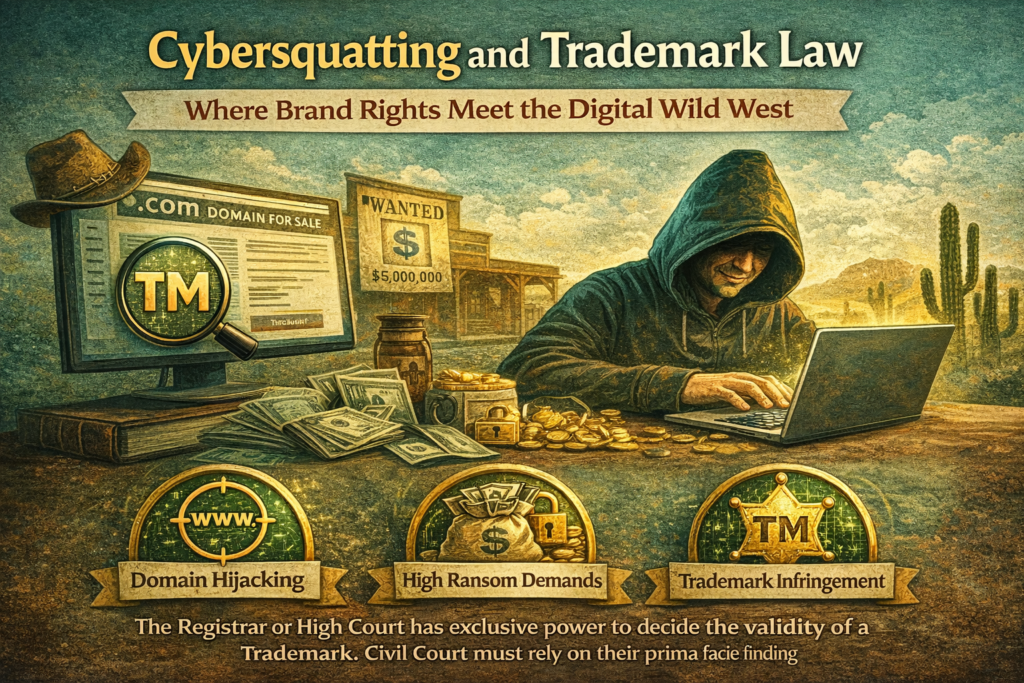
    Where Brand Rights Meet the Digital Wild West

    Introduction

    The, adoption of a website and a domain name have become an important tool for brands to reach consumers. Similar to a trademark, websites and domain names also act as identifiers of a particular brand/ company or business. Websites became tools that complement business in the past, but at some point, with technological developments, domain names and websites are inevitable as consumers’ choice for a particular brand or business based on the online footprints.

    In today’s digital economy, a domain name is often the first point of consumer interaction with a brand. As businesses increasingly rely on online presence, the practice of cybersquatting—registering domain names identical or deceptively similar to established trademarks—has emerged as a serious threat to brand owners.

    Indian courts and international dispute resolution mechanisms now consistently recognize that domain names function as business identifiers, deserving protection under trademark law principles.

    What Is Cybersquatting?

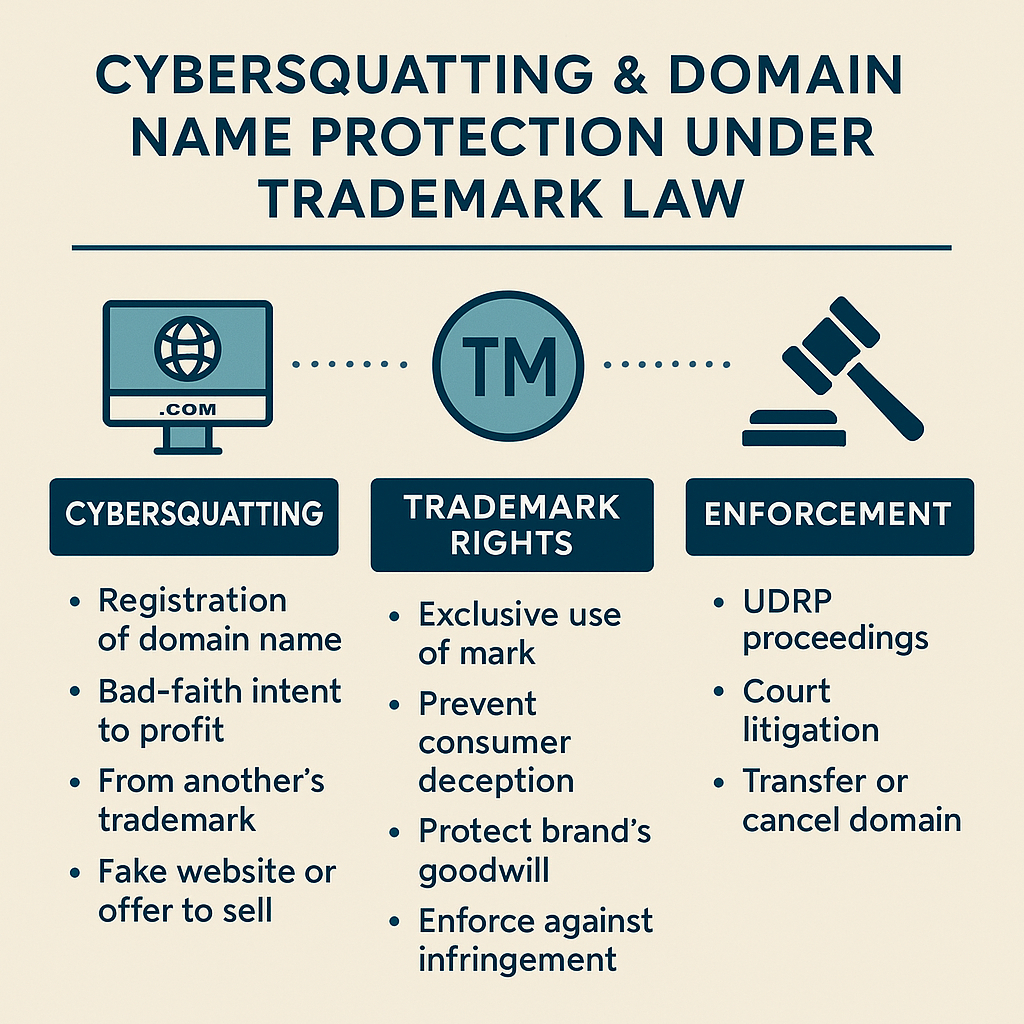
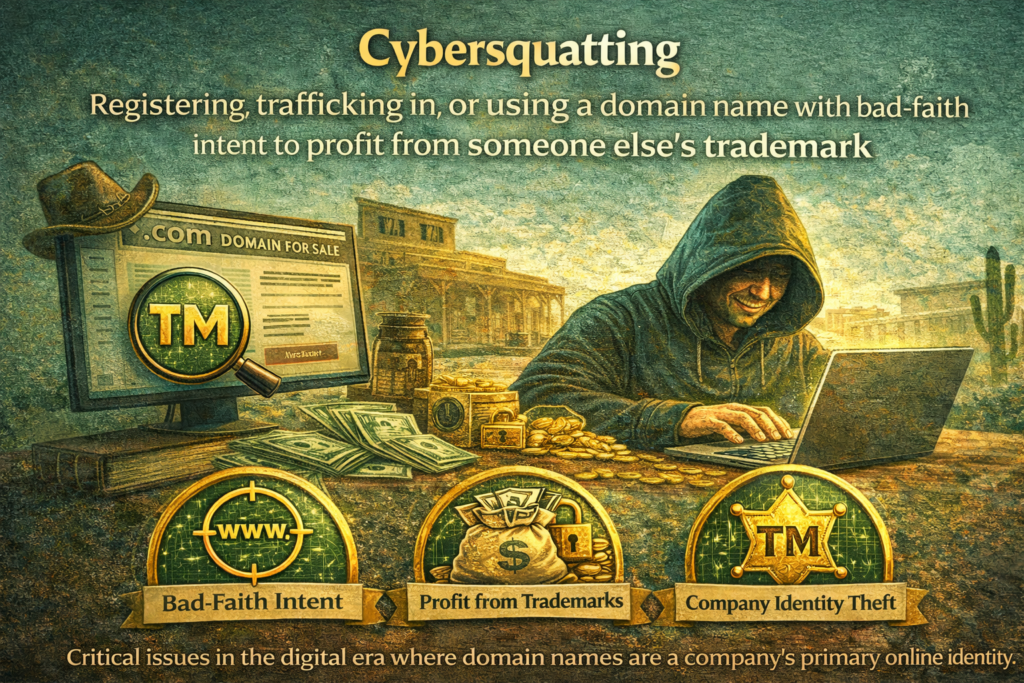
    Cybersquatting is the act of registering, trafficking in, or using a domain name with the bad-faith intent to profit from the goodwill of someone else’s trademark.

    Cybersquatting and domain name protection are critical issues in trademark law, especially in the digital era where domain names often serve as a company’s primary online identity.

    Complementary Role of domain name and Website:

    Domain name and website, these two go hand in hand, while many people do confuse these two terms, understanding the distinction is important. A domain name can be simply called as a path that leads a user to the website and a website is a platform which is developed and is the result that is displayed when one enters the particular domain name. For instance, the domain name shall be stated as the path to reach a particular location, whereas the website is the location itself. Now these websites once developed carry a unique IP address, which is complex and difficult to be remembered, for which domain names are used as an alternative.

    Key role of, a cyber squatter will:

    • Register domain names identical or confusingly similar to existing trademarks or brand names.
    • Try to sell the domain to the trademark owner at an inflated price.
    • Use the domain to mislead consumers, damage the brand, or divert web traffic.

    The purpose of protection of an internet domain name can be viewed equal to the purpose of a trademark registration. The basic purposes behind protection of domain name includes:

    • Protection and Promotion of brand name
    • Better brand outreach, global outreach
    • Supports expansion of business
    • Exclusive right to use the particular name
    • Helps in distinguishing a particular brand’s/ business’ goods and services

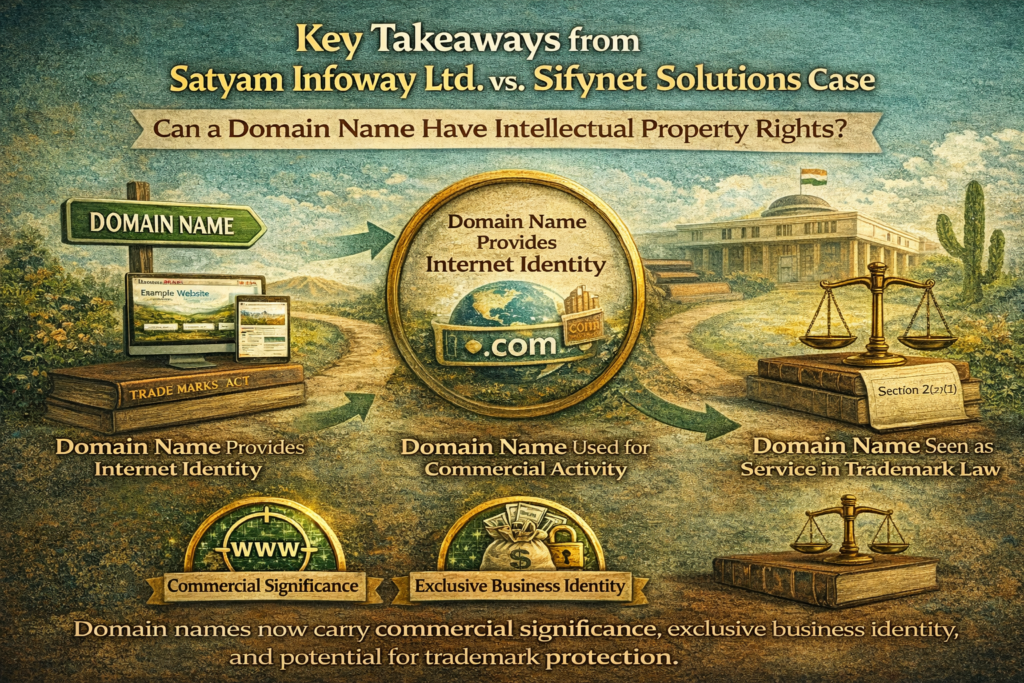
    To understand the above mention aspects the case laws and rulings of the court acts as prism for convenient analysis is Satyam Infoway Ltd. v. Sifynet Solutions. The major issue in this case was whether a domain name can be considered as a word which is capable of differentiating the trade/service which is supplied to the users on the internet and does the same confer any Intellectual Property Rights?

    In the opinion of the court the basic role of a domain name was to provide address for the computers on the internet and that the internet has changed since times, from being as a communication means, it has become a more of carrying a commercial activity and domain name is now used as an identity of a business. It was also mentioned that a domain name may be considered as services under Section 2(z)[ii] of the Trademarks Act and the domain name has become an exclusive identity and as time passes by, more and more activities (commercial) advertise or trade on the web, making the domain name more valuable. A domain name is not only used to facilitate the consumers but it also helps in the identification of the two different business activities. 

    Legal Framework in accordance with Trademark Law around globe :

    Trademark law offers several mechanisms to combat cybersquatting and protect domain names:

    1.  The Anti-cybersquatting Consumer Protection Act (ACPA) — U.S.

    Under the ACPA (15 U.S. Code § 1125(d)):

    • Trademark owners can sue individuals who register domain names identical or confusingly similar to their marks in bad faith.
    • Remedies include:
      • Transfer or cancellation of the domain.
      • Statutory damages ranging from $1,000 to $100,000 per domain name.

    2.  Uniform Domain-Name Dispute-Resolution Policy (UDRP) — International

    Governed by ICANN, the UDRP allows trademark holders to file disputes against domain registrants.

    To succeed, a complainant must prove:

    1. The domain name is identical or confusingly similar to a trademark.
    2. The domain owner has no legitimate rights or interests in the domain.
    3. The domain name was registered and is being used in bad faith.

     If successful, the domain is transferred or cancelled — without the need for a full trial.

    3. National Trademark Laws (e.g., India, EU, UK)

    Many jurisdictions provide legal recourse for domain name disputes under their respective trademark or unfair competition laws. Courts consider:

    • Trademark ownership.
    • Domain use and intent.
    • Likelihood of confusion or brand dilution.

    Best Practices for Domain Name Protection

    • Register your domain name early in all relevant TLDs (.com, .net, .org, country codes).
    • Consider trademarking your domain name if it identifies your brand.
    • Use brand monitoring services to watch for domain registrations similar to your trademark.
    • Act promptly when cybersquatting is detected—early legal action can prevent further damage.A structured analysis of the impact of cybersquatting and domain name protection under trademark law on different stakeholders:

    1. Brand Owners / Trademark Holders
    Negative impact of cybersquatting: Loss of online traffic, dilution of brand goodwill, risk of consumer deception or phishing scams.
    Positive impact of protection mechanisms: Trademark law (through UDRP, INDRP, and national courts) gives tools to recover domains, deter squatters, and safeguard brand reputation.
    Costs involved: Legal fees, arbitration costs, and monitoring services increase business expenses.

    2. Consumers / Internet Users
    Negative impact: Cybersquatted domains may mislead consumers, expose them to fraud, malware, or counterfeit goods. Trust in legitimate brands can decline.
    Positive impact of protection: Strong enforcement ensures consumers are directed to authentic websites, reducing confusion and ensuring quality/safety of goods and services.

    3. Domain Name Registrants / Investors
    Legitimate investors: Face risk of being wrongly accused of cybersquatting if domains resemble trademarks (reverse domain name hijacking).
    Cyber squatters: Face cancellation or transfer of domains, financial penalties, and reputational damage under UDRP/INDRP or trademark litigation.

    4. Regulatory Bodies / ICANN & Arbitration Forums
    Role: Provide global dispute resolution (e.g., UDRP by WIPO, INDRP in India).
    Impact: Greater responsibility to balance trademark rights vs free speech/fair use. Must ensure efficient, cost-effective, and impartial processes.

    5. Legal & Policy Stakeholders
    Law firms, IP attorneys, arbitration professionals: Increasing demand for domain name dispute resolution services.
    Policymakers: Must update rules to address new challenges like gTLD expansion, internationalized domain names, and blockchain-based domains.

    PRACTICAL LEARNINGS FOR BRAND OWNERS AND OTHER STAKEHOLDERS
    Brand owners
    gain protection but face monitoring/enforcement costs.
    Consumers benefit from reduced deception but suffer when cybersquatting succeeds.
    Legitimate registrants risk overreach, while cybersquatters lose illicit gains.
    Regulators and policymakers carry the burden of evolving fair, effective frameworks.

    WHY THIS CASE IS IMPORTANT FOR IP STUDENTS AND PRACTITIONERS

    For students preparing for Trademark Agent and Patent Agent Examinations, this case provides a practical demonstration of:
    • Trademark infringement and passing off
    • Judicial standards for ex‑parte injunctions
    • Role of intermediaries in modern IP enforcement

    For practitioners, the case reinforces that trademark litigation today requires legal strategy aligned with technology and speed.

    KEY TAKEAWAYS • Digital trademark fraud invites swift judicial intervention
    • Ex‑parte relief is achievable with credible and urgent evidence
    • Consumer protection is central to trademark jurisprudence
    • Intermediary cooperation is increasingly mandatory
    • Delay significantly weakens enforcement

    CONCLUSION:

    The incidents of cybersquatting is a wake up call for brand owners to maintain consistency taking consumer trust to next level but it sends a clear signal to put checks on digital impersonators and brand abusers so that trademark law to evolve to match technological misuse.


  • “Can a Trademark Be Attacked from Three Sides? The Hidden Synergy of Sections 47, 57 & 124”

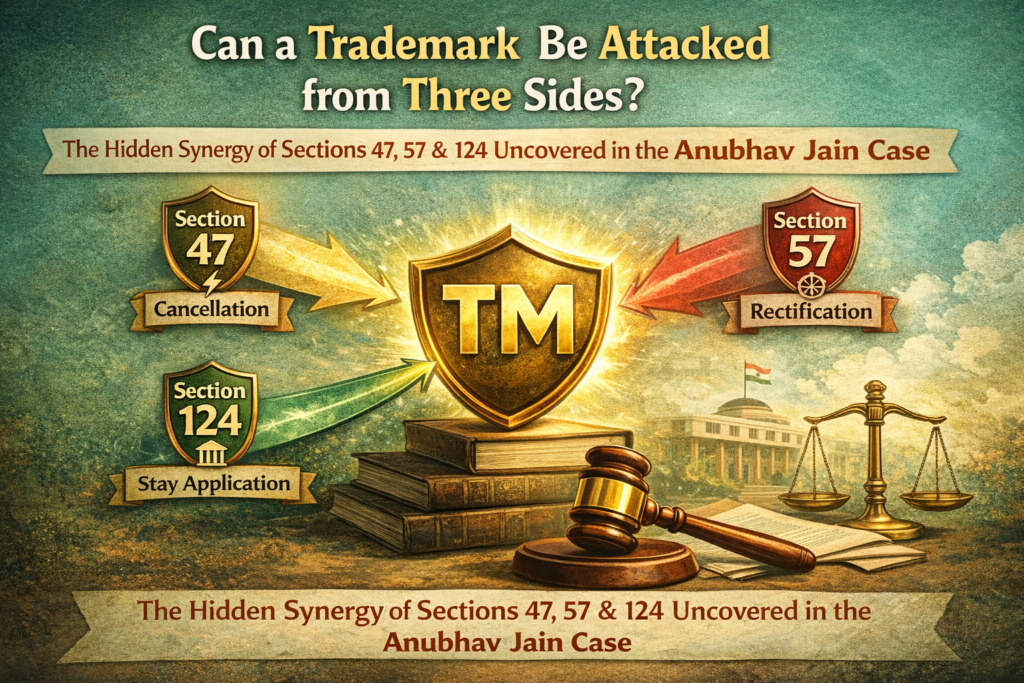
    “Can a Trademark Be Attacked from Three Sides? The Hidden Synergy of Sections 47, 57 & 124”

    The Hidden Synergy of Sections 47, 57 & 124 Uncovered in the Anubhav Jain Case”

    Introduction

    Indian trademark law provides multiple statutory mechanisms to challenge the validity of a registered trademark. However, when rectification proceedings intersect with infringement suits, procedural complexity arises.

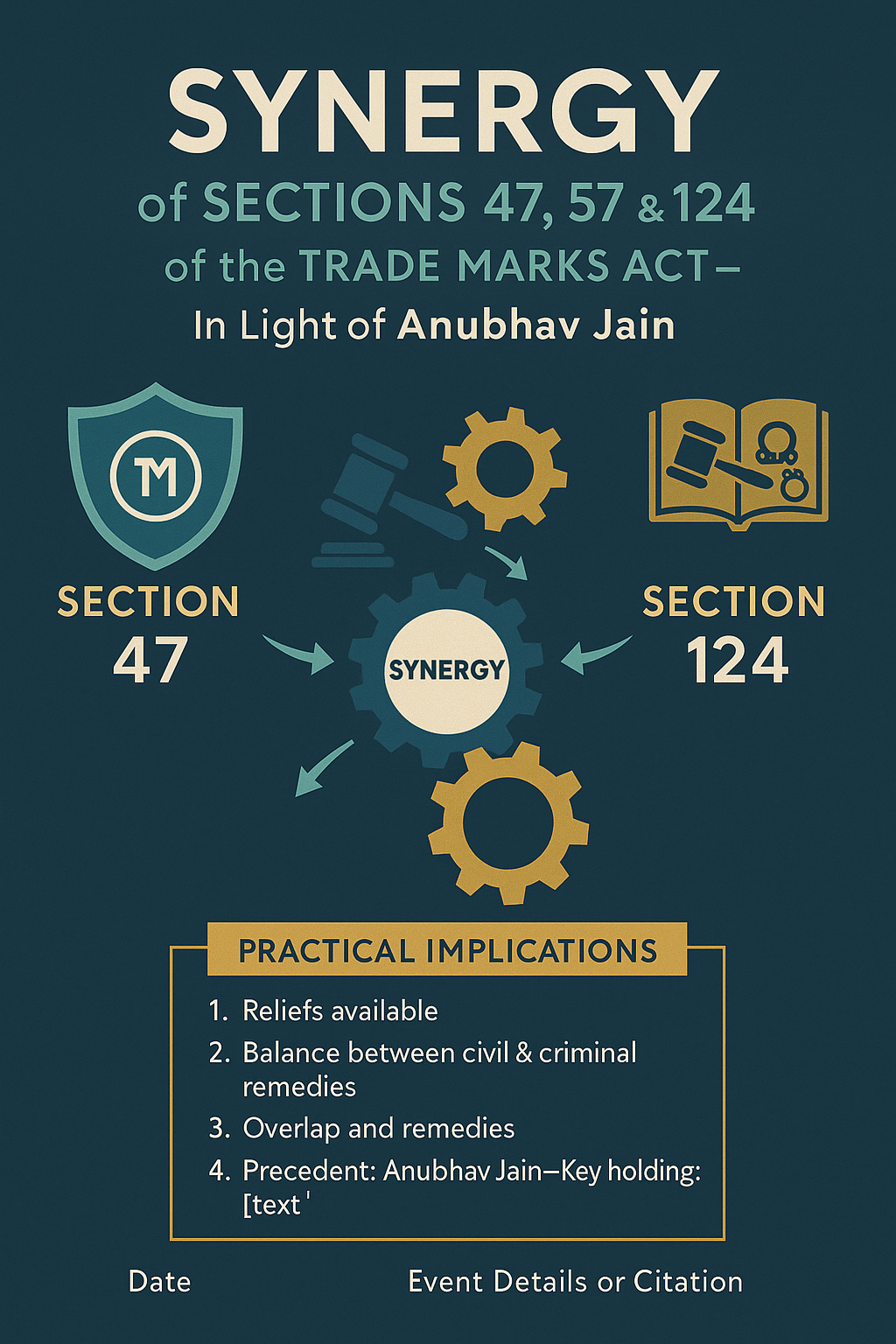
    The Anubhav Jain case serves as a critical judicial lens to understand the interplay and synergy between:

    • Section 47 (removal for non-use), of the Act provides for the removal of a registered trademark from the Register and imposition of limitations on grounds of non-use. A cancellation may also be filed on the grounds of mala fide registration, or wrongly remaining on the Register.

    This provision prevents trademark hoarding and ensures the register reflects commercial reality.

    • Section 57 (rectification of the register), and gives power to the Registrar or High Court to cancel or vary registrations and to rectify the Register. On application made in the prescribed manner to the High Court or to the Registrar, by any person aggrieved, the authority may make such order as it may think fit for cancelling or varying the registration of a trademark on the ground of any contravention or failure to observe a stipulated condition.
      Importantly, Section 47 is a subset of Section 57, since non-use rectification is pursued procedurally under Section 57.

    • Section 124 (stay of infringement suits pending rectification); Section 124 of the Trademarks Act specifically deal with the infringement suit. It applies only where there is, to begin with, a suit, alleging infringement of trademark pending before a Civil Court, and for the rectification of the register, the applicant has to approach the High Court however, the issue of invalided by  the Civil Court.
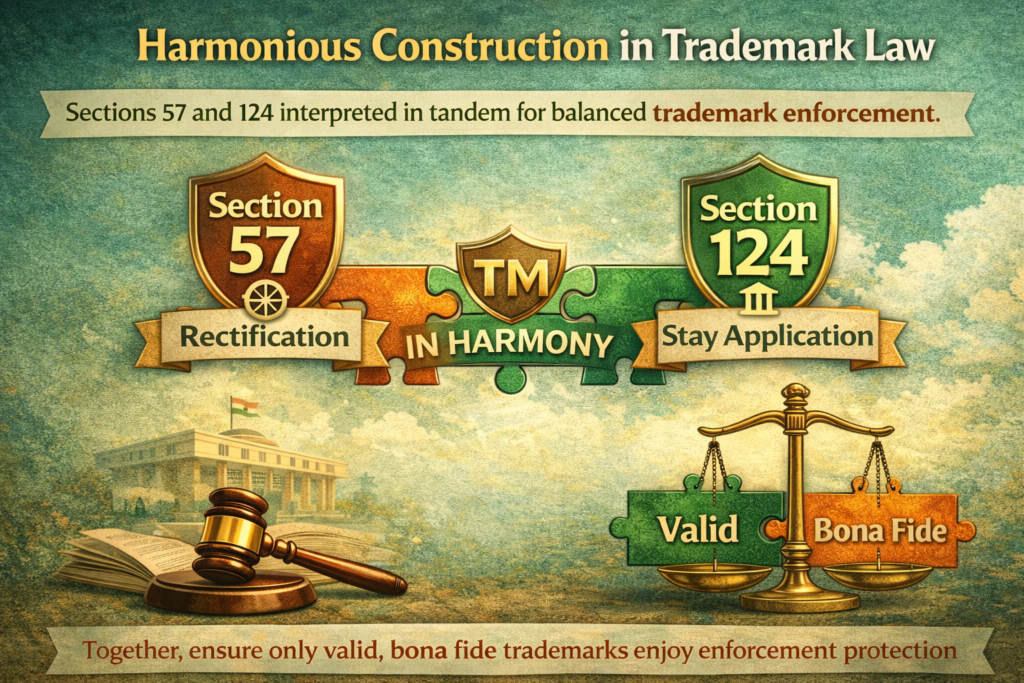
    The High Court has followed the principle of harmonious construction in the impugned case while interpreting Section 57 and Section124 of the Act stated that they are not in derogation of each other, however; they exist in harmony with each other. 
    Together, these provisions aim to ensure that only valid and bona fide trademarks enjoy enforcement protection.

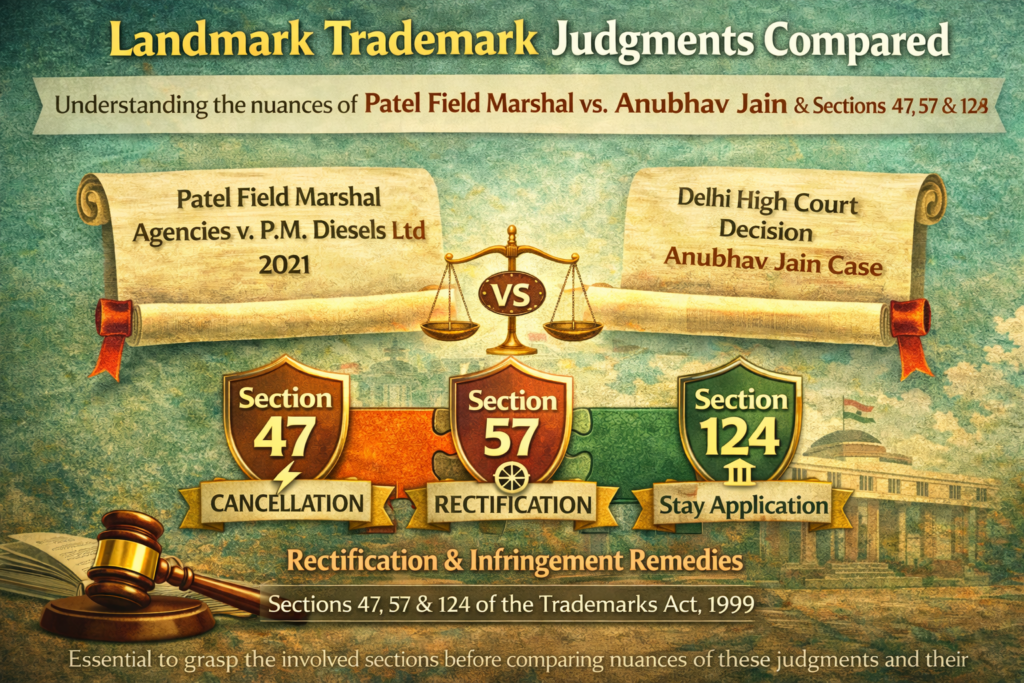
    The landmark judgment Patel Field Marshal Agencies v. P.M. Diesels Ltd which was decided in 2021 by the Hon’ble Supreme Court, laid down the process followed in the rectification pleadings and as well rested the anomalies concerning the issue of invalidity and the recourse available remedies S.47, S.57 and S. 124 of the Trademarks Act,1999 in an infringement suit. The Delhi High Court decision in Anubhav Jain’s case was prima facie which is contrary to the Field Marshal case, 
    It is important to ponder about the nuances of both the judgments and how Anubhav Jain’s case can be beneficial in the practical light in the current scenario. Before that, it is essential to understand the sections involved in these judgments.

    It lays down framework that in an infringement suit wherein the Plea of Invalidity is raised either by the Defendant or the Plaintiff against the registered trademark then the court shall abide by the following procedure which is as follows-

    The Court trying the suit shall-

    1. When the plea for rectification is pending- If the rectification proceedings are pending before the Registrar or High Court and the infringement suit is instituted afterward, then a such suit is to be stayed till the final disposal of the rectification proceedings. (S. 124(1)(b)(i));
    2. Rectification proceedings not pending– When no such proceeding is pending at the time of institution of the suit, on prima satisfaction/tenability of the plea of invalidity of the plaintiff’s or the defendant’s trademark, the court may frame an issue regarding the same and adjourn the suit for three months to enable the party concerned to apply to Registrar or High Court for rectification of the trademark.

    Case law of PATEL FIELD MARSHAL AGENCIES v. P.M. DIESELS LTD

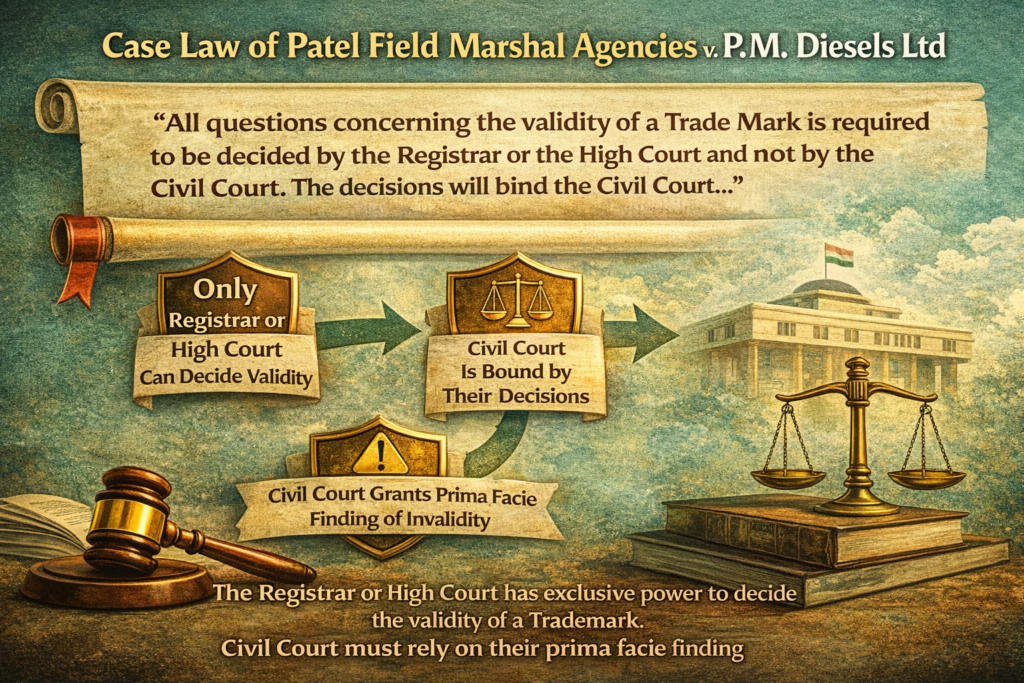
    The Court held that: “all questions concerning the validity of a Trade Mark is required to be decided by the Registrar or the High Court and not by the Civil Court. The decisions will bind the Civil Court. In a case where the issue of invalidity is raised or arises independent of a suit, the prescribed statutory authority will be the sole authority to deal with the matter. However, in a situation where a suit is pending (whether instituted before or after the filing of a rectification application), the exercise of jurisdiction by the prescribed statutory authority is contingent on a finding of the Civil Court as regards the prima facie tenability of the plea of invalidity.”

    Both of these judgments deal with two very different scenarios but not contrary to one another.

    While analyzing the practical dimensions of the Anubhav Jain case the view tends to give a more remedies to the aggrieved party. When the proceedings are pending before the High Court or Registrar for the rectification and in Civil court for the infringement. 

    WHY THIS CASE IS IMPORTANT FOR IP STUDENTS AND PRACTITIONERS

    For students preparing for Trademark Agent and Patent Agent Examinations, this case provides a practical demonstration of:
    • Trademark infringement and passing off
    • Judicial standards for ex‑parte injunctions
    • Role of intermediaries in modern IP enforcement

    For practitioners, the case reinforces that trademark litigation today requires legal strategy aligned with technology and speed.

    KEY TAKEAWAYS

    • Usage of trademarks and imposition of limitations on grounds of non-use.
    • Role of authority in cancelling or varying the registration of a trademark on the ground of any contravention or failure to observe a stipulated condition.
    • the rectification of the register, the room for applicant to approach the High Court

    Conclusion :

    The synergy between Sections 47, 57, and 124 reflects a carefully balanced legislative design—one that promotes commercial honesty, procedural efficiency, and judicial discipline. The Anubhav Jain case stands as a guiding precedent ensuring that trademark enforcement does not shield dormant or improperly registered marks, while simultaneously protecting courts from dilatory tactics.

  • Trade Dress, Prefix & Reputation

    Trade Dress, Prefix & Reputation

    How Boroline Secured Well-Known Trademark Status in Delhi High Court

    A trademark is a distinctive sign, word, name, logo, symbol, label, shape, color combination, sound, or slogan that identifies and distinguishes the goods or services of one business from those of others. A basic dimension to understand the term trademark.

    Under the Trade Marks Act, 1999 (India), a trademark protects brand identity and consumer trust.

    A well-known trademark (e.g., Boroline, TATA, WIPRO) enjoys enhanced protection across all classes, even for unrelated goods/services.

    Background of the case:

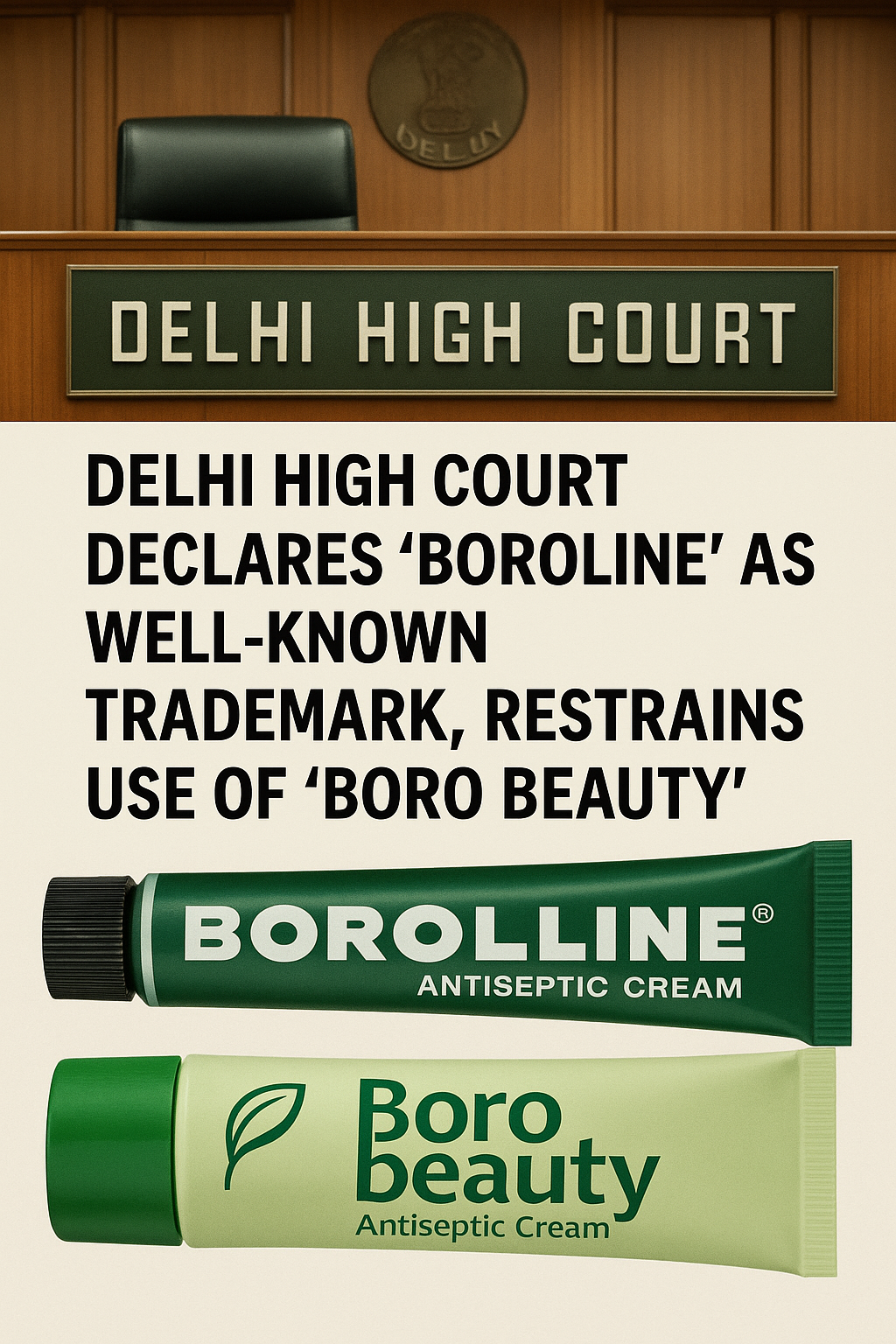
    The suit was filed by GD Pharmaceuticals in 2019 against Cento Products alleging that the latter adopted the mark “BOROBEAUTY‟ which was deceptively similar to the use of its registered trade mark „BOROLINE‟. Boroline was aggrieved by the imitation of its iconic trade dress of a distinct dark green tube ending in an octagonal black cap.

    What are the aspects which made the judgement in favor plaintiff?

    The siting justice affirmed that “There is no denying the fact that “BOROLINE” has attained the status of a household name, and is one of the oldest trademarks, which has been in continuous use, preceding the independence of India,”

    The court also took note of “The duration of the use of the trademark “BOROLINE”, can be gauged from the document showing the advertisement of the product under the mark “BOROLINE”, as occurring in newspaper on 15th August, 1947, the day, our Country attained Independence,” 

     The court declared “Boroline” to be a well-known trademark under the Trade Marks Act, 1999.

     It acknowledged that Boroline has:

    • Extensive use spanning generations.
    • Wide geographical recognition across India (and recognition in other countries).
    • Deep goodwill and consumer association — essentially a household name.

     As a consequence, Boroline gets enhanced legal protection — beyond its specific product class — under Indian trademark law.

    In a significant development in Indian trademark jurisprudence, the Delhi High Court has declared “Boroline”—the iconic antiseptic cream by G.D. Pharmaceuticals Pvt. Ltd.—as a well-known trademark under the Trade Marks Act, 1999, and permanently restrained the use of the mark “Boro beauty” by Cento Products (India).

    The Court held that the defendant’s mark and trade dress were deceptively similar, amounting to trademark infringement, passing off, and dilution of Boroline’s long-established goodwill.

    Directions of Court to respective authorities:  

    The court directed the Registrar of Trademarks to add the word to the list of well-known trademarks, upon G. D. Pharmaceuticals, the company which manufactures Boroline, completing the requisite formalities.

    Dimensions of Final Verdict and Impact on Both Parties:

    • The court permanently injuncted a company namely Cento Products, from manufacturing or selling or advertising similar products with the name “BOROBEAUTY‟.
    • The court directed Cento Products to change its trade dress and trademark, which shall be totally distinct and different from Boroline’s well-known trademark and trade dress.

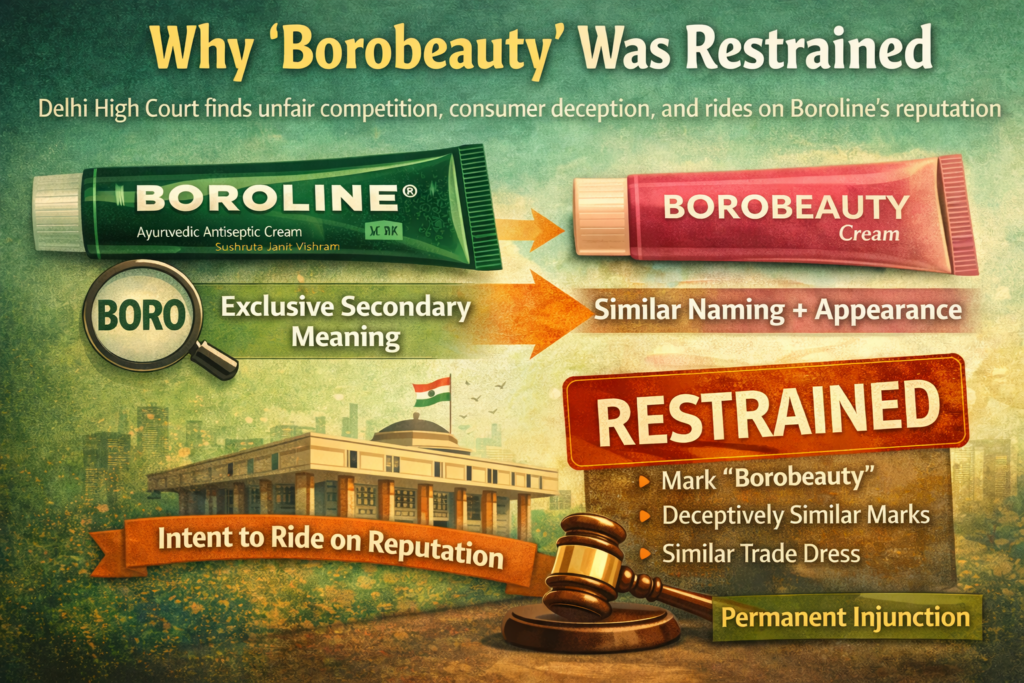
    Why “Borobeauty” Was Restrained

    The Delhi High Court found that:

    • The prefix “Boro” had acquired secondary meaning exclusively associated with Boroline
    • The defendant adopted a similar naming structure and visual appearance
    • Such adoption was not coincidental, but intended to ride on Boroline’s reputation
    • The conduct amounted to unfair competition and consumer deception

    Accordingly, the Court issued a permanent injunction restraining the use of:

    • The mark “Borobeauty”
    • Any other mark deceptively similar to Boroline
    • Packaging or trade dress resembling Boroline’s distinctive appearance

    Relief Granted by the Court

    • Permanent injunction against use of Borobeauty
    • Direction to adopt a distinct and non-infringing brand identity
      ₹2 lakh costs imposed on the defendant
    • Direction to include Boroline in the official list of well-known trademarks

    Significance of the Ruling on IPR Startegies

    This judgment is a milestone for trademark owners and IP strategists, as it:

    • Strengthens enforcement of well-known trademarks in India
    • Reinforces protection of trade dress and brand identity
    • Sends a strong message against phonetic and visual imitation
    • Demonstrates judicial intolerance toward free-riding on legacy brands

    WHY THIS CASE IS IMPORTANT FOR IP STUDENTS AND PRACTITIONERS

    For students preparing for Trademark Agent and Patent Agent Examinations, this case provides a practical demonstration of:
    • Trademark infringement and passing off
    • Judicial standards for ex‑parte injunctions
    • Role of intermediaries in modern IP enforcement

    For practitioners, the case reinforces that trademark litigation today requires legal strategy aligned with daily events of litigation.

    Conclusion : The Delhi High Court’s decision in the Boroline matter sends a clear notice that Trade dress similarity can independently defeat an application even if the word mark differs. Even Class Strategy & Cross-Class Risk Court Position underscored that Well-known marks enjoy protection across classes.

  • Copyright, Functionality, and the Headnote Paradox

    Copyright, Functionality, and the Headnote Paradox

    Lessons from Thomson Reuters v. Ross Intelligence

    The use of plaintiffs headnotes which includes editorial summaries of legal opinions to train its AI-driven legal research tool case by defendant became the central theme of the case Thomson Reuters v. Ross Intelligence has emerged as a landmark decision in terms intersection of artificial intelligence (AI) and copyright law. Here the owner of Westlaw, alleged that this constituted direct copyright infringement.

    Court’s Ruling on Copyright Infringement which opened the nuances in the said issue

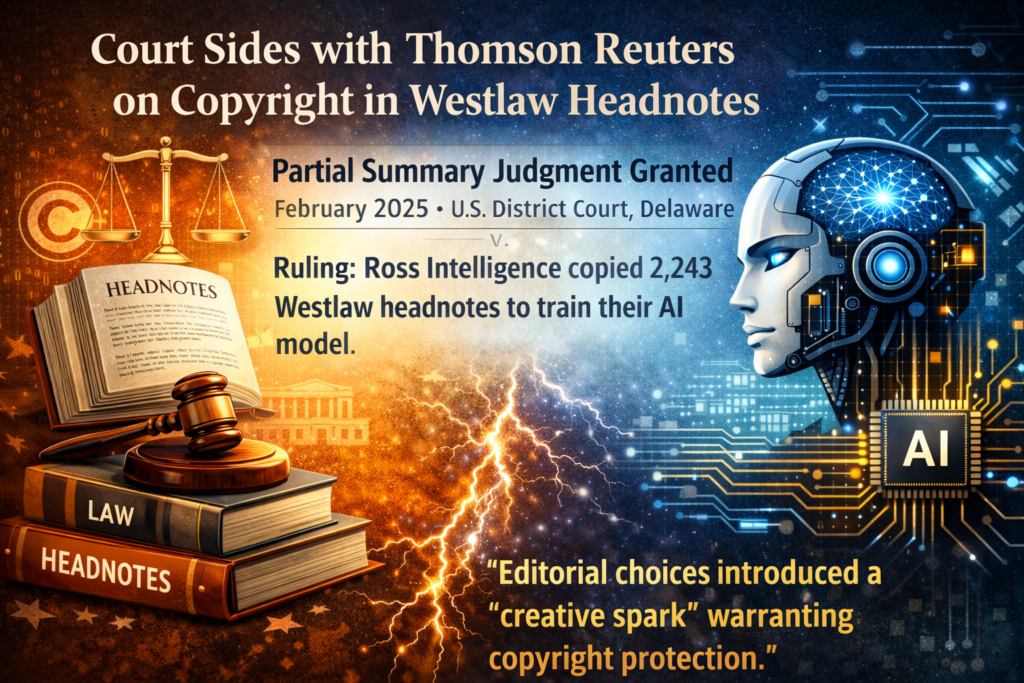
    The ruling which favored the plaintiff, where in February 2025, the U.S. District Court for the District of Delaware granted partial summary judgment on direct copyright infringement. The court held that defendant had copied and substantially appropriated 2,243 Westlaw headnotes to train its AI model.

    Here the efforts were made in terms of argument that the headnotes were factual and lacking in sufficient originality, in this regard the court held that the headnotes met the low threshold for originality required for copyright protection.

    The court emphasized that the editorial choices involved in distilling judicial opinions into headnotes introduced a “creative spark” warranting copyright protection.

    Critical Analysis of the Court’s Ruling in Indian stakeholders context :

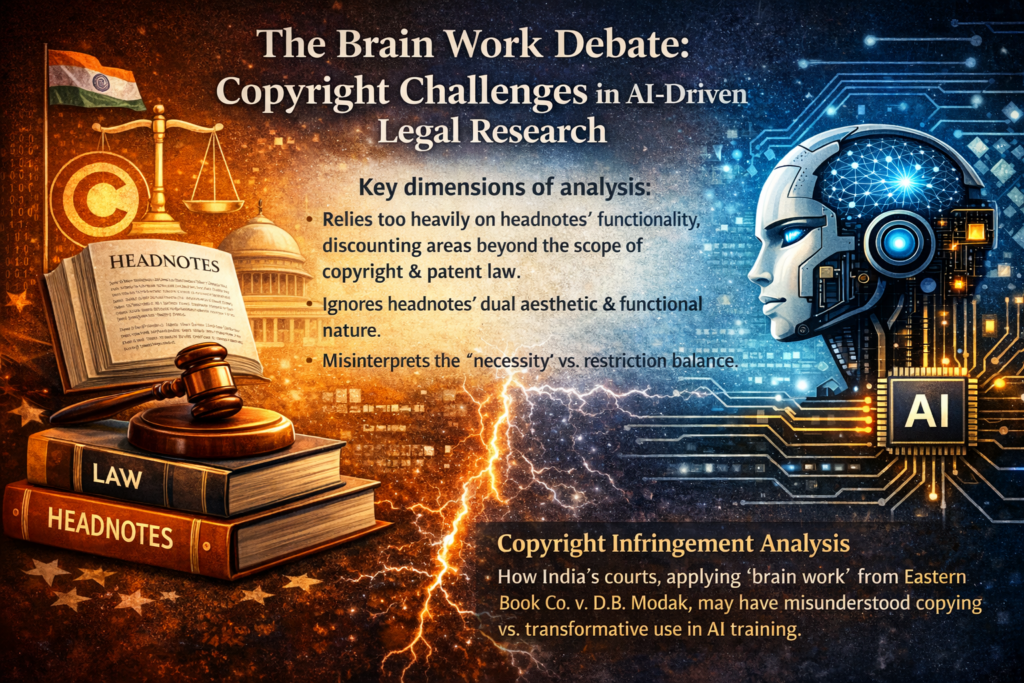
    In India’s context the doctrine of originality refers to “brain work” in such context from the case Eastern Book Company v. D.B. Modak  However, the key dimension of “brain work” lies in displaying the headnotes potentially incorporating quotes or paraphrases in verbatim alongside the judgment for navigation, not in the headnotes or their use in fact.

    While granting copyright to headnotes, it seems that the Court has overlooked the key aspect of “brain work”, was not relevant in the headnotes’ expression itself rather in their creative display along with judicial opinions for easier navigation. The headnote’s essence ‘expressive’ lies in its nature of summary, which enables the users to grasp the crux of judgment crux rather than digging deeper to entire text, combined with the minimal creativity in sequential display its opinion for easier navigation.

    The dimensions of analysis:

    a. Relies too heavily on similar functionality of headnotes to improve search tools, discounting functional aspects which is outside the scope of copyright as well as patent law’s domain;

    b. Ignoring its own recognition that headnotes, like computer software, served both aesthetic and functional purposes;

    c. Interprets the ‘necessity’ requirement to apply restriction.

    The Copyright Infringement Analysis

    In holding summary judgment for infringement, the Court fundamentally discounted the action of plaintiff where headnotes were copied, mere copying would factually amounts to infringement if not used for any ‘expressive’ objective/intent or to portray aesthetic and creative expression. The Court underscored this principle when considering the “amount and substantiality” fair use factor, stating “What matters is not the amount and substantiality of the portion used in making a copy, but rather the amount and substantiality of what is thereby made accessible to a public for which it may serve as a competing substitute.” However, this point was not considered when evaluating prima facie infringement.

    The Court’s analysis reveals a misunderstanding of how technological innovation intersects with copyright law. Undisputedly, the Westlaw headnotes were transformed into a numerical, machine-readable format to enable Ross Intelligence’s AI software to learn linguistic syntax and patterns. The fundamental purpose was to create an effective search functionality—a process that necessarily requires extracting key linguistic patterns from judicial opinions.

    Analysis of Fair Use Defense

    Ross Intelligence invoked the fair use doctrine, asserting that its use of the headnotes was transformative and served a different purpose. However, the court rejected this defense, analysing the four statutory fair use factors:

    a. Purpose and Character of the Use: The court found Ross’s use to be commercial and non-transformative, as it aimed to develop a competing legal research tool without adding new expression or meaning.

    b. Nature of the Copyrighted Work: While acknowledging that the headnotes were not highly creative, the court noted that they possessed sufficient originality to merit protection.

    c. Amount and Substantiality: The court observed that Ross had copied a substantial number of headnotes, which weighed against a finding of fair use.

    d. Effect on the Market: The court concluded that Ross’s use could harm the market for Westlaw’s services by creating a direct competitor, thereby negatively impacting Thomson Reuters’s market share.

    Based on this analysis, the court determined that Ross’s use did not qualify as fair use under U.S. copyright law.

    Implications for AI and Legal Research

    This ruling has significant implications for the use of copyrighted materials in training AI models:

    • AI Training Data: The decision underscores that using copyrighted content, such as editorial summaries or proprietary databases, to train AI systems without authorization can constitute infringement.
    • Fair Use Limitations: The case illustrates the limitations of the fair use defense, particularly when the use is commercial and does not add transformative value.
    • Market Impact Considerations: Courts may give considerable weight to the potential market impact of the unauthorized use of copyrighted materials in AI applications.

    As AI continues to evolve and integrate into various sectors, this case serves as a cautionary tale for developers to carefully consider the legal ramifications of their training data sources.

    The Indian Law Perspective

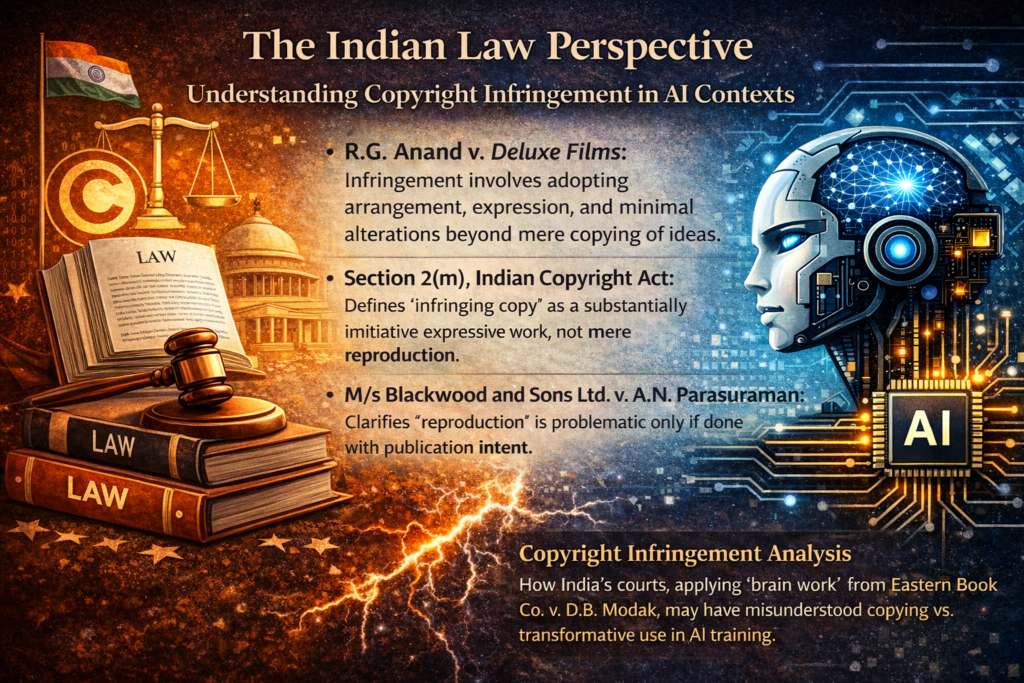
    The Indian legal framework offers a particularly sophisticated approach to understanding copyright in technological contexts. The Supreme Court’s landmark judgment in R.G. Anand v. Deluxe Films provides critical guidance on what constitutes an infringing copy. The Court recognized that infringement is not merely about copying ideas or embedded information, but about adopting the manner, arrangement, and specific expressive elements with minimal alterations in a subsequent expressive work.

    Section 2(m) of the Indian Copyright Act presents a nuanced definition of an ‘infringing copy’ that fundamentally differentiates between reproduction and mere copying. This distinction is crucial in technological contexts like AI training. The law suggests that reproduction becomes problematic only when it involves creating/or intending to create an expressive work that substantially imitates the original’s form of expression.

    The Madras High Court’s judgment in M/s Blackwood and Sons Ltd. v. A.N. Parasuraman further refined this understanding. The Madras High Court interpreted infringing reproduction as reproduction that amounts to publication, as opposed to reproduction for private use or without publication intent. Section 3 of the Act defines publication as “making a work available to the public by issue of copies or by communicating the work to the public.”

    Transformative Use Under Indian Law

    While transformative use is not explicitly part of Section 52 defences in Indian copyright law, courts have increasingly used the concept to restrict the scope of copyright protection itself. The Calcutta High Court’s approach in Barbara Taylor Bradford v. Sahara Media Entertainment significantly limited reproduction and adaptation rights for transformed purposes.

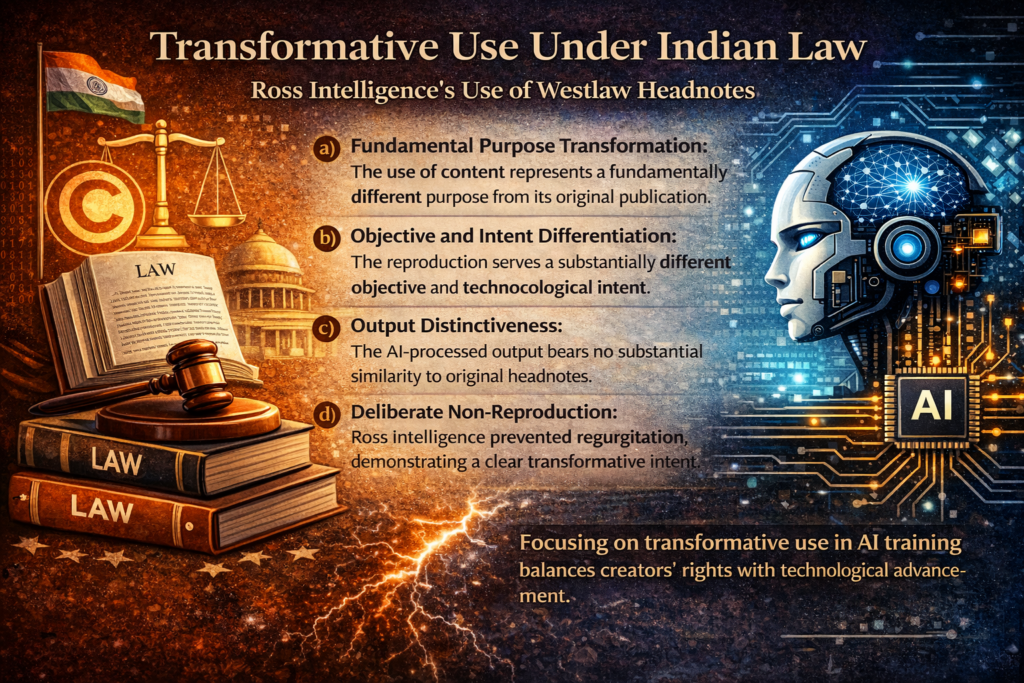
    In the context of AI training, Ross Intelligence’s use of Westlaw Headnotes presents a compelling case for transformative use:

    a) Fundamental Purpose Transformation: The use of copyright-protected content for AI training represents a fundamentally different purpose from the original publication. The objective is to train an artificial intelligence tool without exposing the expressive form to human readers—a stark departure from the original communicative intent.

    b) Objective and Intent Differentiation: The reproduction serves a substantially different objective. While the functional purpose might overlap, the intent is distinctly technological—to enable machine learning and pattern recognition rather than human comprehension.

    c) Output Distinctiveness: The subsequent output—judicial opinions extracted through AI processing—bears no substantial similarity to the original headnotes’ expressive form.

    d) Deliberate Non-Reproduction: Ross Intelligence’s careful effort to prevent headnote regurgitation demonstrates a clear intent to transform, rather than merely copy, the original content.

    This approach aligns with the fundamental principle that copyright protection should not impede technological innovation and extended to functional uses of creative expression. By focusing on the transformative nature of AI training, the law can balance the interests of content creators with the imperative of technological advancement.

    FINAL IP PERSPECTIVE

    While the Court carefully caveated that the judgment does not specifically address Generative AI, the implications are profound and potentially far-reaching. The findings about potential AI training markets and intermediate copying could create significant impediments to technological innovation.

    Intellectual property law does not suppress creativity. It ensures that creativity is respected, controlled, and lawfully shared. For creators and institutions alike, understanding this balance is no longer optional.

    CALL TO ACTION – IIPTA

    At the Indian Institute of Patent and Trademark (IIPTA), we train students and professionals to understand intellectual property as it functions in real disputes, not just in statutes.

    If you want to master copyright, trademark law, and licensing strategy with practical insight, IIPTA is where theory meets application.

  •  Whose Copyright Stands Tall?

     Whose Copyright Stands Tall?

    Saregama v. Vels Film and the Quiet Death of the Composer-First Myth in Indian Cinema

    INTRODUCTION: A JUDGMENT THAT SILENTLY REWIRES THE MUSIC INDUSTRY

    Indian copyright disputes rarely announce their true impact loudly.
    They arrive quietly, wrapped in familiar statutory language, only to reshape industry practice years later.

    The Delhi High Court’s decision in Saregama India Limited v. Vels Film International Limited & Ors. (2025) is one such judgment.

    On the surface, this was a dispute about a re-recorded song.
    In substance, it was a judicial reaffirmation of a truth the industry has long resisted:

    In Indian cinema, authorship does not automatically mean control. Contracts do.

    For decades, composers, lyricists, and filmmakers have operated under a comforting but legally fragile belief that creative authorship confers perpetual authority over musical works. This judgment dismantles that belief with clarity, precision, and very little sympathy.

    This article examines why this decision matters, what myths it destroys, and how it will influence copyright ownership, licensing, and enforcement going forward especially for Indian creators and production houses.


    THE FACTUAL BACKGROUND: STRIPPED OF DRAMA, EXPOSED IN LAW

    The dispute revolved around the legendary Tamil song “En Iniya Pon Nilave” from the 1980 film Moodu Pani.

    • Saregama India Limited, successor to HMV, claimed copyright ownership based on a historical assignment agreement executed with the film’s producer.
    • Vels Film International, while producing the film Aghathiyaa, incorporated a re-recorded version of the same song.
    • Permission, however, was taken not from Saregama, but from the composer, Ilaiyaraaja.

    This raised a deceptively simple question:

    Can a composer license a song that was created for a cinematograph film, even after the producer has assigned rights to a music label?

    The answer, according to the Court, was a firm no.

    THE CORE LEGAL CONFLICT: AUTHORSHIP VS OWNERSHIP

    Indian copyright discourse often collapses authorship and ownership into a single concept. This judgment forcefully separates them.

    What the Court clarified

    • A composer may be the author of a musical work.
    • But ownership of exploitation rights depends on statutory presumptions and contractual arrangements.
    • Emotional narratives around creativity do not override written assignments.

    This distinction is not new, but this judgment makes it impossible to ignore.

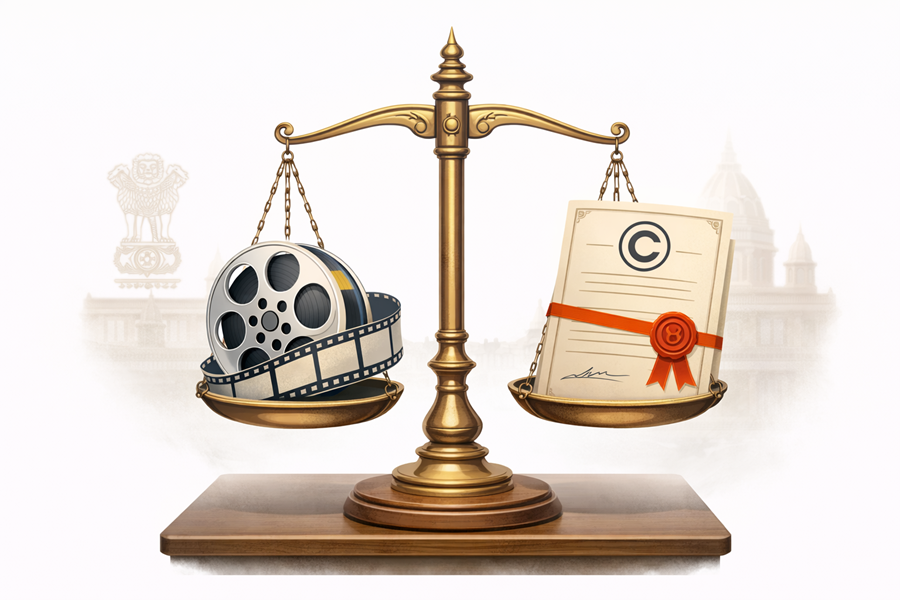
    SECTION 17: WHY PRODUCERS STILL HOLD THE KEYS

    Section 17 of the Copyright Act, 1957 establishes a default rule:

    The producer of a cinematograph film is the first owner of copyright in the film and its sound recordings unless a contract provides otherwise.

    The Court reiterated three critical realities:

    1. Film music is commissioned, not incidental.
    2. Consideration alters ownership dynamics.
    3. Silence in contracts favours producers—not authors.

    Once a producer assigns these rights, the assignee acquires complete commercial control, including the right to license or restrain use.

    This is where decades of industry misunderstanding finally met judicial finality.

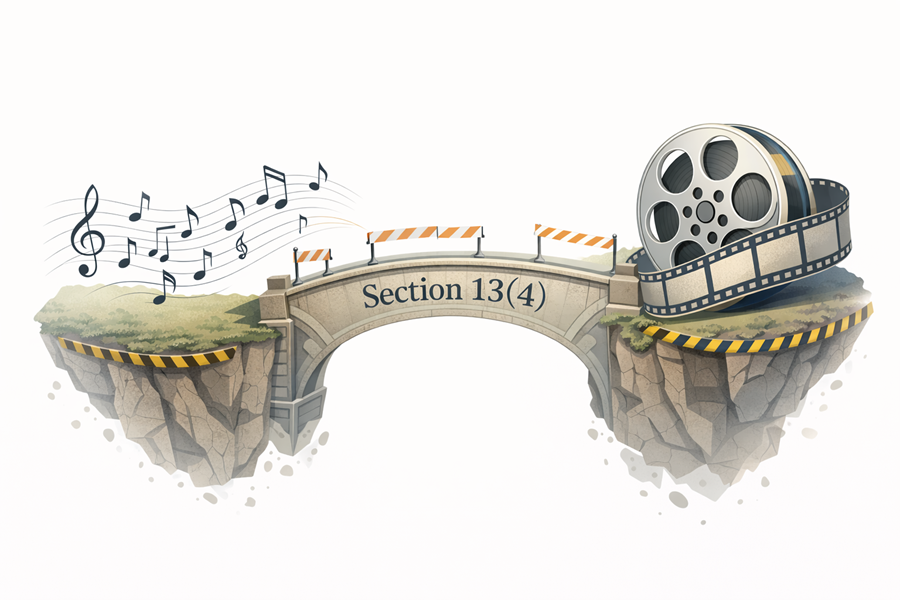
    SECTION 13(4): SURVIVAL IS NOT SOVEREIGNTY

    One of the most misused provisions in Indian copyright litigation is Section 13(4).

    Creators often rely on it to argue that:

    “My copyright survives independently;  therefore I can exploit it.”

    The Court dismantled this logic carefully.

    What Section 13(4) actually does:

    • It prevents extinction of underlying works.
    • It does not override contractual assignments.
    • It does not restore licensing authority once rights are assigned.

    Survival of copyright ≠ freedom to commercially exploit.

    ADAPTATION VS REPRODUCTION: WHERE MOST FILMS GET IT WRONG

    The defendants argued that the re-recorded song was an adaptation, not a reproduction.

    The Court rejected this argument without hesitation.

    Why this matters:

    • Adaptation requires substantial creative transformation
    • Mere re-recording, remixing, or rearrangement does not qualify
    • Cosmetic musical changes do not defeat infringement

    This clarification will have serious consequences for:

    • “Reimagined classics”
    • Tribute albums
    • Film remakes relying on composer permissions

    WHY THE COURT DID NOT STOP THE FILM

    Despite finding infringement, the Court allowed continued use of the song—subject to a ₹30 lakh deposit.

    This was not judicial softness.

    It was commercial realism:

    • The film was close to release
    • Investments had already been made
    • Monetary safeguards preserved rights without market disruption

    This approach reflects a mature copyright judiciary—firm on law, pragmatic on enforcement.

    THE PRECEDENTS THAT SEALED THE OUTCOME

    This judgment stands on strong foundations:

    • IPRS v. Eastern India Motion Pictures Association (1977)
    • ICSAC v. Aditya Pandey (2016)
    • IPRS v. Rajasthan Patrika (2023)

    Together, these cases confirm one uncomfortable reality:

    Indian courts protect contracts more fiercely than sentiment.

    THE MYTH THAT FINALLY COLLAPSES: “COMPOSER-FIRST” OWNERSHIP

    This case quietly ends a long-standing myth:

    • That composers retain overriding control
    • That fame substitutes formal rights
    • That moral authority defeats written assignments

    In Indian cinema, paper defeats passion.

    WHAT THIS MEANS FOR INDUSTRY STAKEHOLDERS

    For composers:

    • Authorship is recognition, not control
    • Contract negotiation is non-negotiable

    For producers:

    • Clear assignments are your strongest defence

    For music labels:

    • Legacy contracts still carry weight

    For filmmakers:

    • Clearance shortcuts are expensive mistakes

    WHY THIS CASE MATTERS BEYOND THE FILM INDUSTRY

    This judgment is not confined to music.

    Its implications extend to:

    • Advertising jingles
    • OTT content
    • Brand collaborations
    • Digital re-use of archival works

    Indian copyright enforcement is moving decisively toward commercial certainty.

    FINAL TAKEAWAY: CREATIVITY DESERVES RESPECT—BUT LAW DEMANDS DISCIPLINE

    This judgment does not diminish artistic contribution.

    It does something more uncomfortable—it demands accountability.

    Music may begin with inspiration, but in cinema, ownership is decided on contracts, assignments, and statutory presumptions.

    Those who ignore this do so at their own cost.

    CALL TO ACTION – IIPTA

    Learn Copyright Law Where Courts Actually Apply It

    At the Indian Institute of Patent and Trademark (IIPTA), we don’t teach copyright as abstract theory.
    We teach it as courts enforce it through real judgments, contracts, and licensing disputes that decide careers and crores.

    If you want to understand ownership, assignments, and enforcement the way the industry must, IIPTA is where that journey begins.

  • Synchronization Rights in Audiovisual Works

    Synchronization Rights in Audiovisual Works

    Why Courts Are Asking Questions and Platforms Should Be Nervous

    A critical reading of INTA’s response to the Andean Court

    Introduction: When Courts Ask, “What Is a Right?”, the Market Is Already Ahead

    Courts do not seek clarification on intellectual property rights in a vacuum.
    They do so when industry practice begins to outpace legal certainty.

    The Andean Court of Justice’s recent questions on synchronization rights in audiovisual works and INTA’s response to them signal precisely this moment: a collision between traditional copyright frameworks and modern audiovisual exploitation models.

    This is not merely a regional issue.
    It is a global copyright stress test.

    Synchronization Rights: Simple in Theory, Fragmented in Practice

    In theory, synchronization rights allow music to be combined with visual content—films, advertisements, games, streaming series.

    In practice, synchronization licensing is one of the most fragmented and commercially sensitive areas of copyright law.

    Why?

    Because every audiovisual use typically involves:

    • Rights in the musical composition
    • Rights in the sound recording
    • Territorial exploitation
    • Platform-specific monetisation models

    Courts intervene when licensing assumptions stop matching reality.

    Why the Andean Court’s Questions Matter

    The Court of Justice of the Andean Community (TJCA) operates within a supranational legal system whose interpretations override national law.

    When such a court seeks clarification on synchronization rights, it indicates:

    • Inconsistent national interpretations
    • Licensing disputes crossing borders
    • Commercial uncertainty affecting creators and platforms

    This is not doctrinal curiosity.
    It is damage control through jurisprudence.

    INTA’s Intervention: Not Advocacy, but Legal Stabilisation

    INTA’s response must be read carefully.

    INTA does not legislate.
    It contextualises.

    By addressing synchronization rights within:

    • The Andean Common Regime (Decision 351)
    • Existing copyright harmonisation principles
    • International licensing practices

    INTA effectively signals to the court:

    Over-restrictive interpretations will destabilise creative markets, not protect them.

    This is a subtle but important position.

    The Andean IP Framework: Why Uniform Interpretation Is Non-Negotiable

    The Andean Community’s IP regime is built on:

    • Direct applicability
    • Jurisprudential consistency
    • Mandatory compliance by national courts

    In audiovisual works, inconsistent interpretations of synchronization rights would result in:

    • Platform-level licensing paralysis
    • Increased transaction costs
    • Reduced regional content circulation

    The court’s role is not to expand rights but to clarify their operational boundaries.

    The Hidden Issue: Platforms, Not Producers, Are Driving This Debate

    Although framed as a creator-protection issue, synchronization disputes today are driven largely by:

    • Streaming platforms
    • Cross-border digital distribution
    • Algorithm-driven content monetisation

    Traditional licensing assumptions—territorial, time-bound, medium-specific—are increasingly incompatible with platform economics.

    Courts are now being asked to reconcile:

    • Static statutory language
    • Dynamic digital exploitation

    This is where interpretation becomes policy.

    What This Means for Creators and Rights Holders

    For creators:

    • Legal clarity reduces licensing friction
    • Harmonised interpretation improves bargaining predictability

    For rights holders:

    • Synchronization rights cannot be treated as isolated permissions
    • They must align with platform-scale exploitation realities

    For MSMEs (which dominate the Andean market):

    • Predictability matters more than theoretical exclusivity

    Key Learnings for IP Professionals

    Strategic Takeaways

    • Synchronization rights sit at the intersection of copyright and commerce
    • Courts intervene when markets become legally unstable
    • Supranational interpretation shapes national enforcement
    • Digital platforms are redefining licensing assumptions

    Why This Matters for IP Education in India

    At IIPTA, we teach copyright not as static sections but as living systems shaped by courts, contracts, and commerce.

    Understanding developments like the Andean Court’s inquiry prepares professionals to:

    • Anticipate licensing disputes
    • Draft future-proof contracts
    • Advise clients beyond statutory literalism

    IIPTA

    Want to understand copyright where law meets real-world exploitation?
    Learn how audiovisual rights, licensing structures, and judicial interpretation function in global markets.

     Explore IIPTA’s Copyright & Media Law programs.

  • Striking the Right Chord or Merely Tuning the Instruments?

    Striking the Right Chord or Merely Tuning the Instruments?

    What the SWA–MCAI MoU Really Means for Copyright, Credit, and Creative Control in India

    An IP professional’s reading of authorship, contracts, and bargaining power

    Introduction: Credit Was Never the Core Problem—Power Was

    India’s copyright statute has never denied authorship to screenwriters, lyricists, or composers. On paper, the law has long recognised their creative contribution.

    And yet, for decades, these very creators have struggled for:

    • Proper credit
    • Fair remuneration
    • Contractual clarity

    The disconnect lies not in the Copyright Act, but in how power operates within the creative industry.

    The recent MoU between the Screenwriters Association (SWA) and the Music Composers Association of India (MCAI) must be read through this lens—not as a legal revolution, but as a recalibration of negotiating strength.

    The Real Industry Problem the MoU Responds To

    Historically, film and music contracts in India have followed a predictable pattern:

    • Producers control financing and distribution
    • Creators negotiate individually
    • Assignments under Section 18 become routine

    The result?

    Statutory authorship exists, but economic ownership migrates upward.

    The MoU is an attempt to disrupt this pattern—not by changing the law, but by changing how creators approach contracts.

    What the SWA–MCAI MoU Actually Changes

    The MoU does three important things:

    1. Reasserts Co-Authorship as a Negotiating Baseline

    By recognising lyricists and composers as co-authors and primary artists, the MoU pushes back against long-standing credit hierarchies where visibility was reserved for performers.

    2. Encourages Contractual Separation

    Requiring separate contracts for lyricists and composers prevents bundled negotiations where one creator’s leverage is diluted by another’s urgency.

    3. Creates Collective Bargaining Pressure

    Unity matters because copyright contracts are rarely about law they are about leverage.

    Copyright Law Already Allowed This—So Why Didn’t It Happen Earlier?

    This is where legal realism matters.

    Under the Copyright Act:

    • Section 2(d) recognises authorship
    • Section 17 vests first ownership in authors
    • Section 57 protects moral rights

    So why were creators still sidelined?

    Because copyright law does not police bargaining power.
    Contracts do.

    The MoU does not create new rights.
    It reduces the cost of asserting existing ones.

    Moral Rights: Credit Is Not Decorative

    The emphasis on consistent credit across promotional material is not symbolic—it is strategic.

    Moral rights under Section 57:

    • Survive assignment
    • Protect attribution
    • Preserve creative identity

    By insisting on visible credit, creators are reclaiming reputational capital, which directly influences future bargaining strength.

    The Proposed Standard Agreement for Screenwriters: Why It Matters More Than the MoU

    The proposed standardised agreement addresses issues creators face daily:

    • Vague credit clauses
    • Open-ended indemnities
    • Payment uncertainty

    By formalising:

    • Proportional credit
    • Prominent placement
    • Clear remuneration terms

    the agreement shifts negotiations from individual desperation to collective norms.

    What This MoU Cannot Do (And Why You Should Care)

    A serious IP analysis must acknowledge limits.

    • An MoU is not enforceable law
    • Producers can still refuse terms
    • Platforms remain outside its reach

    Its strength lies not in compulsion, but in collective refusal to undercut one another.

    Key Learnings for IP Professionals

    • Copyright law enables rights; contracts decide outcomes
    • Collective bargaining reshapes negotiations
    • Moral rights are strategic tools, not afterthoughts
    • Industry reform happens incrementally, not instantly

    Why This Matters for IP Education

    At the Indian Institute of Patent and Trademark (IIPTA), we teach intellectual property as it actually operates—at the intersection of:

    • Statutes
    • Contracts
    • Industry practice

    Understanding developments like the SWA–MCAI MoU requires more than legal literacy.
    It requires commercial and institutional awareness.

    Want to understand copyright the way creators and producers negotiate it?
    Learn how authorship, assignment, moral rights, and contracts function in the real creative economy.

    Explore IIPTA’s Copyright & Media IP programs.