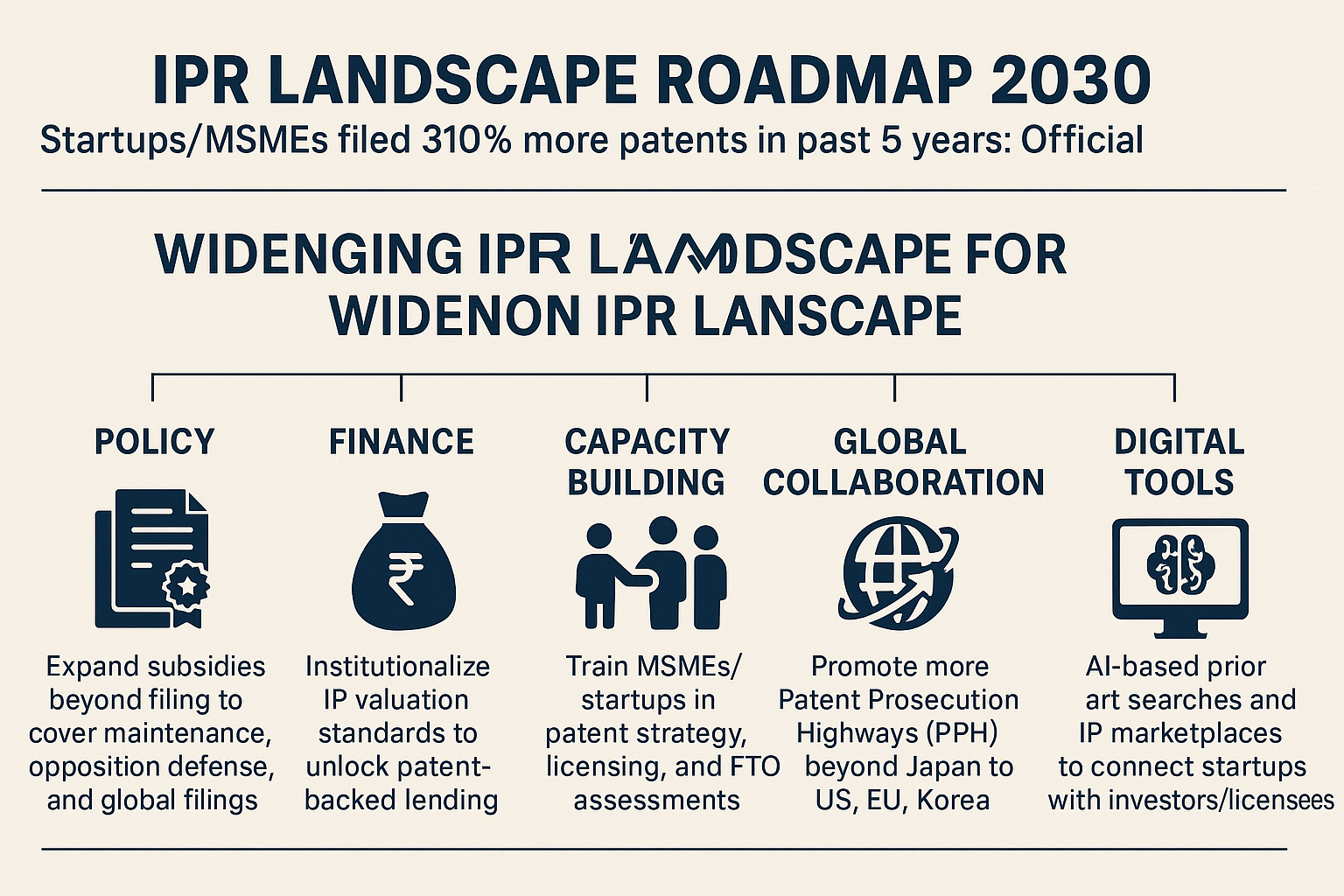
A Thrust for expansion of Innovation Landscape
In the developing economy it is not only the role of large industries who always take the responsibility of social welfare in terms of employment generation the same role is shifting to ground level players who are popularly known as Micro Small and Medium Enterprises and in recent years one more participant is startups. These players are also demonstrating their potential to contribute for economic development generally and innovation landscape by adapting Research and Development strategies particularly.
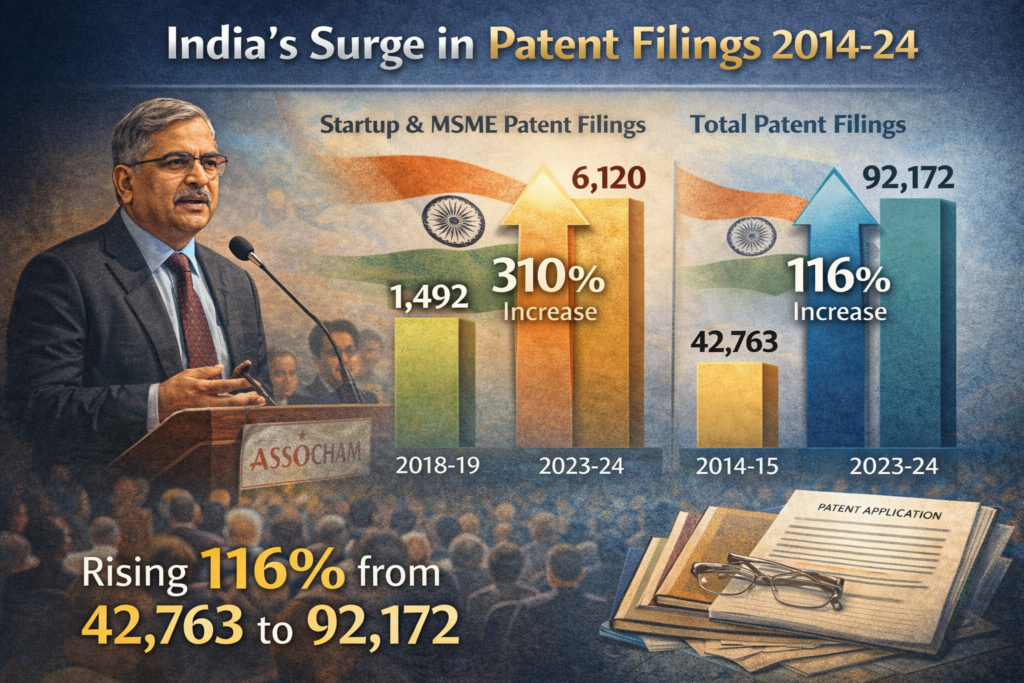
To justify the above narration, recently Joint Controller General of Patents, Designs and Trademarks, addressing an event organized by ASSOCHAM mentioned that Patent filings by startups and MSMEs have increased by 310 per cent in the last 5 years from 1,492 in 2018-19 to 6,120 in 2023-24 that the filing of patent applications in India has surged by 116 per cent rising from 42,763 in 2014-15 to 92,172 in 2023-24.
As we are all aware that innovation should be encouraged through reward, capacity to innovate is considered as individual intellect which is further referred as Intellectual Property and Patent is one such legal protection for 20 years which is provided in India and most of the other countries around the globe. Patent protection which is one such aspect gives exclusive right to patentee for both product (amendment of 2005 to Indian Patent Act 1970) and also to process, which gives privilege administratively and economically.
Factors Driven that driven to entry of stakeholders from various strata of Business establishment:
There are various dimensions of governance structure takes credit for this progress in justified way which are analyzed as follows ;
The provisions like early publication which is prescribed under Section 11 A of the Indian Patent Act 1970 for all stakeholders and Expedited examination under Rule 24 C Indian Patent Rules 2003 particularly for Individual/ Startups and MSMEs. The fee structure in various stages of prosecution also highly affordable which are treated in par with individual inventor.
Which is one dimension and when it comes to implementation stage, National Intellectual Property Awareness Mission (NIPAM) launched in 2021, NIPAM has educated over 2.4 million students and faculty across India about IP rights, fostering a culture of innovation and IP protection.
This coincides with government schemes like Startup India, National IPR Policy (2016), Patent Prosecution Highway (with Japan), fee rebates (up to 80% for startups), and expedited examination.
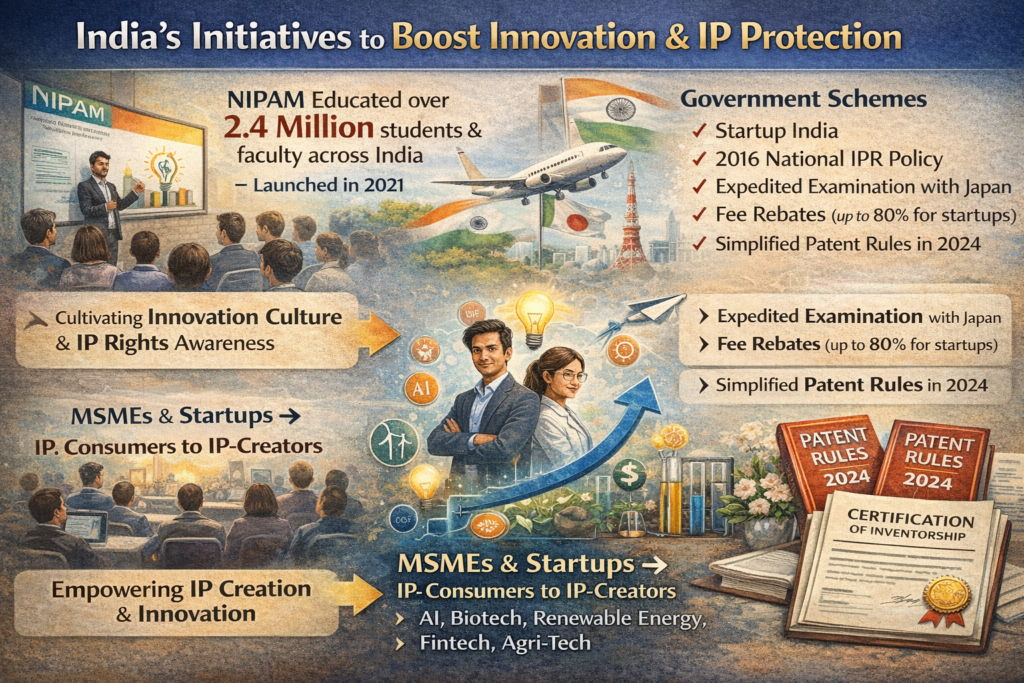
Recently the patent rules have been amended in 2024 in order to further simplify and streamline the procedure and create conducive environment for innovation and protection of Intellectual Property (IP) in India.
In addition to this a certification of inventorship has also been introduced to enhance patenting ecosystem in India by formally recognizing efforts of the inventors explicitly.
Time interval to file ‘working statements of patents’ has been reduced from once in a year to once in every three years to lessen the administrative burden on applicants and reduce compliance costs.
Where MSMEs and startups are shifting from being IP-consumers to IP creators, particularly in AI, biotech, renewable energy, fintech, and Agri-tech.
From the above aspects analysis it can be infer that India’s IPR policy has provided a comprehensive framework for Innovation ecosystem and stakeholders landscape across the nation in terms of creation, protection and commercialization despite of this a progressive evaluation is necessary.
Global Positioning and India’s justification:
India, long criticized in USTR’s Special 301 reports for weak IP enforcement, can now showcase a growing domestic stakeholder base invested in IP protection. This strengthens India’s negotiating hand in trade/IP dialogues (e.g., with US/EU).
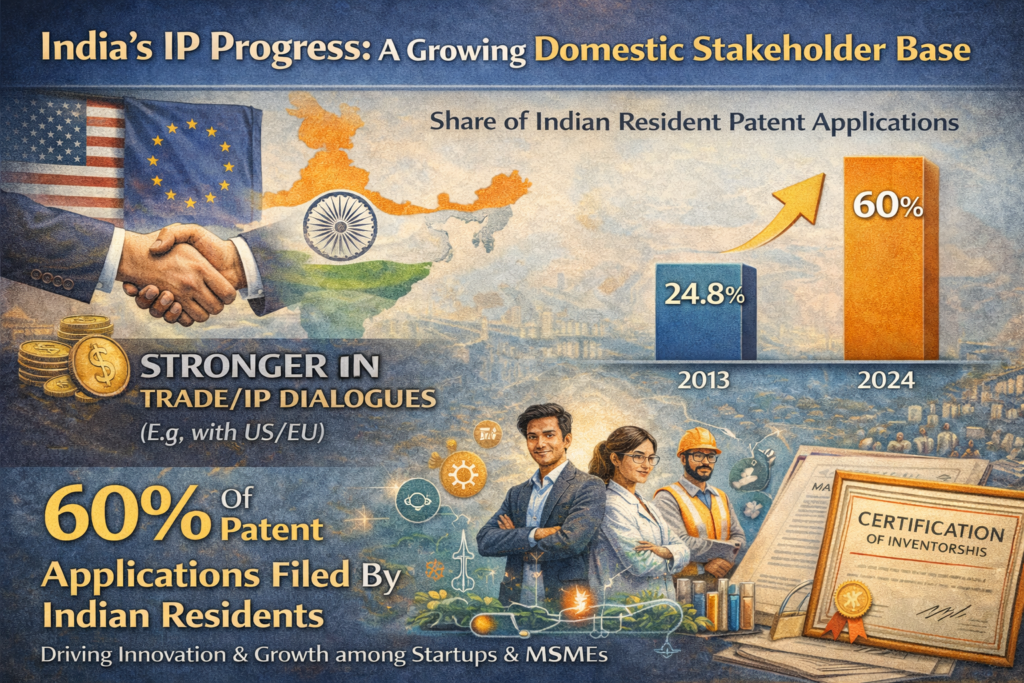
It is also to take note of the facts and figures where the share of patent applications filed by Indian residents grew from 24.8% in 2013 to 60% in 2024, showcasing increased domestic engagement in IP protection.
These developments underscore India’s commitment to fostering innovation and protecting intellectual property, particularly among startups and MSMEs, which are vital to the country’s economic growth and technological advancement.
What Innovators & R&D Teams Should Learn from This Development and need to take care of multidimensional aspects?
There is certain thing which should be taken as precautionary aspects before filing the patent application to carry out the process smoothly and to reap benefits of the trends The aspects which need support from the attorney are as follows
A. Disclose the invention clearly and Completely: Since the India
Patent law demands high scientific detail, not summaries and description.
So, any patent application MUST include the dimensions and aspects :
- Methodology
- Lab protocols
- Culture conditions
- Experimental results
- Genetic sequence information (in case of biotechnology particularly)
- Deposit details (if needed in case biological material used for the work)
B. Draft Claims Smartly (avoid boarder claims) :
Claims provide actual protection for the invention and claims are considered as legal boundaries of an invention. So, it is necessary to draft claims in a smarter way as;
Smart claims:
- Match the description
- Are precise
- Highlight inventive steps
A well-drafted claim directly proportional to Higher chance of grant.
C. Understand Section 3 and Section 4 (Non- Patentable Inventions) which are Restrictions under Indian Patent Act 1970 generally
Common rejection grounds particularly as follows:
- Section 3(c) – natural organisms
- Section 3(d) – known variants
- Section 3(i) – diagnostic & therapeutic methods
- Section 3(j) – plants, animals, seeds
- Section 4 -atomic energy
If your invention falls under any of the above-mentioned category You need expert drafting to overcome objections.
D. Impact on Startups & Researchers
This development signals that:
- India is open to startup and MSME business landscape where government is coming up with policies and executive initiatives.
- BUT only when applications are drafted with precision and scientific depth will get edge over others.
For startups, researchers, and companies, the key considerations are as follows:
- Needful preparation of detailed, high-quality patent specifications.
- Need to work with experts who understand both science as well as patent law.
- Need to avoid broad, vague, or incomplete disclosures.
How IIPTA Helps Innovators from Startups and MSME landscape by analysis of current or reported filing patterns for training
At IIPTA (Indian Institute of Patent & Trademark), the innovators get guidance
understand patent drafting, according to provisions of Section 10, and
Section 3, with consideration of global patent landscape.
Guiding with Compliance of Early Publication and Expedited examination under Rule 24c of Indian Patent Rules 2003.
Conclusion: Inventions become assets not just by filing but by getting legal recognition which is patent in particular case
When the budding business like startups and MSMEs integrate the inventive approach it widens the landscape of IPR where there is a room for grassroot level talent which amplifies the responsibility of IPR professionals.