What Innovators Must Know Before Filing in India
Delhi High Court Rejects Biotech Patent: What Innovators Must Know Before Filing in India
Biotechnology is one of the most exciting and rapidly advancing fields in the world today, but in India, it is also one of the most challenging domains for patent protection. A recent judgment of the Delhi High Court in The Regents of the University of California v. The Controller of Patents has once again reminded innovators, startups, researchers and companies that even a scientifically brilliant invention can fail at the Indian Patent Office if the drafting is not legally strong. The Court’s decision to uphold the rejection of a genetically modified Salmonella-based vaccine patent offers crucial insights for anyone preparing to file a biotech patent in India.
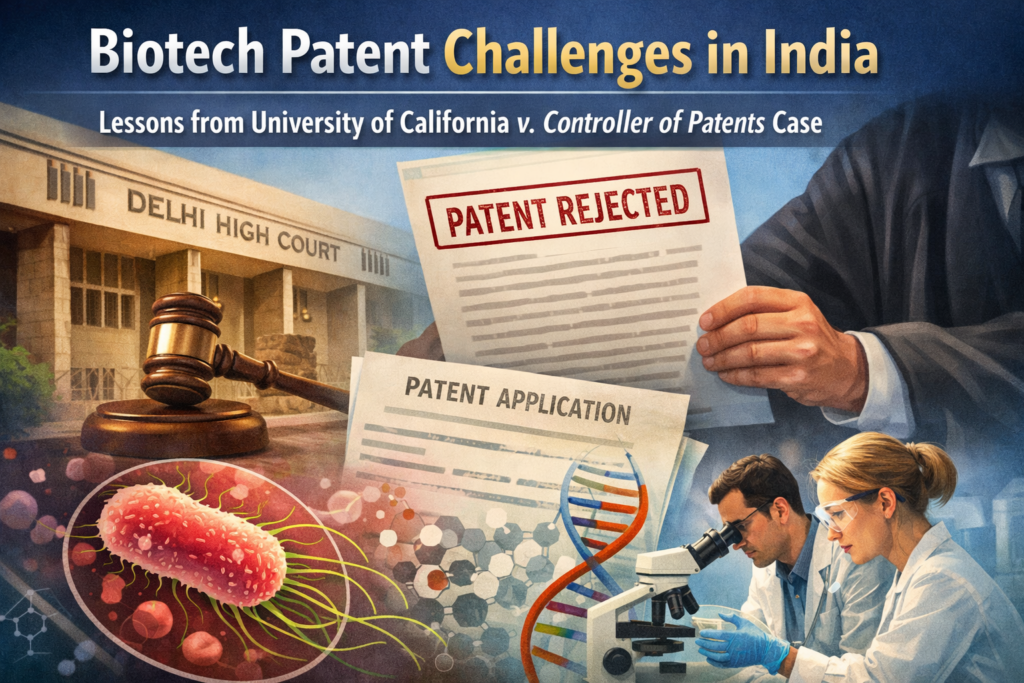
The University of California had filed an application for a recombinant Salmonella strain intended for use as a livestock vaccine. While the scientific concept was strong and potentially valuable to the agricultural and veterinary sectors, the patent office rejected the application on several grounds. When the matter reached the Delhi High Court, the judges examined the specification closely and found that the invention did not meet the essential requirements of the Patents Act, particularly the detailed disclosure standards that India expects in biotechnology inventions.
One of the central problems was that the application lacked a complete and reproducible explanation of how the recombinant strain was created. Indian patent law, under Section 10(4), requires applicants to disclose the invention in such detail that a person skilled in the art can replicate it without undue experimentation. In this case, the Court observed that the patent application did not describe the exact genetic modifications, experimental procedures, or steps required to produce the modified organism. Without this information, the invention could not be reproduced, and therefore did not meet the disclosure requirement.
Another major issue was the drafting of claims. Under Section 10(5), the claims of a patent must be clear, precise and supported by the description. However, the claims in this application were drafted so broadly that they could cover naturally occurring mutations of Salmonella. This created a second legal problem. Indian law, specifically Section 3(c), does not allow patents on discoveries of natural living organisms. Since the broad wording of the claims risked overlapping with natural forms of the organism, the Court held that the invention fell into the prohibited category.
In its final decision, the Delhi High Court agreed with the Patent Office and upheld the rejection, not because the science lacked merit, but because the legal drafting did not meet Indian standards. This judgment illustrates a fundamental truth about biotechnology patents in India: the quality of drafting is just as important as the scientific innovation itself. Even the most groundbreaking biotechnological invention can be rejected if the disclosure is incomplete or the claims are not carefully drafted.
For biotech innovators, this case carries a powerful lesson. India expects a high level of technical detail, including genetic sequences, laboratory methods, experimental data and information that ensures reproducibility. High-level descriptions, summaries or theoretical explanations are not enough. Inventors must also be extremely careful when drafting claims, ensuring they are neither overly broad nor vague, and that they reflect only what is actually invented—not what exists in nature.
This decision also has significant implications for biotech startups and research teams. In a field where innovation moves quickly, patent protection plays a crucial role in attracting investment, commercializing technology, and protecting competitive advantages. However, drafting a successful biotech patent requires collaboration between scientists who understand the invention and patent professionals who understand the law. Without this partnership, even a promising invention may not meet India’s strict requirements.
At IIPTA, we help innovators bridge this gap. We train researchers, students and startups to understand how to prepare high-quality patent specifications, how to overcome Section 3 objections, and how to draft claims that are both enforceable and compliant with Indian law. Our programs are designed to give applicants the clarity, confidence and legal strategy needed to protect their inventions successfully.
The Delhi High Court’s judgment ultimately reminds us that in biotechnology, drafting matters as much as discovery. To succeed in the Indian patent system, innovators must ensure that their applications are complete, precise and legally sound. With the right guidance and expertise, even complex biotech inventions can be protected and commercialized effectively
Delhi High Court Rejects Biotech Patent: What Every Innovator Must Know Before Filing in India
Are Biotech Patents Becoming Harder in India?
Biotechnology is one of the fastest-growing innovation sectors, yet it also faces the highest rejection rate at the Indian Patent Office.
A recent Delhi High Court decision in The Regents of the University of California v. Controller of Patents is a wake-up call for researchers, companies, and R&D teams.
Why? Because the court has made it crystal clear:
If your biotech patent lacks complete disclosure, it will be rejected — no matter how innovative it is.
This blog breaks down the case in simple words and explains how innovators can protect their biotech inventions successfully
. A. What Was the Patent About?
The University of California filed a patent for a genetically modified Salmonella strain to develop a livestock vaccine.
The invention was scientifically strong — but legally weak.
The IPO rejected it, and the High Court agreed. Why? Because great science is not enough.
You also need great patent drafting.
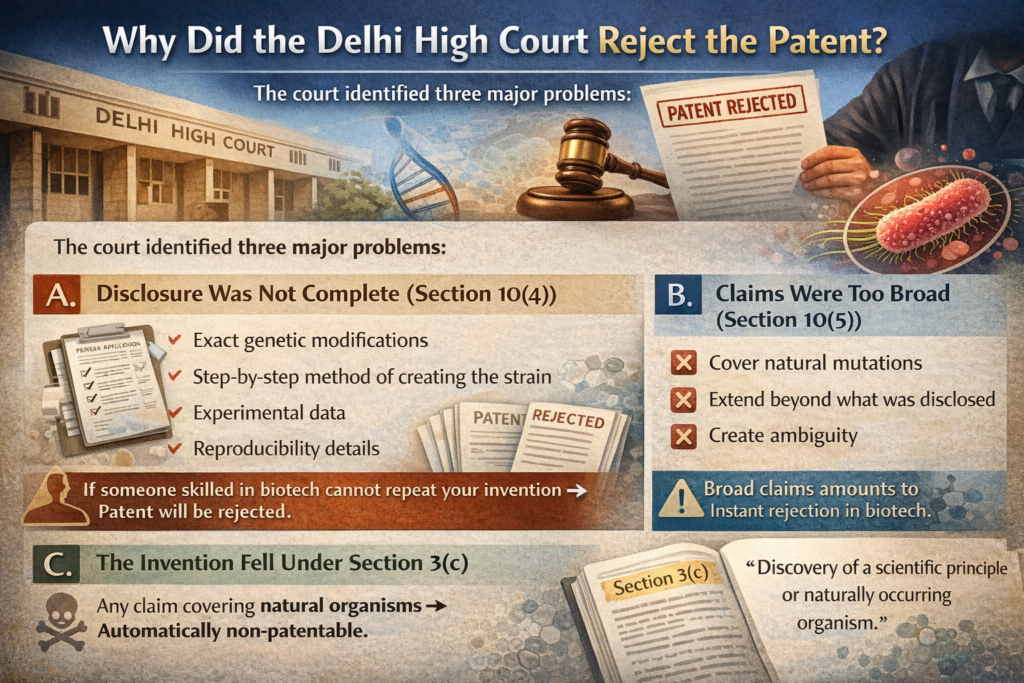
B. Why Did the Delhi High Court Reject the Patent?
The court identified three major problems:
a. Disclosure Was Not Complete (Section 10(4))
The patent application did not clearly disclose:
- Exact genetic modifications
- Step-by-step method of creating the strain
- Experimental data
- Reproducibility details
If someone skilled in biotech cannot repeat your invention → Patent will be rejected.
b. Claims Were Too Broad (Section 10(5))
The claims were so broad that they could:
- Cover natural mutations
- Extend beyond what was disclosed
- Create ambiguity
Broad claims amounts to Instant rejection in biotech.
C. The Invention Fell Under Section 3(c)
Section 3(c) excludes:
“Discovery of a scientific principle or naturally occurring organism.”
Because the claims were broad enough to include natural Salmonella, the court applied Section 3(c).
Any claim covering natural organisms → Automatically non-patentable.
What Innovators & R&D Teams Should Learn from This Case
Disclose the invention clearly and Completely:
Since the India Patent law demands high scientific detail, not summaries and description.
So, any patent application MUST include the dimensions and aspects:
- Methodology
- Lab protocols
- Culture conditions
- Experimental results
- Genetic sequence information (in case of biotechnology particularly)
- Deposit details (if needed in case biological material used for the work)
Draft Claims Smartly (avoid boarder claims):
Claims provide actual protection for the invention and claims are considered as legal boundaries of an invention. So, it is necessary to draft claims in a smarter way as;
Smart claims:
- Match the description
- Are precise
- Highlight inventive steps
A well-drafted claim directly proportional to Higher chance of grant.
Understand India’s Section 3 of Indian Patent Act 1970 which are restrictions / non-patentable inventions
Common rejection grounds:
- Section 3(c) – natural organisms
- Section 3(d) – known variants
- Section 3(i) – diagnostic & therapeutic methods
- Section 3(j) – plants, animals, seeds
If your invention falls here → You need expert drafting to overcome objections.
Impact on Biotech Startups & Researchers
This judgment signals that:
- India is open to biotech patents
- BUT only when applications are drafted with precision and scientific depth
For startups, researchers, and companies, the key considerations are as follows:
- Needful preparation of detailed, high-quality patent specifications.
- Need to work with experts who understand both science as well as patent law.
- Need to avoid broad, vague, or incomplete disclosures.
How IIPTA uses case law for training
At IIPTA (Indian Institute of Patent & Trademark), case law like he Regents of the University of California v. Controller of Patents .
In understanding patent drafting,
Section 3 compliance, and global patent trends.
Hands-on practice with live biotech cases
Conclusion: Strong Patents Create Opportunity—and Responsibility
The case law Regents of the University of California v. Controller of Patents .
For IP professionals, the real takeaway is this: patent grants are not endpoints. They are inflection points in a longer strategic journey where legal strength, commercial intent, and public interest synchronization is essential criteria needs to be taken in drafting stage itself .
Those who understand this intersection build durable IP strategies. Those who do not merely collect certificates.