How a Copyright Dispute Pulled the ED into the Enthiran Saga
The movie Enthiran, which is famously known as Robo world wide which was theatrically released in 2010. In the year 2011 author Aarur Tamilnadan alleged that the film’s storyline was plagiarized from his earlier work Jugiba.
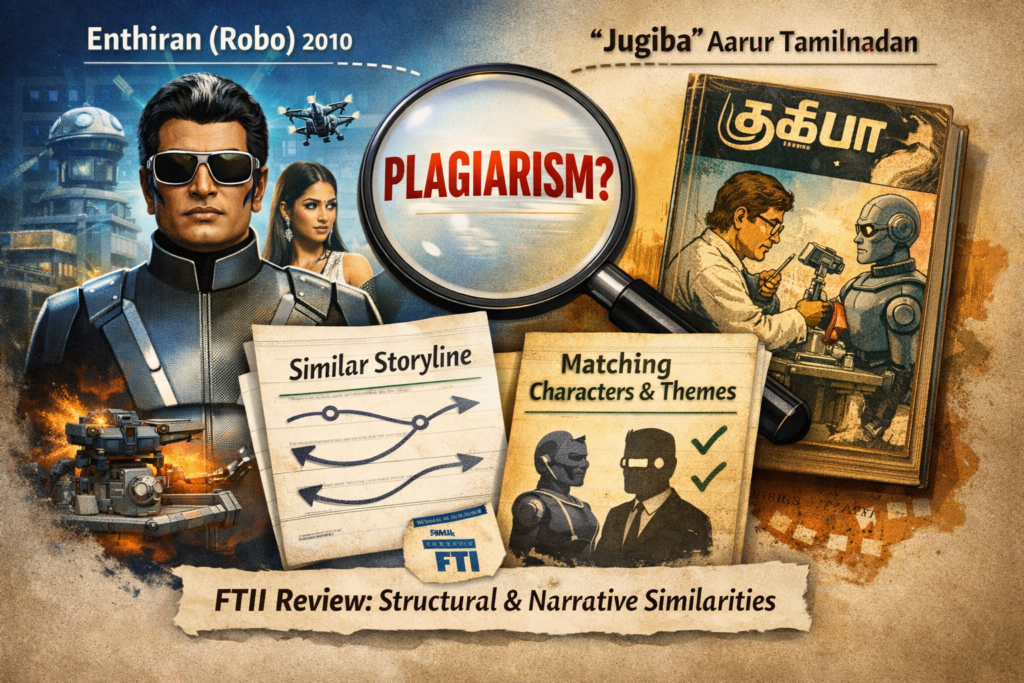
As the independent review conducted by Film and Television Institute of India (FTII) justified the claims of plagiarism through identification similarities between Enthiran and Jugiba in terms of structural narrative, flow of character and themes.
Background of the Dispute
In 2011, Tamilnadan filed a civil suit and a criminal complaint alleging that Enthiran plagiarized his 1996 story Jugiba. He sought damages and claimed that Shankar had committed offenses under Section 63 of the Copyright Act infringement and Section 420 of the Indian Penal Code cheating.
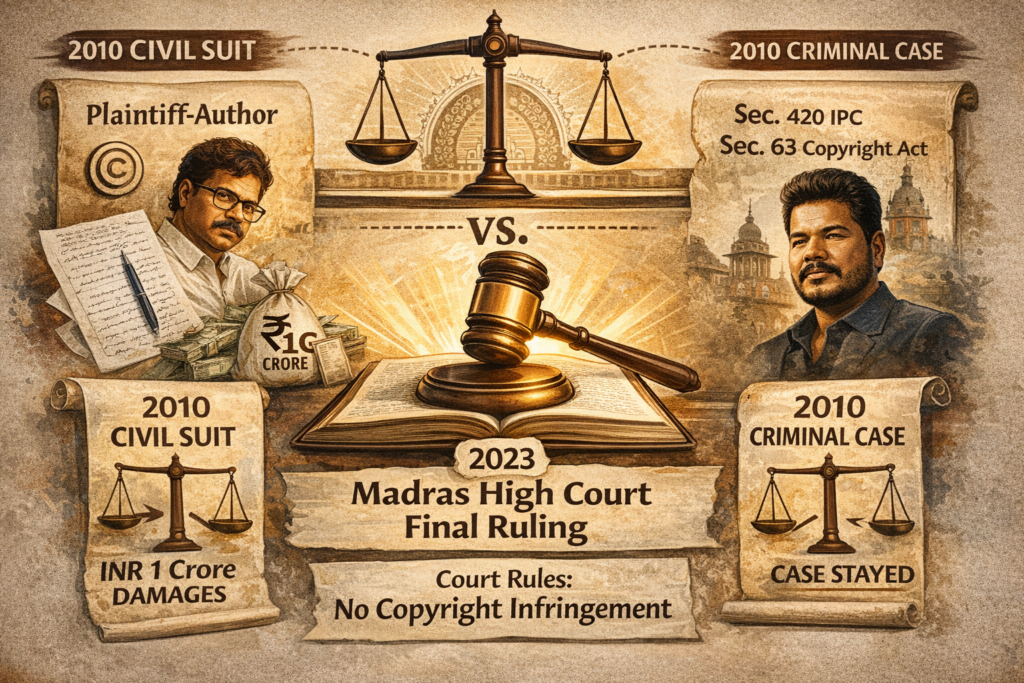
In the present case both, the civil suit and the criminal case were filed by plaintiff against defendant in 2010. In the civil suit, the writer sought a declaration that he was the first author and owner of the “Enthiran”, a permanent injunction against the director, rendering the accounts of profit made by the film to plaintiff, and also damages worth INR 1 Crore.
After duration more than 3 years after a decade, the Madras High Court in 2023 decided the civil suit in favor of defendant . The Court observed that the plaintiff failed to prove copyright infringement.
The court citied well-established principle from the R.G. Anand v. Deluxe Films (1978) was applied to highlight the idea-expression dichotomy and the Court found that while both the works Jugiba and Enthiran involved humanoid robots, their ways of carrying out the story were very different.
The judgement pointed out the flaws in plaintiff’s submissions as unable to prove literal imitation by providing sufficient evidence, as well as lack of independent witnesses to rely on for his claims. The Court also found that the similarities may be considered generic and even inevitable in a sci-fi narrative of a robot film.
The criminal case dimension analysis as in 2019, the High Court turned down the criminal charge under Section 420, based on the facts and circumstances of the case do not make an issue for the offence. The Court also sidelined the case against the producer but allowed it to continue vis a vis Sec. 63 against defendant. But in 2023, influenced by the civil suit finding in favor of Defendant, the Madras High Court stayed the proceedings in the criminal case.
Repercussions of Allowing a crime investigating agency to Investigate Intellectual property like Copyright Cases which is a civil suit:
A copyright owner could file a civil suit and/or explore remedies under criminal law, according to their circumstances for out-of-court, settlement simpler negotiations, and other strategies as first step. But now, due to the PMLA’s involvement, even if the parties settle, the money laundering investigations will continue.
However, one argument could be that this may not eventually matter since the money laundering charges are dependent on whether the scheduled offences (i.e. copyright infringement) have been proved or not.
Theoretically, PMLA’s involvement even affects existing copyright remedies and makes them redundant.
As remedies like Mareva injunctions , helps the plaintiff in preventing an infringer from disposing of their assets so that damages can be recovered.
But with PMLA in effect, these assets can be attached as proceeds of crime under the PMLA and be confiscated by the Government instead. While Section 64 already allowed for the seizure of infringing copies, the PMLA now adds another mechanism that can cause conflict.
The main issue here is, that the Government’s ability to seize assets may have priority over the plaintiff’s right to recover damages. This situation demands clarity whether the PMLA will be considered to supersede the Copyright Act since it is a more recent enactment, too.
The application of PMLA to cases like these, where defendants’ assets were being attached without a definitive judicial ruling, creates a chilling effect. Based on allegations alone, creative professionals may be faced with serious repercussions when people weaponize copyright disputes.
The need for a clearer, more balanced approach to IP disputes in India has never been more highlighted. At this point, the Enthiran case seems to be a reflection of how due process and justice remain shadows in a dystopian criminal system.
Legal and Ethical Considerations
The involvement of crime investigative agencies and action has raised concerns about the application of money laundering laws to copyright disputes which is a civil case . The ED’s further move came despite the dismissal of civil suit’ as well as stay on criminal proceedings, leading to concerns about overreach.
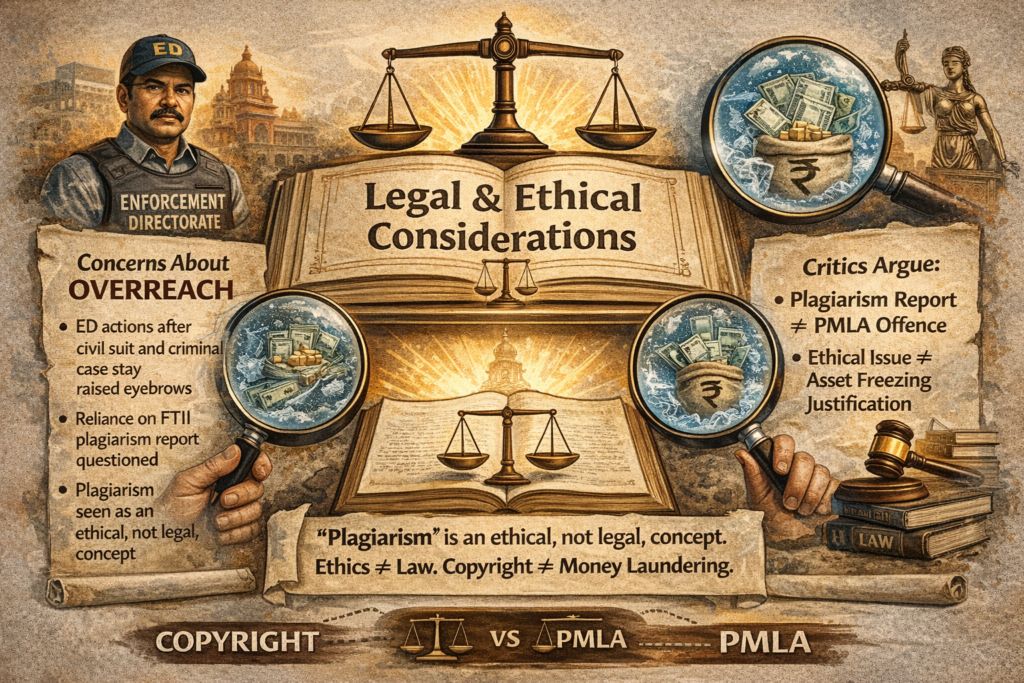
The stand of critics argument that the agency relying on the FTII report and the use of the term “plagiarism” which is an ethical, not legal, concept which does not justify asset freezing under PMLA provisions.
Present Scenario :
On March 11, 2025, the Madras High Court stayed the ED’s provisional attachment of defendant’s assets, demanding the rationale behind the action despite the prior dismissal of the civil suit and the stay on criminal proceedings. The court directed the ED to submit a counter-affidavit, with the hearing scheduled for April 21, 2025.
Key Learnings :
The case highlights the danger of blurring civil wrongs with economic crimes.
Reinforces the importance of keeping PMLA confined to serious financial criminality, not creative disputes.
Encourages predictable, innovation-friendly IP enforcement.
Protects India’s film and creative industries from chilling effects.
Conclusion :
This case underscores the complexities of application of financial and crime laws to intellectual property disputes and highlights the need for clear legal frameworks to address such intersections.
CALL TO ACTION – IIPTA
At the Indian Institute of Patent and Trademark (IIPTA), we train students and professionals to understand intellectual property as it functions in real disputes, not just in statutes.
If you want to master copyright, trademark law, and licensing strategy with practical insight, IIPTA is where theory meets application
Leave a Reply