After ANI, Bollywood Music Labels Face Off with Open AI
Open AI which is backed by the tech giant Microsoft and having second largest market in terms of users. legal challenges are mounting globally and in India, its second biggest market by users. In a significant escalation of the ongoing legal challenges faced by OpenAI in India, major Bollywood music labels—including T-Series, Sare Gama, and Sony Music—have sought to join a copyright lawsuit against the AI company.
Their primary concern revolves around the alleged unauthorized use of their sound recordings to train OpenAI’s AI models, which they argue infringes upon their copyrights.
Key Issues
Under Sections 13 and 14 of the Copyright Act, rights for sound recordings, including adaptation, making a copy, and distribution to the public, are provided. This is distinct from the protection/rights associated with written content or images, which come u/s 13(1)(a).
The arguments of the music labels mainly contend that OpenAI extracts music compositions, sound recordings and lyrics to train their Gen AI models without permission. The argument about composition seems to be unclear . Regardless, with respect to the other works, the use by Open AI would seem like a direct infringement of the copyright of labels under Section 14. Open AI has defended itself against allegations of copyright infringement by invoking the principle of ‘fair use’ principles in employing publicly available data to build its AI models
Under Section 52 of the Indian Copyright Act, fair use extends to matters such as research, review or criticism. However, the transformative use defense is not available in the statute, and there exists no judicial precedent regarding AI training under Indian law, making this case all the more important, similar defenses of fair use have not worked for other tech companies like Telegram and seem like a long shot for Open AI.
Jurisdiction Challenges :
OpenAI’s contends about the jurisdiction . It has been argued that lack of the jurisdiction in Indian courts to decide on the case as they have no servers or permanent office in India, and lack of training activities locally.
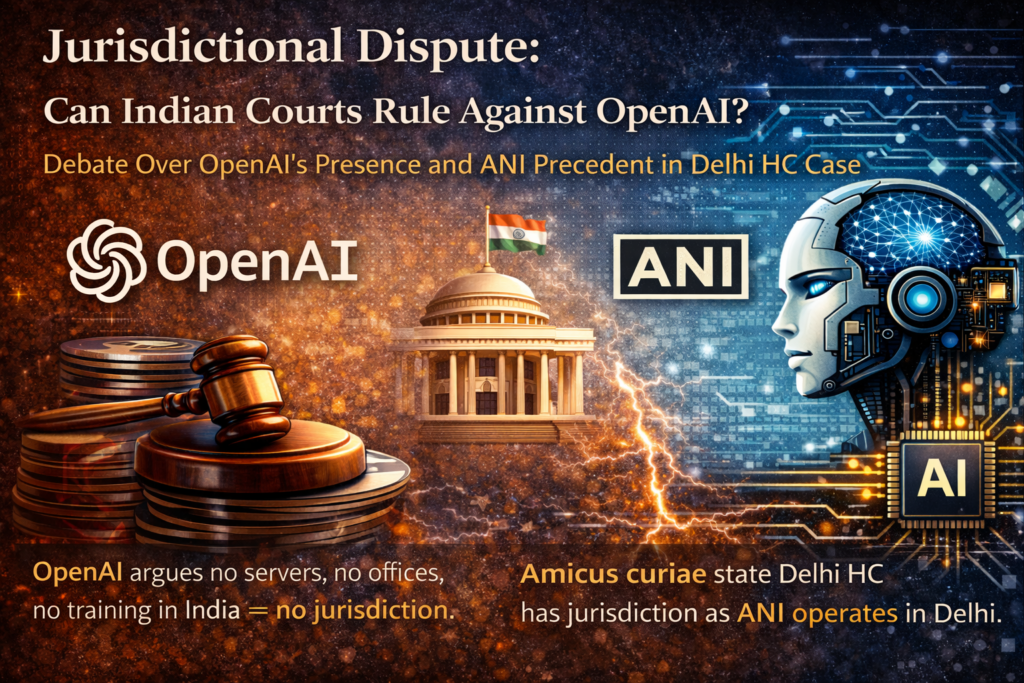
In contrast to this two amicus curiae appointed have stated in their submissions that the Delhi HC does have jurisdiction since ANI operates out of New Delhi. Based on the Court’s final word, this would be an important factor in deciding the trajectory of the case.
Locus Standi or Right to Sue:
The case, was filed by news agency ANI in 2024, initially had alleged that OpenAI’s ChatGPT was using their content without authorization to train the AI models. Similarly, the music labels want to join the bandwagon. Previously, even the Federation of Indian Publishers and the Digital News Publishers Association (DNPA) had sought to intervene and be made parties to the suit.
The scope of the suit could be broadened to include these issues. However, it remains to be seen what the court will decide since this may require them to frame additional issues for adjudication as has already said that affected parties must file individual suits as the current suit by ANI cannot continue expanding.
Broader Implications on Industry:
The ruling of this case not only decide on the future of AI companies and the data they can use for training but also the business models of the music labels and, arguably more importantly, the livelihoods of artists, composers and producers of India. The IMI even claimed that this may affect the global industry, too, acting as a dangerous precedent for the acceptance of AI systems being trained on copyrighted materials.
Response from Policy Makers :
In response to the mounting legal challenges involving AI and copyright, the Indian government has established a panel to review its copyright laws. This panel aims to examine how current laws apply to AI-generated content and to propose recommendations addressing the legal and policy implications of AI in copyright.
Global Context
This legal battle in India reflects a broader global trend where content creators are challenging AI companies over the use of copyrighted material.
Similar lawsuits have been filed in the U.S. and Europe, indicating a growing concern over how AI models are trained using existing creative works without proper authorization or compensation.
IMPLICATIONS FOR FILMMAKERS AND CONTENT CREATORS
This dispute sends a clear message:
• Real organizations are not free narrative tools
• Script clearance is a legal necessity
• Disclaimers are not absolute shields
• Reputation-based claims are real and enforceable
Failure to address these issues at the scripting stage can result in injunctions, edits, and reputational fallout.
LEARNINGS FOR IP STUDENTS AND PROFESSIONALS
For students of intellectual property law, this case demonstrates:
• Practical application of passing off principles
• Balance between speech and trademark rights
• Protection of non-commercial goodwill
• Judicial preference for proportionate remedies
This is not theoretical law; it is applied to IP governance.
FINAL IP PERSPECTIVE
The outcome of this case could set a significant precedent for how AI companies operate in India and potentially influence global practices concerning the use of copyrighted content in AI training.
Leave a Reply