MSF vs Dharma Productions and the Limits of Artistic Freedom
INTRODUCTION
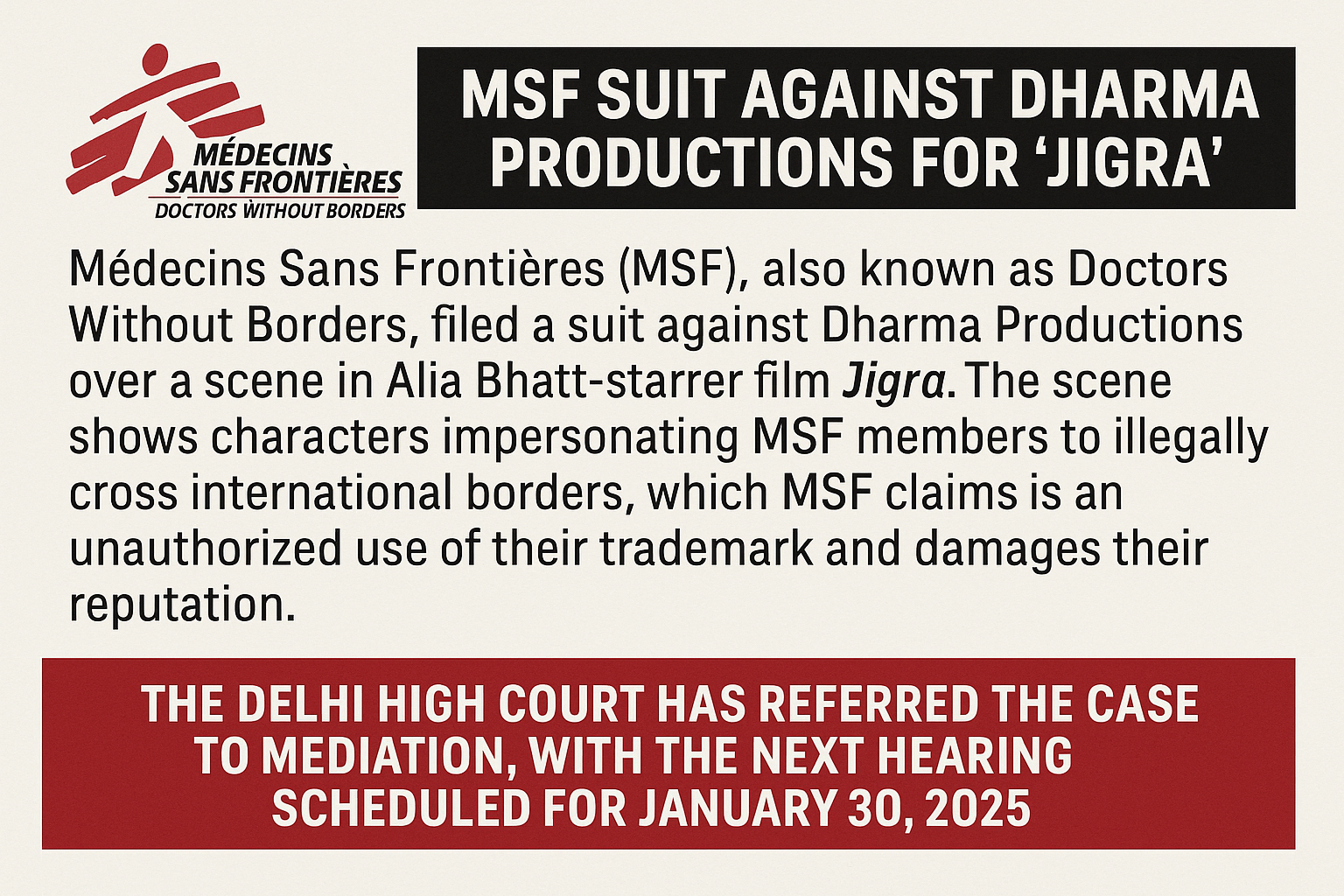
In December 2024, Médecins Sans Frontières (Doctors Without Borders), one of the world’s most respected humanitarian organizations, initiated legal proceedings against Dharma Productions regarding a scene in the film Jigra. The dispute does not revolve around box office performance or cinematic critique, but around a far more sensitive issue: the unauthorized and allegedly misleading use of a real-world humanitarian identity in a fictional narrative.
This case has attracted attention not merely because it involves a major film production house, but because it raises fundamental questions about trademark law, reputation, artistic freedom, and the legal responsibilities of content creators. For intellectual property professionals, students, and creators, this dispute serves as a contemporary illustration of how IP law quietly but firmly regulates storytelling.
FACTUAL BACKGROUND OF THE DISPUTE
According to pleadings placed before the Delhi High Court, a scene in Jigra depicts characters impersonating personnel associated with “Doctors Without Borders / Medics Without Frontiers” to facilitate illegal border crossings. MSF contends that this portrayal creates a false association between the organization and unlawful activities.
MSF asserts that the use of its name, even without its logo, is sufficient to mislead viewers and damage the organization’s goodwill. Given MSF’s humanitarian role and global reputation for neutrality, even fictional misrepresentation can undermine public trust.
The Delhi High Court, after hearing preliminary submissions, referred the matter to mediation, signalling judicial preference for amicable resolution while keeping all legal issues open.

WHY NGOs OCCUPY A SPECIAL POSITION IN TRADEMARK LAW
Unlike conventional commercial trademarks, humanitarian and non-profit organizations rely almost entirely on reputation and trust. Their marks signify neutrality, safety, and ethical conduct. Any dilution or tarnishment of such marks can have consequences far beyond commercial loss.
Indian trademark jurisprudence recognises that well-known marks and marks associated with public trust deserve enhanced protection. In cases involving NGOs, courts are particularly sensitive to reputational harm and false association.
TRADEMARK INFRINGEMENT, PASSING OFF, AND TARNISHMENT
MSF’s claims potentially fall under multiple legal doctrines:
• Passing off, where misrepresentation leads the public to believe there is an association or endorsement
• Trademark dilution, where the distinctiveness of a well-known mark is weakened
• Tarnishment, where a mark is linked with illegal or unethical conduct
Importantly, Indian courts have held that even non-commercial or narrative use may be actionable if it damages goodwill or causes confusion.
ARTISTIC FREEDOM AND ITS LEGAL LIMITS
Indian constitutional jurisprudence protects freedom of expression, including artistic expression. However, such freedom is not absolute. Courts routinely balance creative liberty against competing rights such as reputation, privacy, and intellectual property.
When a real and identifiable entity is portrayed as engaging in unlawful conduct, the defence of artistic freedom becomes significantly weaker. The law does not prohibit fictional storytelling; it regulates irresponsible representation.
NOMINATIVE USE: WHY THE DEFENCE MAY FAIL
A common defence in such disputes is nominative fair use — using a trademark merely to identify the entity. However, nominative use is permissible only when:
• The reference is necessary
• No endorsement is implied
• The use is minimal
In Jigra, the allegation involves impersonation and narrative reliance on the MSF identity, which goes beyond incidental reference.
WHY THE COURT CHOSE MEDIATION
The Delhi High Court’s referral to mediation reflects practical judicial reasoning. Film-related disputes often resolve through:
• Scene edits
• Disclaimers
• Muted references
• Modified dialogue
Such outcomes preserve creative expression while safeguarding reputation, without entering prolonged litigation.
IMPLICATIONS FOR FILMMAKERS AND CONTENT CREATORS
This dispute sends a clear message:
• Real organizations are not free narrative tools
• Script clearance is a legal necessity
• Disclaimers are not absolute shields
• Reputation-based claims are real and enforceable
Failure to address these issues at the scripting stage can result in injunctions, edits, and reputational fallout.
LEARNINGS FOR IP STUDENTS AND PROFESSIONALS
For students of intellectual property law, this case demonstrates:
• Practical application of passing off principles
• Balance between speech and trademark rights
• Protection of non-commercial goodwill
• Judicial preference for proportionate remedies
This is not theoretical law; it is applied to IP governance.

CONCLUSION
The MSF vs Dharma Productions dispute underscores a fundamental principle: creative freedom thrives within legal boundaries. Intellectual property law does not silence storytelling; it ensures accountability.
As films increasingly draw from real-world institutions, legal diligence becomes as essential as creative vision. For creators and lawyers alike, this case serves as a timely reminder that reputation, once compromised, is difficult to restore.