
Saregama v. Vels Film and the Quiet Death of the Composer-First Myth in Indian Cinema
INTRODUCTION: A JUDGMENT THAT SILENTLY REWIRES THE MUSIC INDUSTRY
Indian copyright disputes rarely announce their true impact loudly.
They arrive quietly, wrapped in familiar statutory language, only to reshape industry practice years later.
The Delhi High Court’s decision in Saregama India Limited v. Vels Film International Limited & Ors. (2025) is one such judgment.
On the surface, this was a dispute about a re-recorded song.
In substance, it was a judicial reaffirmation of a truth the industry has long resisted:
In Indian cinema, authorship does not automatically mean control. Contracts do.
For decades, composers, lyricists, and filmmakers have operated under a comforting but legally fragile belief that creative authorship confers perpetual authority over musical works. This judgment dismantles that belief with clarity, precision, and very little sympathy.
This article examines why this decision matters, what myths it destroys, and how it will influence copyright ownership, licensing, and enforcement going forward especially for Indian creators and production houses.

THE FACTUAL BACKGROUND: STRIPPED OF DRAMA, EXPOSED IN LAW
The dispute revolved around the legendary Tamil song “En Iniya Pon Nilave” from the 1980 film Moodu Pani.
- Saregama India Limited, successor to HMV, claimed copyright ownership based on a historical assignment agreement executed with the film’s producer.
- Vels Film International, while producing the film Aghathiyaa, incorporated a re-recorded version of the same song.
- Permission, however, was taken not from Saregama, but from the composer, Ilaiyaraaja.
This raised a deceptively simple question:
Can a composer license a song that was created for a cinematograph film, even after the producer has assigned rights to a music label?
The answer, according to the Court, was a firm no.
THE CORE LEGAL CONFLICT: AUTHORSHIP VS OWNERSHIP
Indian copyright discourse often collapses authorship and ownership into a single concept. This judgment forcefully separates them.
What the Court clarified
- A composer may be the author of a musical work.
- But ownership of exploitation rights depends on statutory presumptions and contractual arrangements.
- Emotional narratives around creativity do not override written assignments.
This distinction is not new, but this judgment makes it impossible to ignore.

SECTION 17: WHY PRODUCERS STILL HOLD THE KEYS
Section 17 of the Copyright Act, 1957 establishes a default rule:
The producer of a cinematograph film is the first owner of copyright in the film and its sound recordings unless a contract provides otherwise.
The Court reiterated three critical realities:
- Film music is commissioned, not incidental.
- Consideration alters ownership dynamics.
- Silence in contracts favours producers—not authors.
Once a producer assigns these rights, the assignee acquires complete commercial control, including the right to license or restrain use.
This is where decades of industry misunderstanding finally met judicial finality.
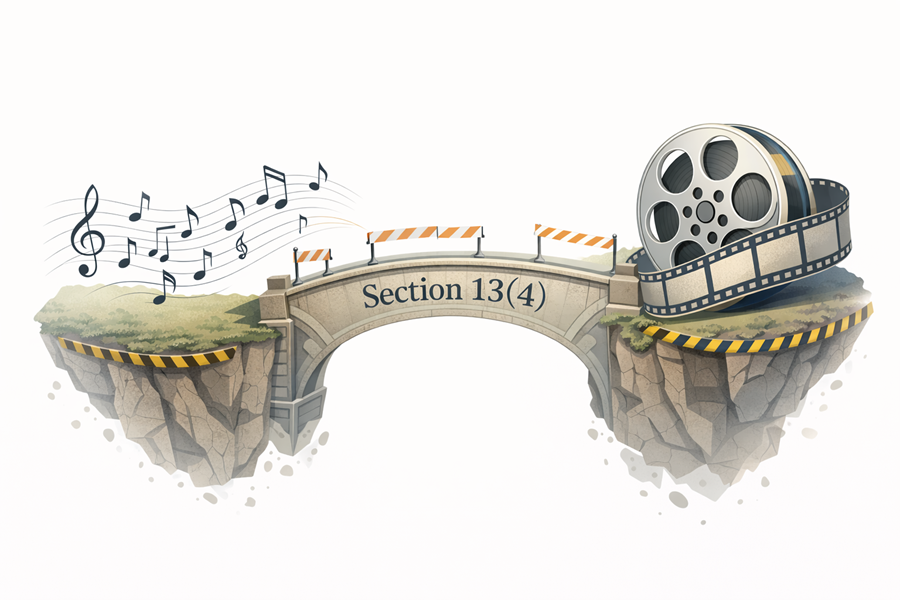
SECTION 13(4): SURVIVAL IS NOT SOVEREIGNTY
One of the most misused provisions in Indian copyright litigation is Section 13(4).
Creators often rely on it to argue that:
“My copyright survives independently; therefore I can exploit it.”
The Court dismantled this logic carefully.
What Section 13(4) actually does:
- It prevents extinction of underlying works.
- It does not override contractual assignments.
- It does not restore licensing authority once rights are assigned.
Survival of copyright ≠ freedom to commercially exploit.
ADAPTATION VS REPRODUCTION: WHERE MOST FILMS GET IT WRONG
The defendants argued that the re-recorded song was an adaptation, not a reproduction.
The Court rejected this argument without hesitation.
Why this matters:
- Adaptation requires substantial creative transformation
- Mere re-recording, remixing, or rearrangement does not qualify
- Cosmetic musical changes do not defeat infringement
This clarification will have serious consequences for:
- “Reimagined classics”
- Tribute albums
- Film remakes relying on composer permissions
WHY THE COURT DID NOT STOP THE FILM
Despite finding infringement, the Court allowed continued use of the song—subject to a ₹30 lakh deposit.
This was not judicial softness.
It was commercial realism:
- The film was close to release
- Investments had already been made
- Monetary safeguards preserved rights without market disruption
This approach reflects a mature copyright judiciary—firm on law, pragmatic on enforcement.
THE PRECEDENTS THAT SEALED THE OUTCOME
This judgment stands on strong foundations:
- IPRS v. Eastern India Motion Pictures Association (1977)
- ICSAC v. Aditya Pandey (2016)
- IPRS v. Rajasthan Patrika (2023)
Together, these cases confirm one uncomfortable reality:
Indian courts protect contracts more fiercely than sentiment.
THE MYTH THAT FINALLY COLLAPSES: “COMPOSER-FIRST” OWNERSHIP
This case quietly ends a long-standing myth:
- That composers retain overriding control
- That fame substitutes formal rights
- That moral authority defeats written assignments
In Indian cinema, paper defeats passion.
WHAT THIS MEANS FOR INDUSTRY STAKEHOLDERS
For composers:
- Authorship is recognition, not control
- Contract negotiation is non-negotiable
For producers:
- Clear assignments are your strongest defence
For music labels:
- Legacy contracts still carry weight
For filmmakers:
- Clearance shortcuts are expensive mistakes
WHY THIS CASE MATTERS BEYOND THE FILM INDUSTRY
This judgment is not confined to music.
Its implications extend to:
- Advertising jingles
- OTT content
- Brand collaborations
- Digital re-use of archival works
Indian copyright enforcement is moving decisively toward commercial certainty.
FINAL TAKEAWAY: CREATIVITY DESERVES RESPECT—BUT LAW DEMANDS DISCIPLINE
This judgment does not diminish artistic contribution.
It does something more uncomfortable—it demands accountability.
Music may begin with inspiration, but in cinema, ownership is decided on contracts, assignments, and statutory presumptions.
Those who ignore this do so at their own cost.

CALL TO ACTION – IIPTA
Learn Copyright Law Where Courts Actually Apply It
At the Indian Institute of Patent and Trademark (IIPTA), we don’t teach copyright as abstract theory.
We teach it as courts enforce it through real judgments, contracts, and licensing disputes that decide careers and crores.
If you want to understand ownership, assignments, and enforcement the way the industry must, IIPTA is where that journey begins.
Leave a Reply