A Game-Changer for Global Patent Research
World Intellectual Property Organisation, (WIPO) The World Intellectual Property Organization (WIPO) is the United Nations agency that serves the world’s innovators and creators, ensuring that their ideas travel safely to the market and improve lives everywhere.
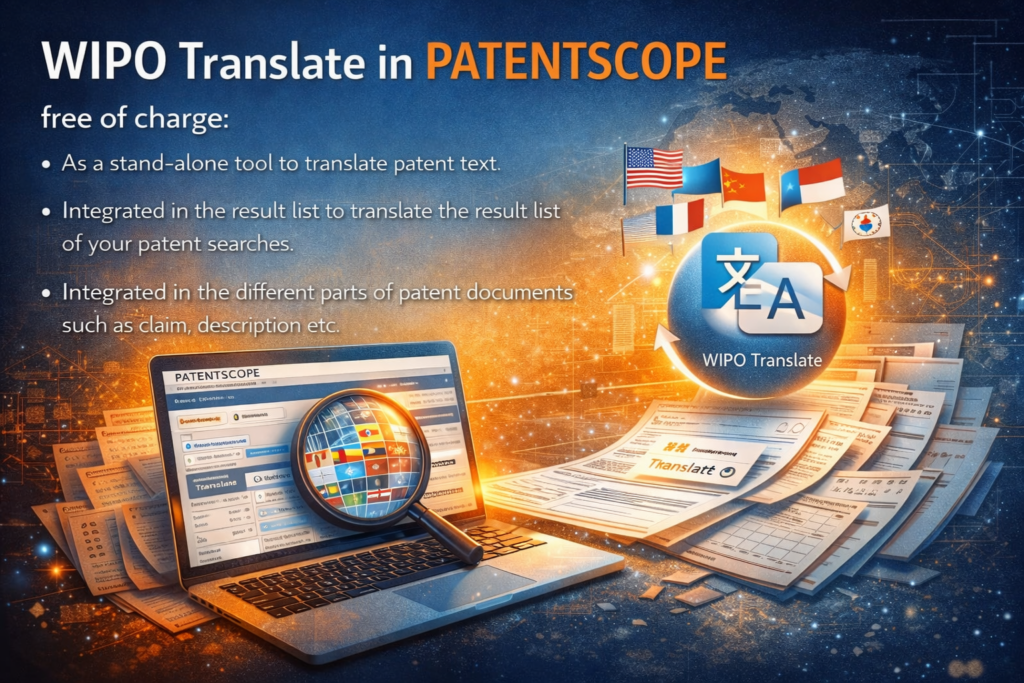
WIPO Translate is available in WIPO’s global patent database PATENTSCOPE free of charge: As a stand-alone tool to translate patent text. Integrated in the result list to translate the result list of your patent searches. Integrated in the different parts of patent documents such as claim, description etc.
WIPO Translate is an AI-powered neural machine translation tool developed by the World Intellectual Property Organization (WIPO). It is specifically trained on patent documents to provide accurate translations of technical content. Integrated into PATENTSCOPE, WIPO Translate enables users to translate various parts of patent documents, including:
- Titles
- Abstracts
- Descriptions
- Claims
- Full-text content
This functionality allows users to access and understand patent information across different languages, facilitating global research and innovation.
Creators and innovators worldwide use IP to translate their ideas into assets. These properties create economic and social benefits that improve the lives of people everywhere.
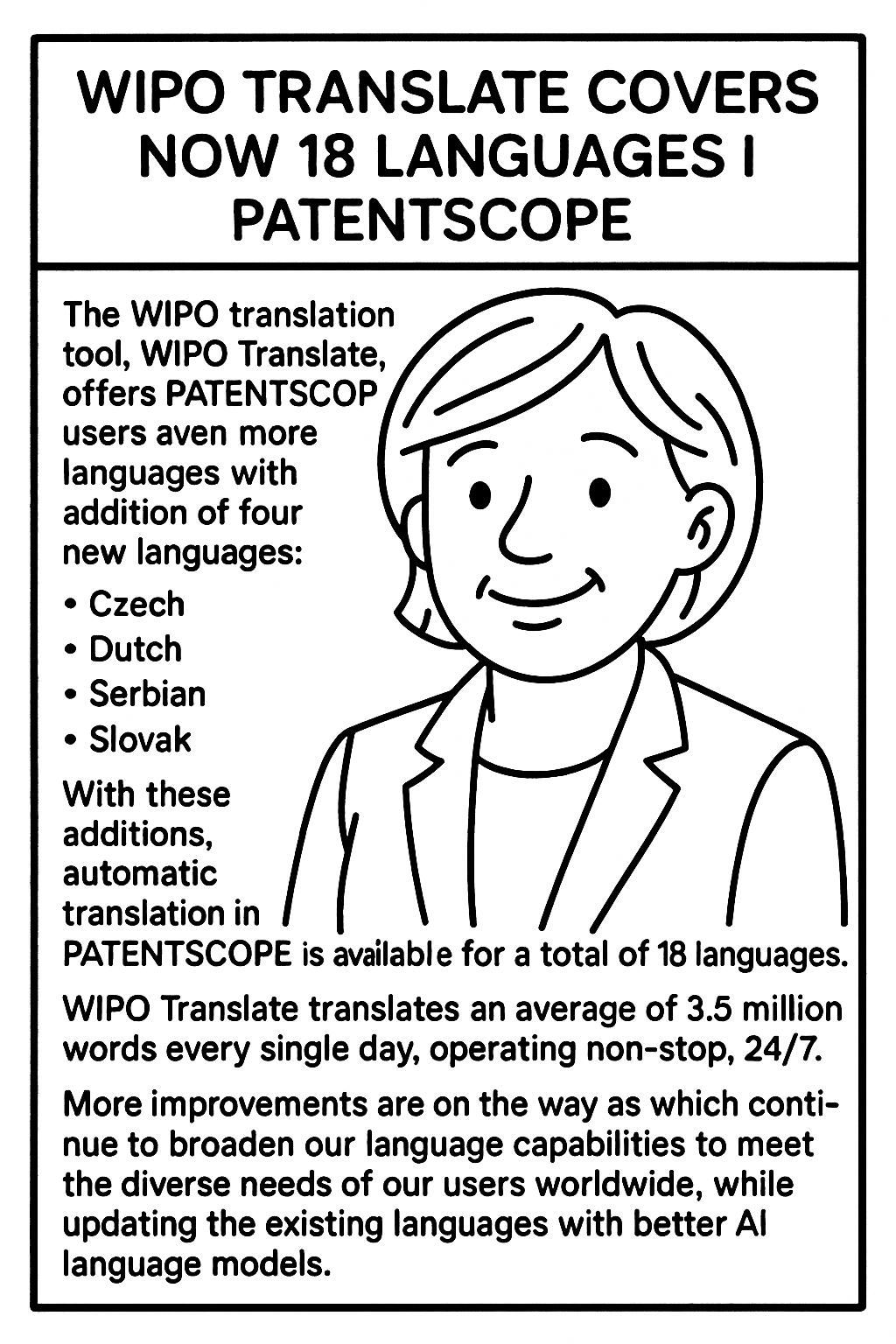
The WIPO translation tool, WIPO Translate, offers PATENTSCOPE users even more languages with the addition of four new languages:
- Czech
- Dutch
- Serbian
- Slovak
With these additions, automatic translation in PATENTSCOPE is available for a total of 18 languages.
WIPO Translate translates an average of 3.5 million words every single day, operating non-stop, 24/7.
To put this into perspective, that’s equivalent to translating the entire text of about 7,000 standard-length novels daily – assuming an average of 500 words per page and 100 pages per novel.
More improvements are on the way as which continue to broaden our language capabilities to meet the diverse needs of our users worldwide, while updating the existing languages with better AI language models
Highlights
- Expanded Language Support: With the recent additions, WIPO Translate now covers 18 languages, enhancing accessibility for a broader user base.
- High Translation Volume: The tool translates an average of 3.5 million words daily, operating continuously to meet user demands.
- User-Friendly Interface: Translations are seamlessly integrated into the PATENTSCOPE platform, allowing users to view translated content directly within search results and document views.
How to Use WIPO Translate in PATENTSCOPE
- Access PATENTSCOPE: Navigate to PATENTSCOPE
- Perform a Search: Use the search functionality to find patent documents of interest.
- View Translations: In the search results or within a specific patent document, look for translation options to view content in your preferred language.
This integration of WIPO Translate into PATENTSCOPE significantly enhances the ability of users worldwide to access and comprehend patent information, promoting greater collaboration and innovation across linguistic boundaries.
Broader Implications
- Geographic inclusion: Addition of Czech, Slovak, Serbian, and Dutch widens access for Central/Eastern Europe and Benelux markets.
- AI in IP: WIPO Translate’s reliance on neural machine translation reflects the growing role of AI in legal/technical domains.
- Equity in IP: Smaller players and developing economies benefit most, as they gain cheaper access to multilingual patent data.
- Quality vs. speed tradeoff: While translations broaden reach, patent litigation or licensing still requires human-verified translations.
- Future trajectory: As AI language models improve, the scope may expand to more Asian and African languages, further democratizing global IP access.
The expansion of WIPO Translate to 18 languages in PATENTSCOPE strengthens transparency, inclusivity, and efficiency in the global patent system. It lowers barriers for SMEs, examiners, and researchers while creating new strategic considerations for large firms and translation professionals.
More than a technical enhancement—it is a structural shift in how different IP stakeholders’ access, interpret, and leverage global patent information. Its ripple effects are being felt across the entire innovation ecosystem.
Impact on Innovators & Startups
Language barriers often restricted prior-art searches to English-centric databases, increasing risks of accidental infringement or weak patents.
Startups and MSMEs gain competitive parity with large corporations in global patent intelligence.
Due to:
- Easier access to patent literature from China, Japan, Korea, Europe, and emerging economies
- Improved novelty and inventive-step assessments
- Reduced dependency on costly professional translations in early-stage R&D
Impact on Researchers & Academic Institutions
A Landscape shift, academic research becomes more globally informed, reducing duplication and accelerating innovation.
For universities and public research institutions:
- Easier access to global technological trends
- Better mapping of white spaces and research gaps
- Stronger technology-transfer and commercialization strategies
How IIPTA uses such Cases in Training
At the Indian Institute of Patent and Trademark (IIPTA), update of global like WIPO are used to teach:
Students to have track on global database with latest or recent updates
Wider knowledge about stakeholders of global landscape.
Using the database of WIPO to understand the content in convenient language.
Conclusion: Updating with current trends is an opportunity opens plethora of opportunity in IPR landscape in terms of reaching underserved potential areas of Research and Development
Since most part of the world is remaining underserved or unserved in terms converting intellect into asset because of language barrier the move from WIPO is one of the objective where both creators and innovators worldwide use IP to translate their ideas into assets. At large these properties create economic and social benefits that improve the lives of people everywhere.